Did You Know
Did You Know: This Wireless Charger Has a Peltier Cooling Chip Inside to Chill Your Phone While It Charges
A teardown of TORRAS's three-in-one Qi2 charger found a thermoelectric cooling module, a fan and a temperature sensor, all running off a 67-watt adapter. The cooler switches itself on by default.
SAN FRANCISCO · Maya Chen, Did You Know · Nov 16 2026
SAN FRANCISCO - Did you know that a wireless phone charger can come with a refrigeration chip of its own? TORRAS’s three-in-one Qi2 charger, model WX7, has a thermoelectric cooling module and a fan built into the upright panel behind the phone. ChargerLAB took one apart in a teardown published Nov. 5 and found the part is marked “TEC1-7102” and “XD-2026/04,” a stock thermoelectric cooling specification, the kind of component often called a Peltier module.
The idea is simple even if the part is not. Wireless charging wastes some of its energy as heat, and a phone sitting on a charging pad has nowhere obvious to put it. TORRAS calls its answer Tora-Iceon, a system that, in ChargerLAB’s words, combines a built-in thermoelectric cooling module with a cooling fan “to reduce the temperature on the back of the phone during charging.” Run current through a Peltier module and one face gets cooler while the other gets hotter. In the WX7 the module sits in the upright panel with the Qi2 charging module, and the fan and the openings in the rear panel push air out the back.
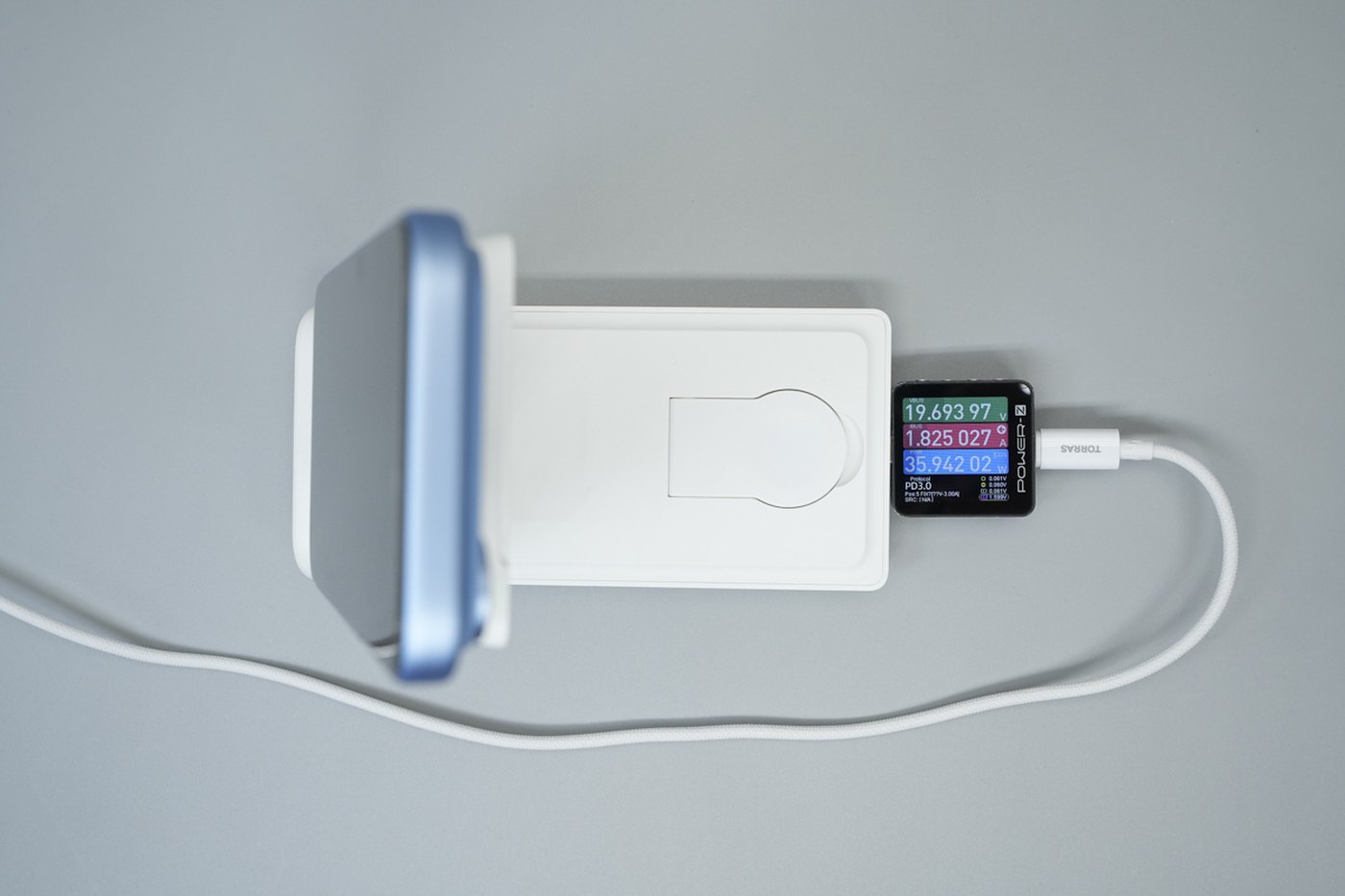 Image: ChargerLAB
The charger is rated to hand a phone 25 watts, plus 5 watts each to a watch and a pair of earbuds, for a total of 35 watts at most. ChargerLAB’s POWER-Z meter showed what it takes to do that. With an iPhone 18 Pro attached, the unit drew 19.69 volts at 1.83 amps, or 35.94 watts. Add AirPods on the base and the draw rose to 43.61 watts, at 19.62 volts and 2.23 amps. The site did not say how much of that goes to the cooler and how much is lost along the way, and TORRAS does not publish the module’s own consumption. The fan alone is rated at 5 volts and 0.30 amps, or about 1.5 watts, by simple multiplication. Idle with nothing attached, the charger drew about 0.78 watts.
That appetite explains the box. The charger ships with a 67-watt GaN adapter, model HC200364R067, and ChargerLAB says it powers “both the wireless charging and cooling systems.” TORRAS’s manual tells owners to use the included charger, or any third-party adapter that supports USB-C Power Delivery at 67 watts or more.
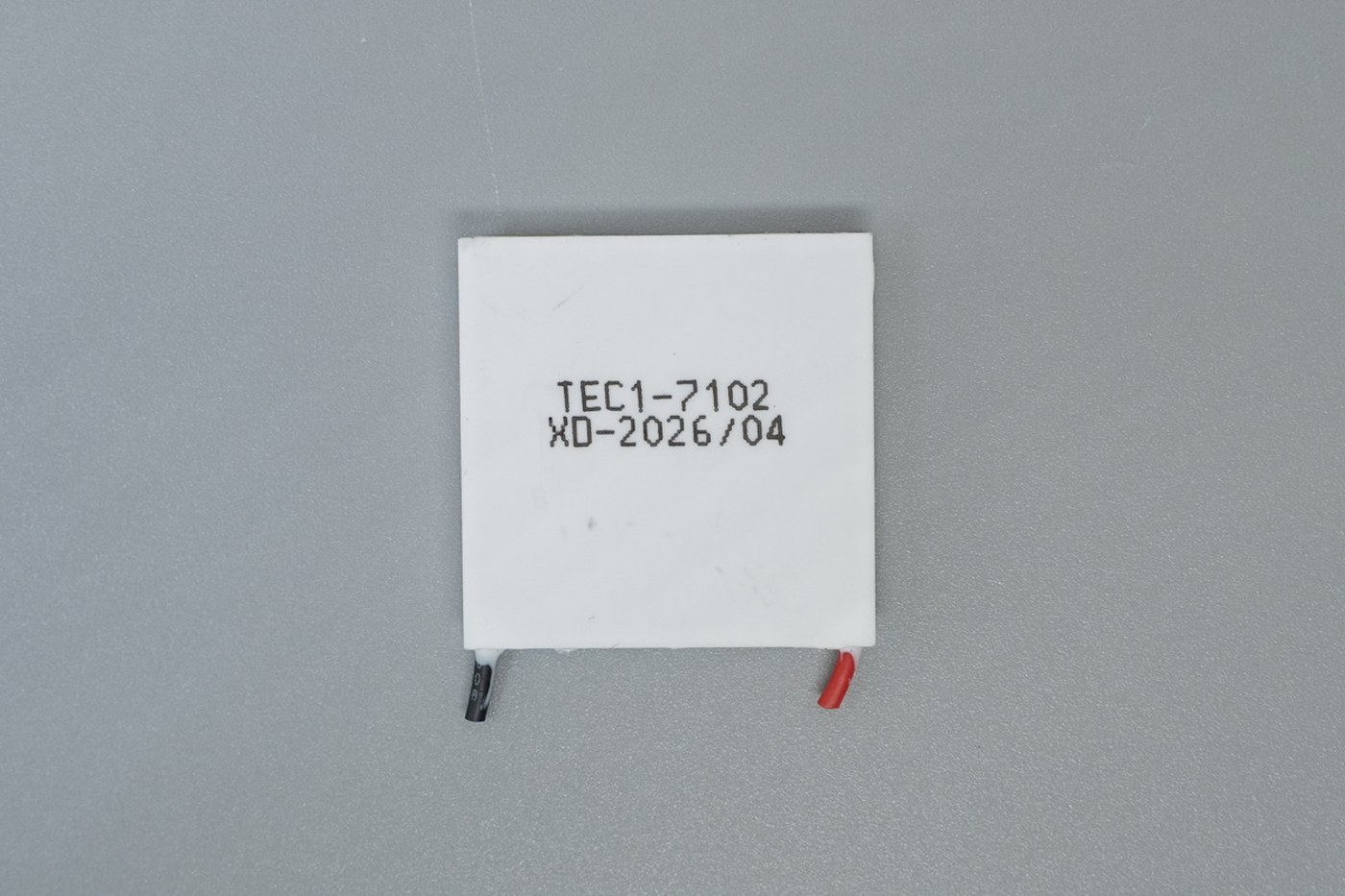 Image: ChargerLAB
Two details stand out. First, the cooling is on from the moment the charger is plugged in. The manual says the fan and the thermoelectric cooling turn on by default, and a crescent-shaped button on the side switches them off when held for three seconds. Lifting the phone off and snapping it back on turns them on again. Second, the module is not a lump of metal. Opened up, it shows rows of tiny paired semiconductor pellets sandwiched between two ceramic plates, the structure that lets electricity push heat from one side to the other.
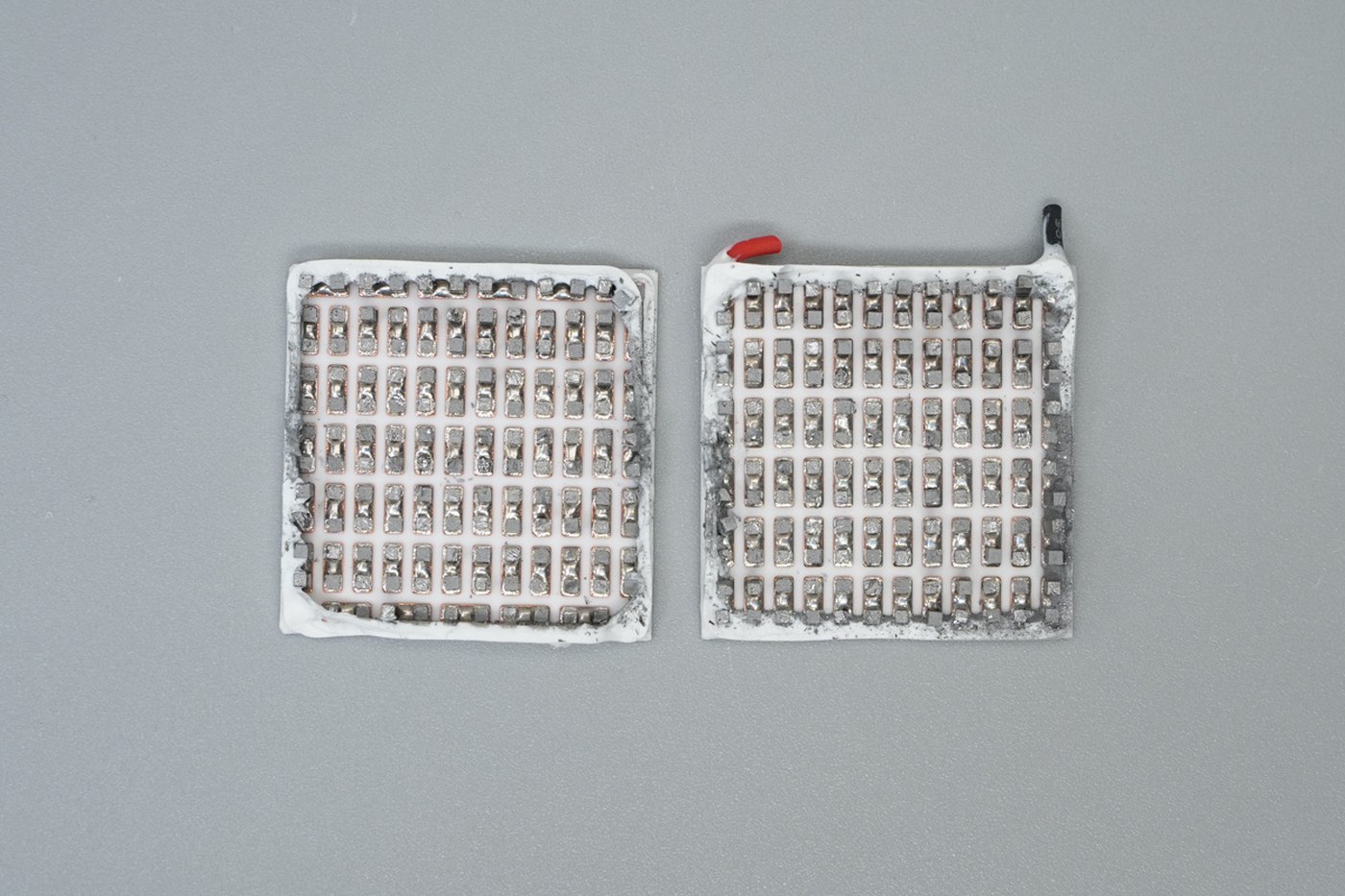 Image: ChargerLAB
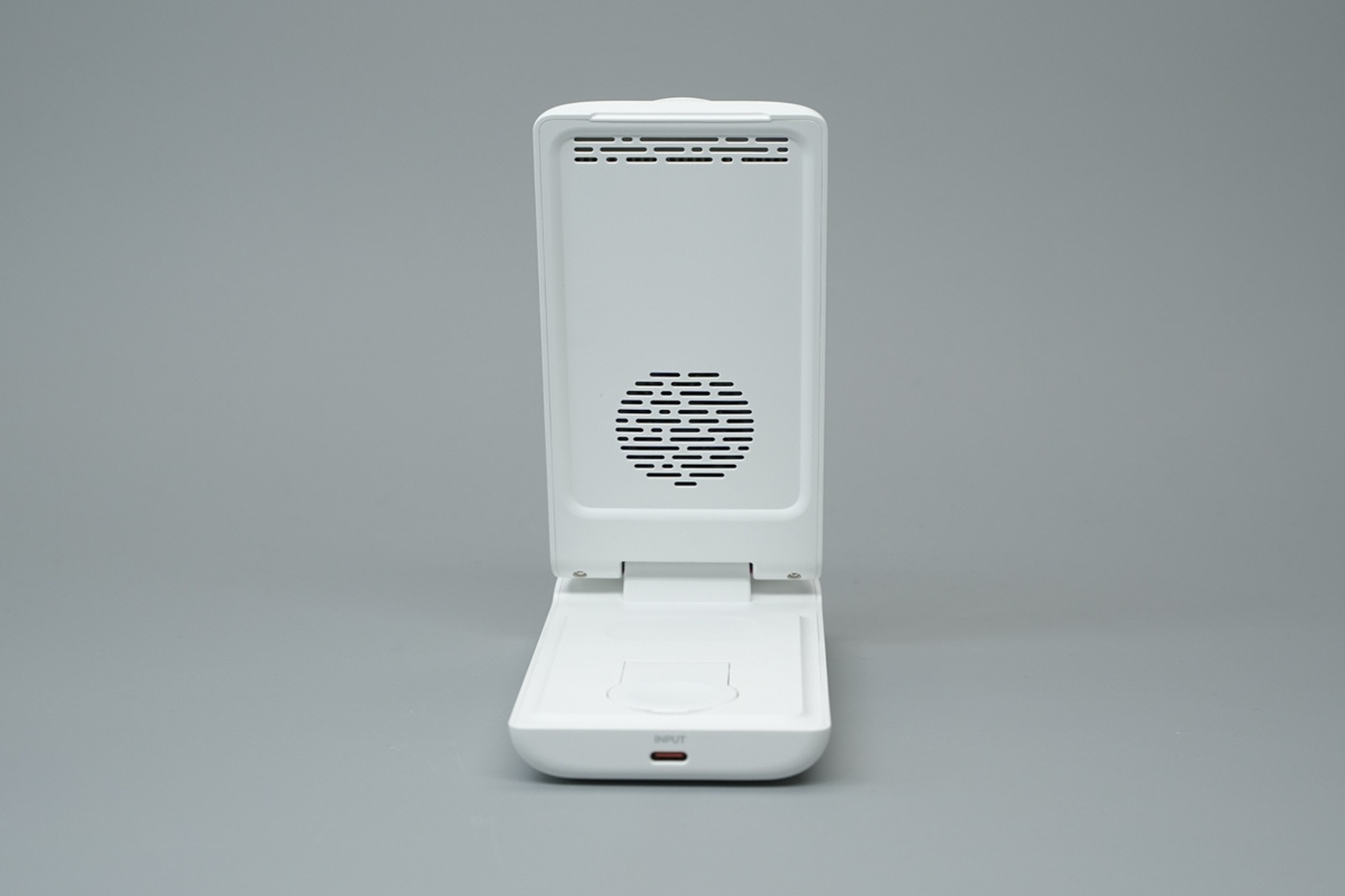
A small fan, a cooling plate and an NTC thermistor, a temperature-sensing part, complete the system. ChargerLAB found the thermistor near the hinge and a cooling plate inside the upright panel, and the Qi2 charging module is held there by a metal bracket with a white thermal pad between the module and the metal plate. The fan is a COOLING CLB4007SM, and its vent is the round grille on the back of the stand.
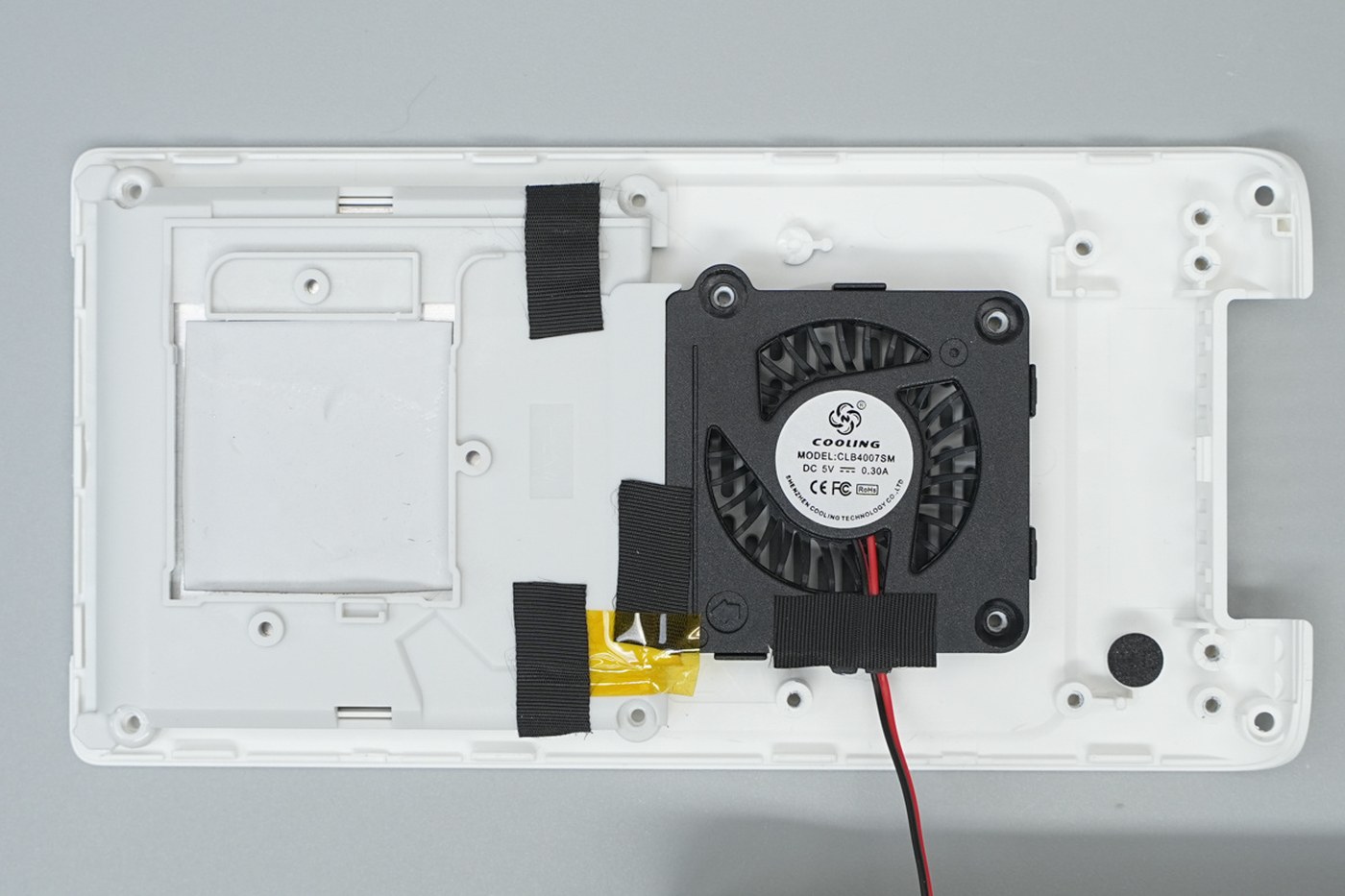 Image: ChargerLAB
The charger itself is compact for what it holds. It measures about 155.17 by 74.16 by 29.80 millimeters when folded, roughly 6.1 by 2.9 by 1.2 inches, and weighs about 336.8 grams, or 11.9 ounces. The stand unfolds on a hinge to angles of 45 to 62 degrees, so a phone can sit upright for video calls while it charges. The manual lists a working temperature of 0 to 35 degrees Celsius, or 32 to 95 degrees Fahrenheit.
TORRAS’s U.S. store lists a three-in-one charger with the same 25-, 5- and 5-watt outputs and a TEC cooling system, sold as the Icestation Pro, at $139.99 on sale, down from a regular $169. The company says the cooling area “can reach as low as about 61°F / 16°C” and that a phone can reach about 50 percent in 30 minutes. Those are the maker’s claims, and ChargerLAB’s teardown did not test them. What the teardown does show is plain: when a company says its charger actively cools your phone, there is a real cooling chip behind the glass.