Did You Know
Did You Know: About 540 Bytes of Firmware Turn a €40 USB-C Hub Into a Nintendo Switch 2 Dock
A Switch 2 charges from an ordinary USB-C hub but refuses to show a picture. One hobbyist sniffed the official dock's handshake, taught a Cable Matters hub to repeat it, and found the hex string once described as Nintendo's key sitting in a version record.
NEW YORK · Noah Park, Did You Know · Nov 13 2026
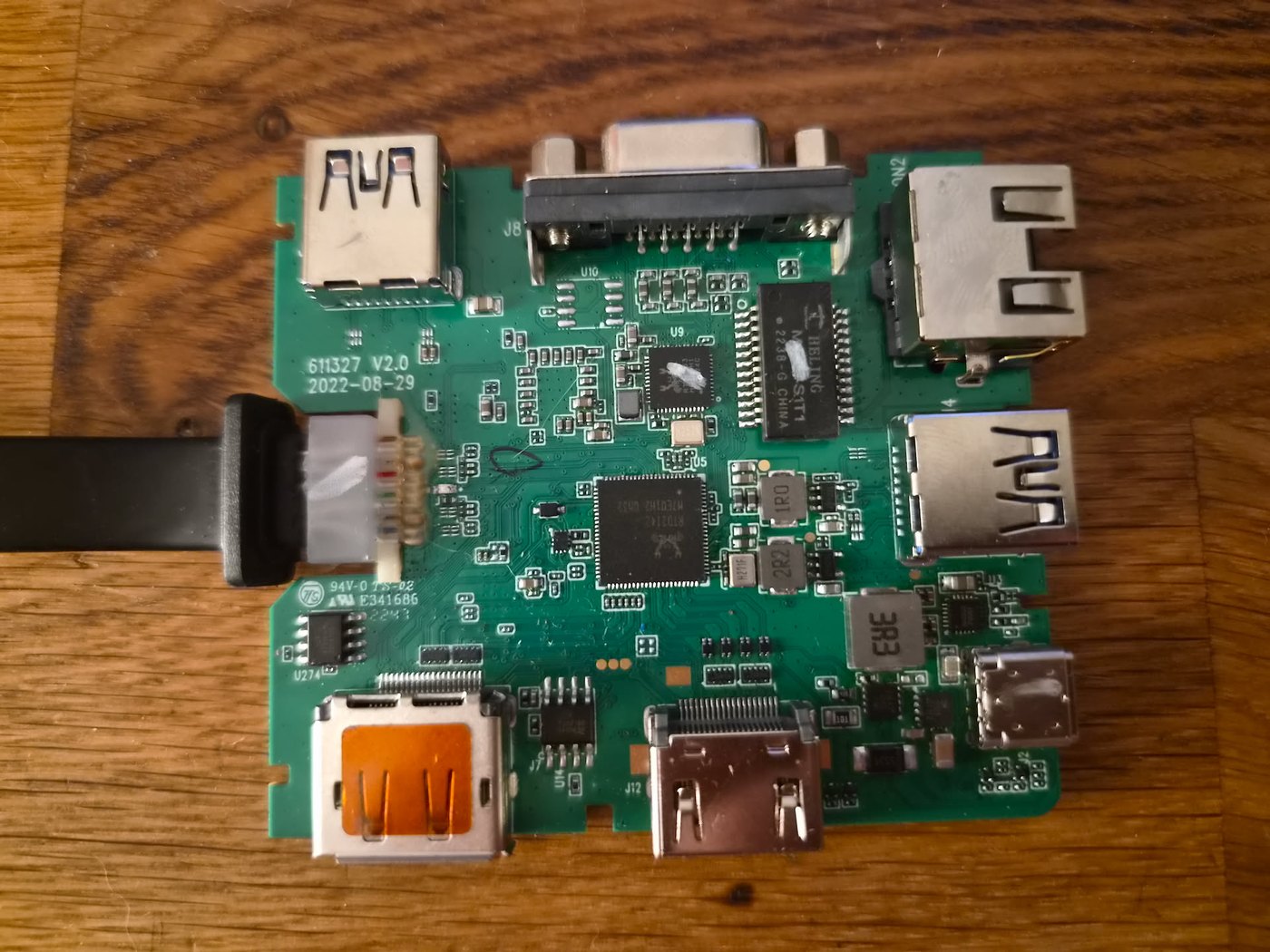
NEW YORK - Did you know that the gap between a generic USB-C travel hub and a working Nintendo Switch 2 dock comes down to about 540 bytes of code? That is how much Michał Kopeć, who writes as mkopec, added to the firmware of a Cable Matters hub to get TV mode working, as he explained in a Nov. 9 blog post titled “Making a €40 USB-C hub work as a Nintendo Switch 2 dock.” Tom’s Hardware put the hub at about $45 when it picked up the story on Thursday, and Hackaday followed the same day.
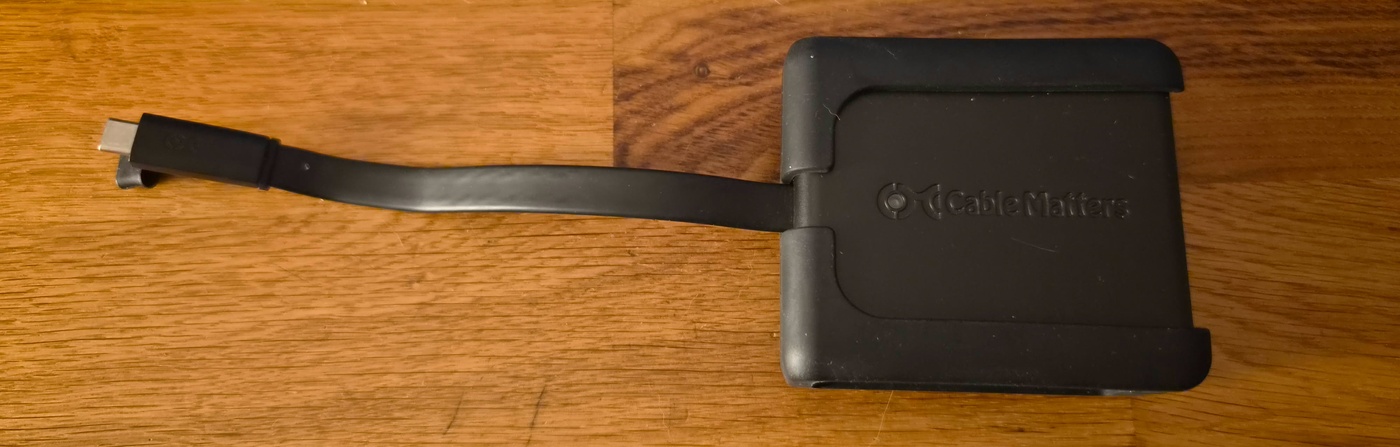 Image: Michał Kopeć
Kopeć wanted a lighter dock for travel. The official one is bulky and feels fragile, he wrote, and his hub already handled USB-C DisplayPort video for his other devices. “Unfortunately, Nintendo went in a proprietary direction (as they so often do), so a regular generic hub will not work as a dock,” he wrote. With the stock firmware, the console got surprisingly far. It negotiated power, entered DisplayPort Alt Mode and configured the video pins, and the hub acknowledged every step. Then nothing appeared on the screen.
To see what was missing, he put a WITRN K2 USB power delivery sniffer, a gift from a friend, on the cable between the console and the official dock. The log showed the dock identifying itself with Nintendo’s vendor ID, 057E, and product number 2062. It also advertised a second, Nintendo-only mode next to the standard DisplayPort one, and the Switch entered Nintendo’s mode first. After the video was set up, the console sent a short run of numbered vendor messages, and the dock answered each one.
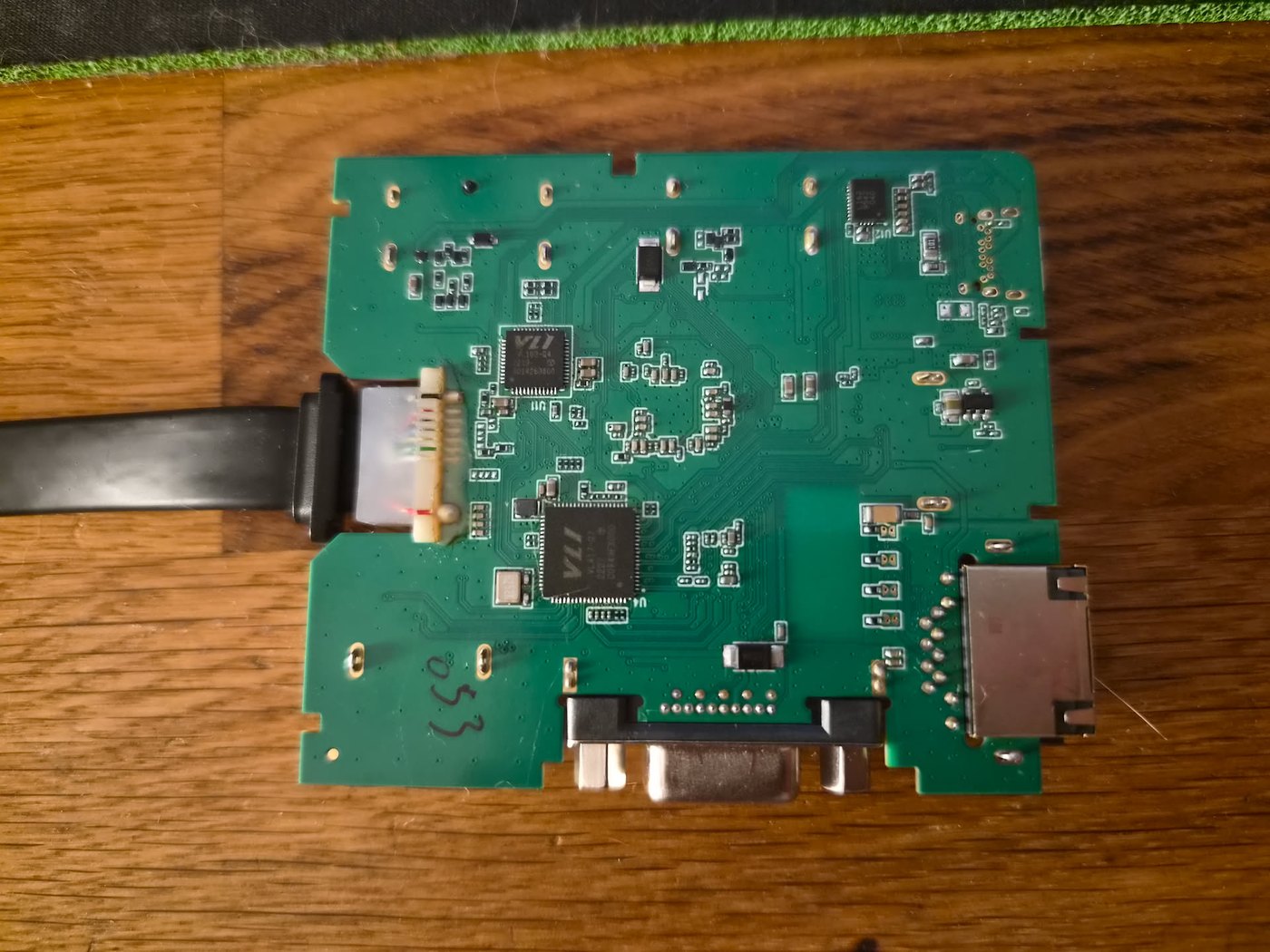 Image: Michał Kopeć
The chip that has to answer is the hub’s VIA Labs VL103 power delivery controller, which runs on an 8051 microcontroller with 32 KiB of firmware. Linux’s fwupd tool could already dump and flash it through the hub’s VL817 USB chip. Kopeć placed his responder in the image’s erased space, hooked it into the stock code, and changed one thing at a time. Answering Nintendo’s discovery and mode messages was not enough. Neither was matching the dock’s 15 V, 2.8 A power offer, nor reporting Nintendo’s vendor ID instead of VIA’s. The picture finally appeared in version five, when the hub returned the official dock’s complete identity. Versions six and seven copied the dock’s answers to its version queries, which removed a pause of about 3 seconds while docking.
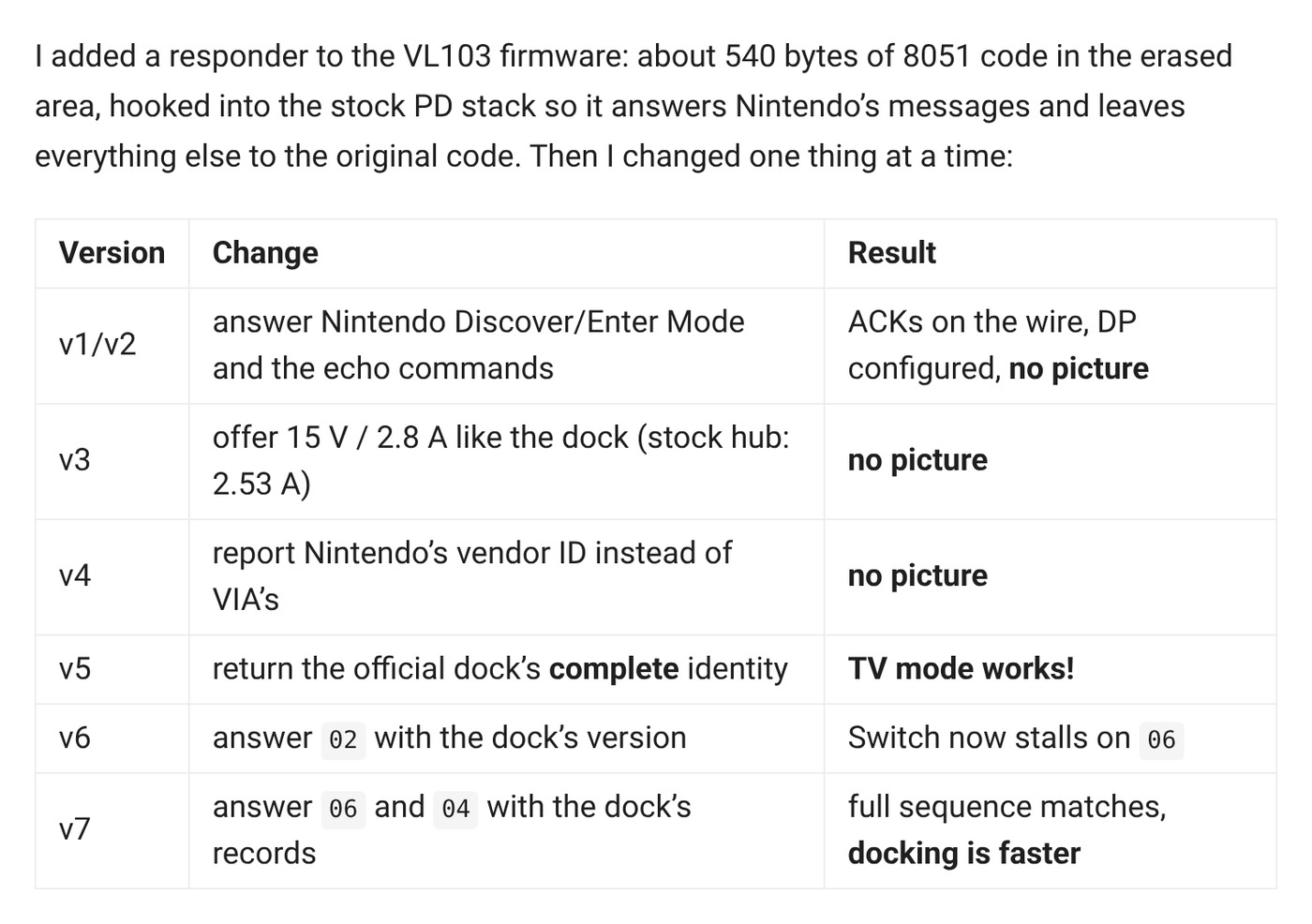 Image: Michał Kopeć’s blog
One of those replies has a history. In 2025, The Verge reported that two accessory makers said Nintendo was using a new encryption scheme and some form of dedicated encryption chip to block third-party docks, which Nintendo would neither confirm nor deny. The same report quoted Antank as saying a repeating hex string, 33 01 07 DA 06 01 6D 68, “is indeed the current key being used by Nintendo.” In Kopeć’s capture, that string is the dock’s answer to command 06, and he files it as a version record whose layout matches Cypress/Infineon CCGx firmware versions. His hub simply repeats it. He is open that he does not know what most of the commands mean, and the README says no feature behind them is implemented.
A second fix went into the hub’s Realtek RTD2142, the chip that turns DisplayPort into HDMI. With HDR on, colors looked washed out because the small packet describing the picture told the TV it was standard BT.709 color rather than BT.2020. A 108-byte patch now marks HDR frames correctly. “The pixels were fine all along, only the label was wrong,” Kopeć wrote.
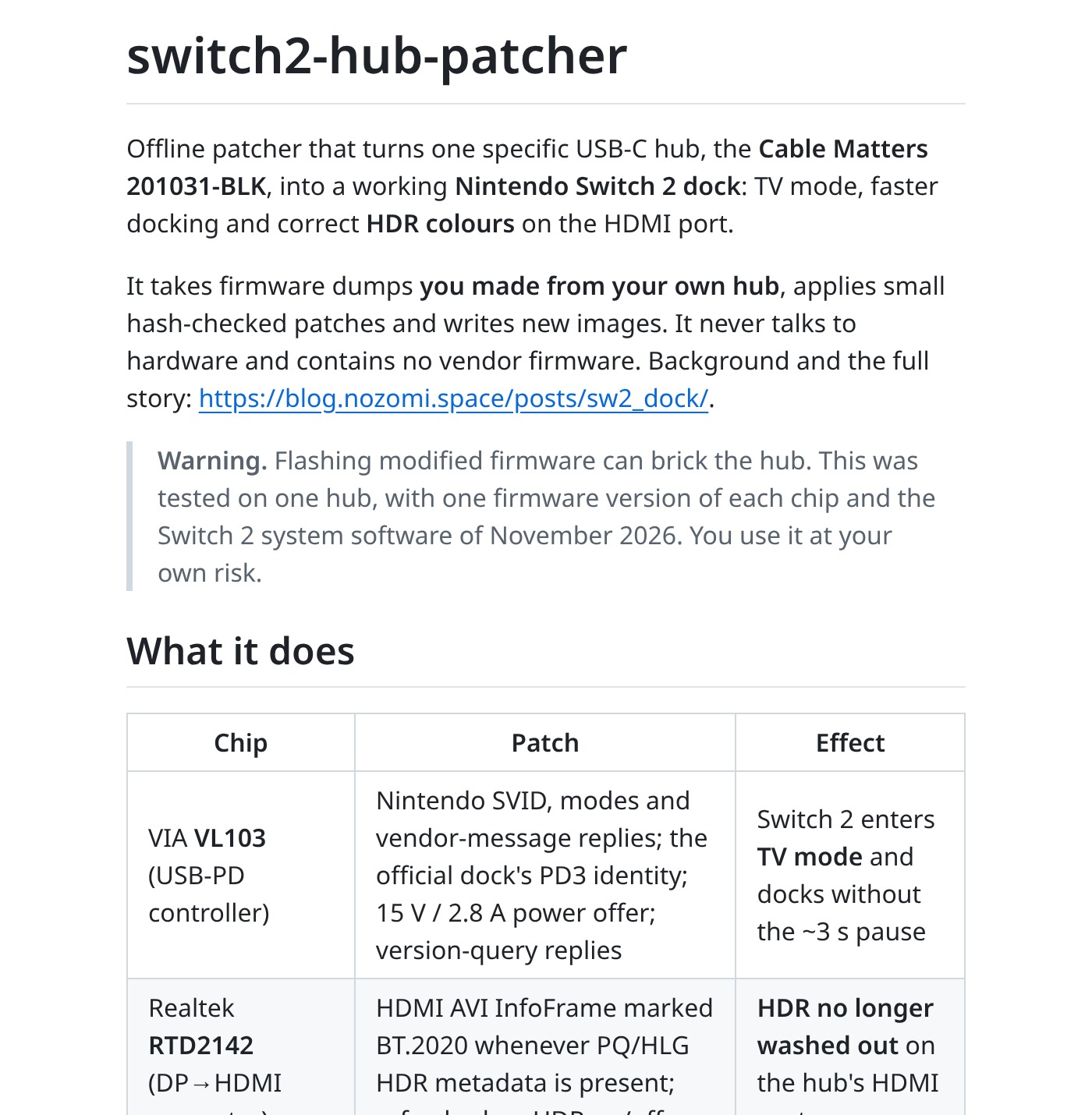 Image: switch2-hub-patcher on GitHub
The results have limits. Variable refresh rate does not work, because the hub’s firmware has no support for it, so Kopeć keeps it switched off. HDR through the hub’s DisplayPort port is still washed out, and he did not test the USB ports or Ethernet closely. He has since posted the tool as switch2-hub-patcher on GitHub. It covers only the Cable Matters 201031-BLK, refuses any firmware dump that does not match the exact stock images, warns that flashing can brick the hub, and was tested on one unit with the Switch 2 system software of November 2026. The power patch also cuts the hub’s own reserve from 7 W to 3 W. None of it has changed how the hub behaves elsewhere. “Even though the hub now reports itself as an official Nintendo dock, it still works normally with my PC and my phone,” he wrote.