Did You Know
Did You Know: Your Smartwatch's Speaker Can Track Your Whole Body Like Sonar, No Extra Hardware Needed
Cornell researchers turned the speaker and microphone of an unmodified Galaxy Watch 6 into an ultrasonic sonar that places 12 joints from head to ankles. The same model ran on a Galaxy Watch 7 and a Pixel Watch 3 without retraining.
ITHACA, N.Y. · Noah Park, Did You Know · Nov 17 2026
ITHACA, N.Y. - Did you know that the smartwatch on your wrist already carries the hardware to follow the movement of your whole body, not just your arm? Researchers at Cornell’s SciFi Lab have shown that the small speaker and microphone built into an ordinary watch can work as a sonar. The speaker sends out sound too high for people to hear, the microphone catches the echoes that bounce back off the wearer, and a small AI model turns those echoes into the positions of 12 joints, from the head down to the ankles.
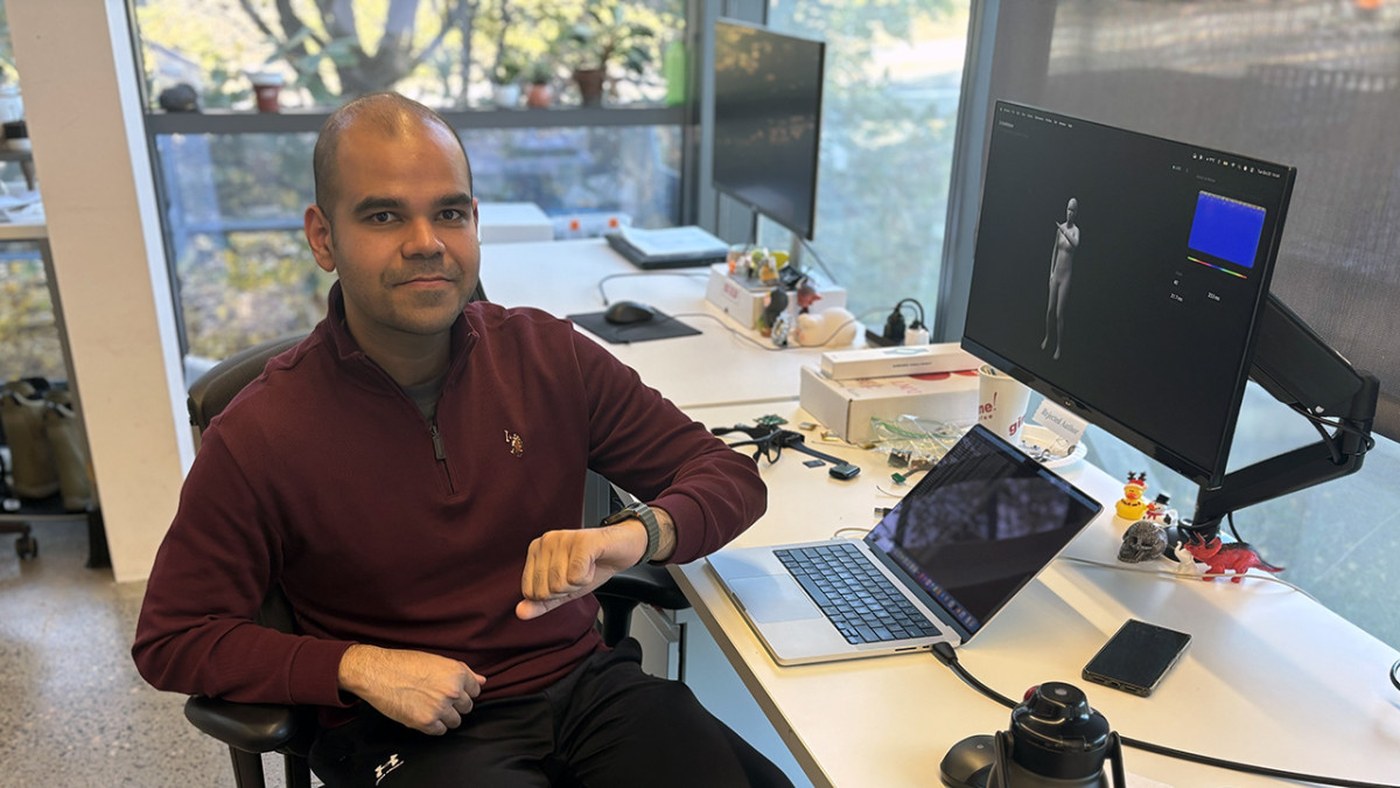
The system is called EchoMotion, and the Cornell Chronicle described it on Nov. 11. The lab, directed by Cheng Zhang, an associate professor of information science, ran its main test on an unmodified Samsung Galaxy Watch 6. Nothing was added to the watch. “This is a very important jump for body tracking,” said Saif Mahmud, the doctoral student who is the paper’s lead author.
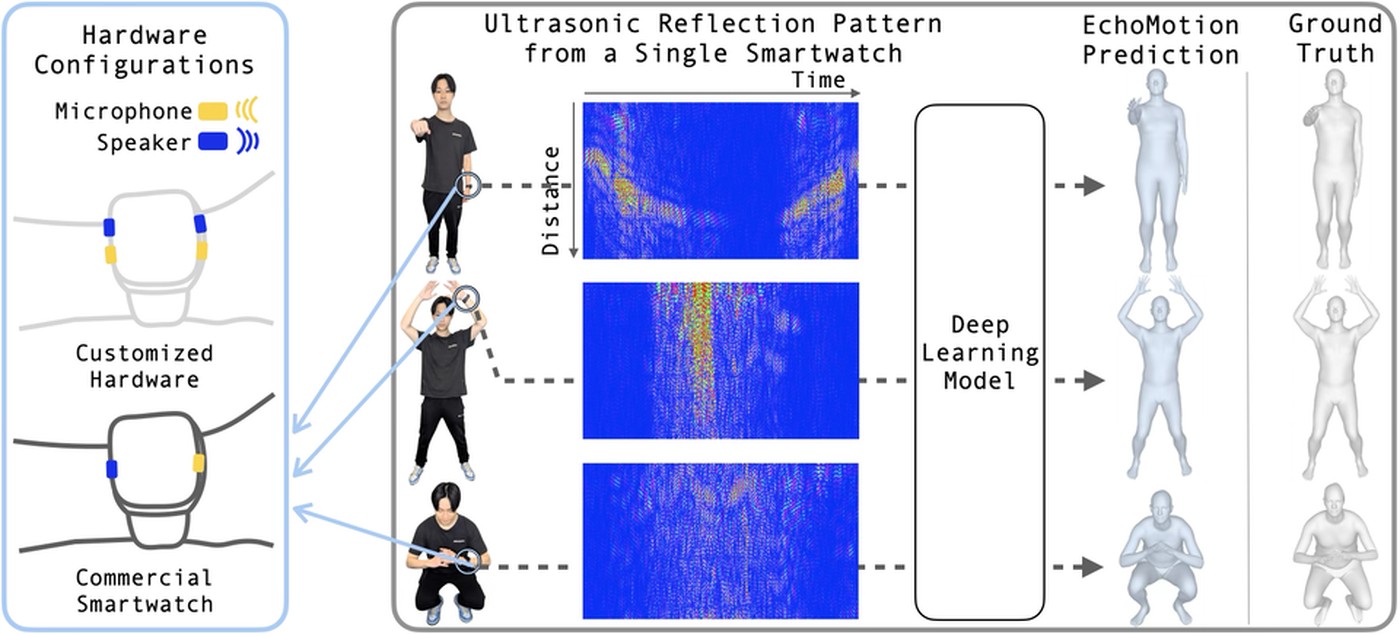 Image: Saif Mahmud / Cornell SciFi Lab
The reason this matters is what watches normally sense. Mahmud told the Chronicle that existing wearables rely on accelerometers and gyroscopes, sensors that measure the movement of the device alone. A watch knows how your wrist swings. It has no direct way to tell whether your knees are bent. Tracking the whole body has meant extra gear, such as phones, earbuds or virtual reality headsets, or a camera pointed at you. Sound gets around that. As the arms, legs and torso move, the pattern of echoes changes, and the model learns to read that pattern as a pose.
The team started with its own hardware. Its first device was a 3D-printed watch replica with a speaker and microphone pair on each side, which wrapped the wearer in what the Chronicle called “a sphere of inaudible sound waves.” Ten volunteers wore it on the nondominant hand through 18 exercises, while cameras recorded their true poses for comparison.
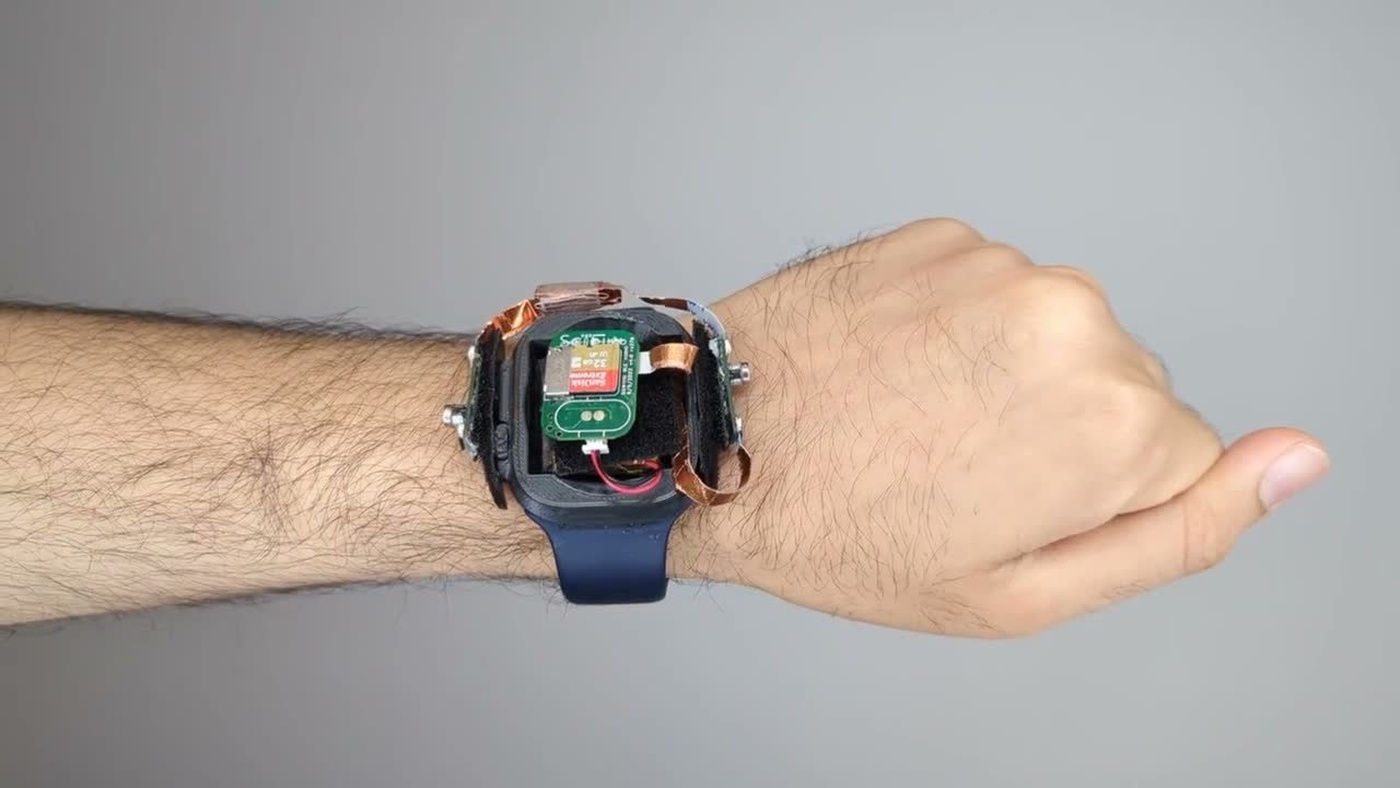 Image: The Gadgeteer
Retail watches have only one speaker and one microphone, so the harder test came next. On the stock Galaxy Watch 6, with 15 people the system had never seen, the average error for each joint was under four inches. A one-time calibration of 12 minutes, in which the watch learns the wearer’s body, cut that error by more than a third, to about 2.4 inches. The paper, published in the Proceedings of the ACM on Interactive, Mobile, Wearable and Ubiquitous Technologies, puts the commercial watch result at a mean per-joint position error of 5.99 centimeters, against 5.36 centimeters for the custom prototype.
Then the same model went onto two other watches, a Samsung Galaxy Watch 7 and a Google Pixel Watch 3, and worked without any retraining. In a LinkedIn post about the paper, Mahmud described the Galaxy Watch 6 version as “a software-only app on an unmodified Samsung Galaxy Watch 6, which has just one pair,” and wrote that “the whole pipeline runs on the watch, at about 120 ms per prediction.”
The cost to the battery is small. In the prototype, sensing drew about 12 milliwatts, which Cornell says is roughly 40 times less than a wearable camera, and a 30-minute session on the Galaxy Watch 6 used 5% to 6% of the battery. Sound also leaves no pictures behind. Cornell says acoustic signals preserve privacy for the wearer and the people around them, and they produce smaller amounts of data that are easier and cheaper to process than camera footage.
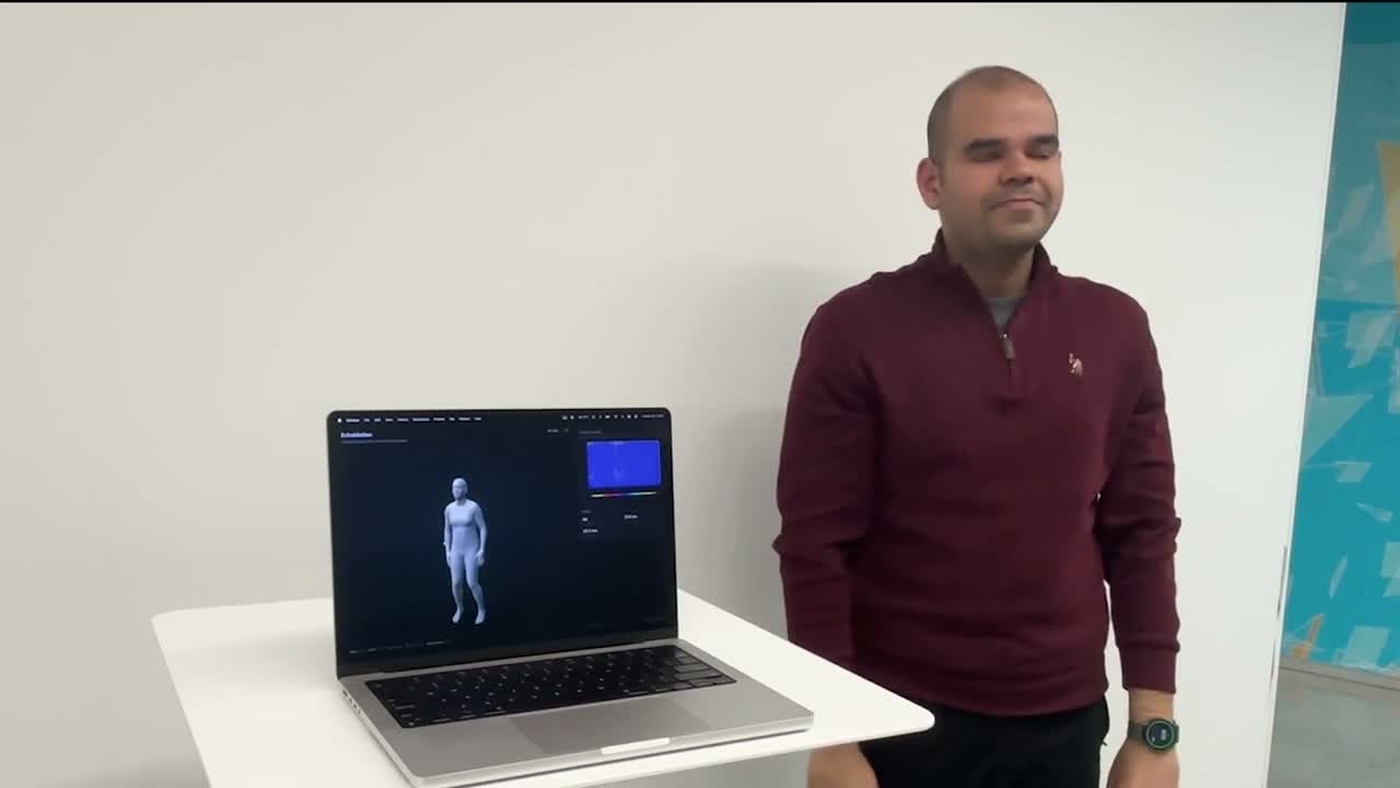 Image: The Gadgeteer
The researchers also took the watch out of the lab. Ten more participants did the same 18 exercises in a small room, in a narrow hallway and next to a noisy road. Furniture and traffic noise did not get in the way, but performance slipped slightly in the hallway, where echoes came back off other people. The paper’s abstract reports a mean joint error of 6.41 centimeters for that semi-in-the-wild study. Mahmud expects more training data, from thousands of users rather than dozens, to help in crowded places such as the subway.
“We have made significant efforts in making EchoMotion work on commercial devices, so that the adoption can be very easy,” Mahmud said. That is the surprise in the work: the parts it needs already sit inside watches people wear today. What is missing is software, and that has not shipped. EchoMotion is still a research system, with, as The Gadgeteer put it, “no app, no download and no release date.”
The team’s next target is fitness. Cornell says the lab is developing the technology so that a personal fitness agent could count a user’s reps and correct their form, for example in a Bulgarian split squat. The group is also pairing it with first-person video on smart glasses to track the objects a person handles. “In the very near future, with wearables like smartwatches or smartglasses, a personal agent will write a description of your whole day,” Mahmud said. For now, the watch you already own keeps that ability in reserve, a speaker and a microphone waiting for the right app.