
AI
Google's Gemini 4 Carbon Tops the Leaderboard Two Weeks After Argon, but Only Cyber Defenders Can Use It
Google says its new frontier model leads on finding, exploiting and patching software flaws and can work for days on a single engineering task. Developers and consumers will have to wait while a small group of security teams tries it first.
Mountain View, Calif. · Jordan Hale, AI · Oct 29 2026
MOUNTAIN VIEW, Calif. - Google released its second frontier model in two weeks on Wednesday, and most people will not be able to touch it yet. Gemini 4 Carbon, announced by Google DeepMind’s Koray Kavukcuoglu, is the company’s “strongest model with state-of-the-art cybersecurity and long horizon capabilities,” according to Google’s announcement. It is going first to a subset of cyber defenders through Google’s Fairwind Program, with developers, businesses and consumers to follow “as soon as possible.”
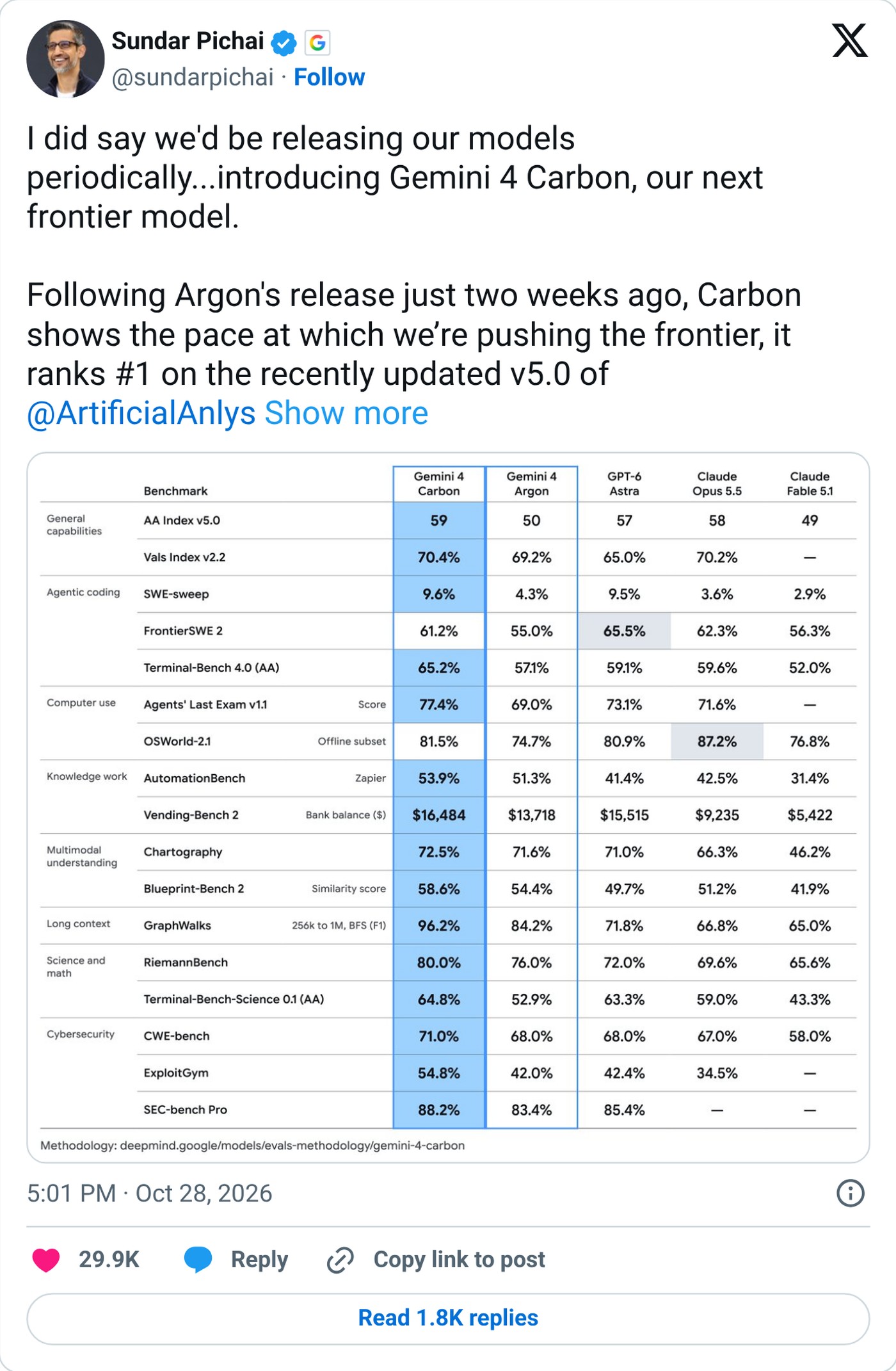 Screenshot: @sundarpichai on X
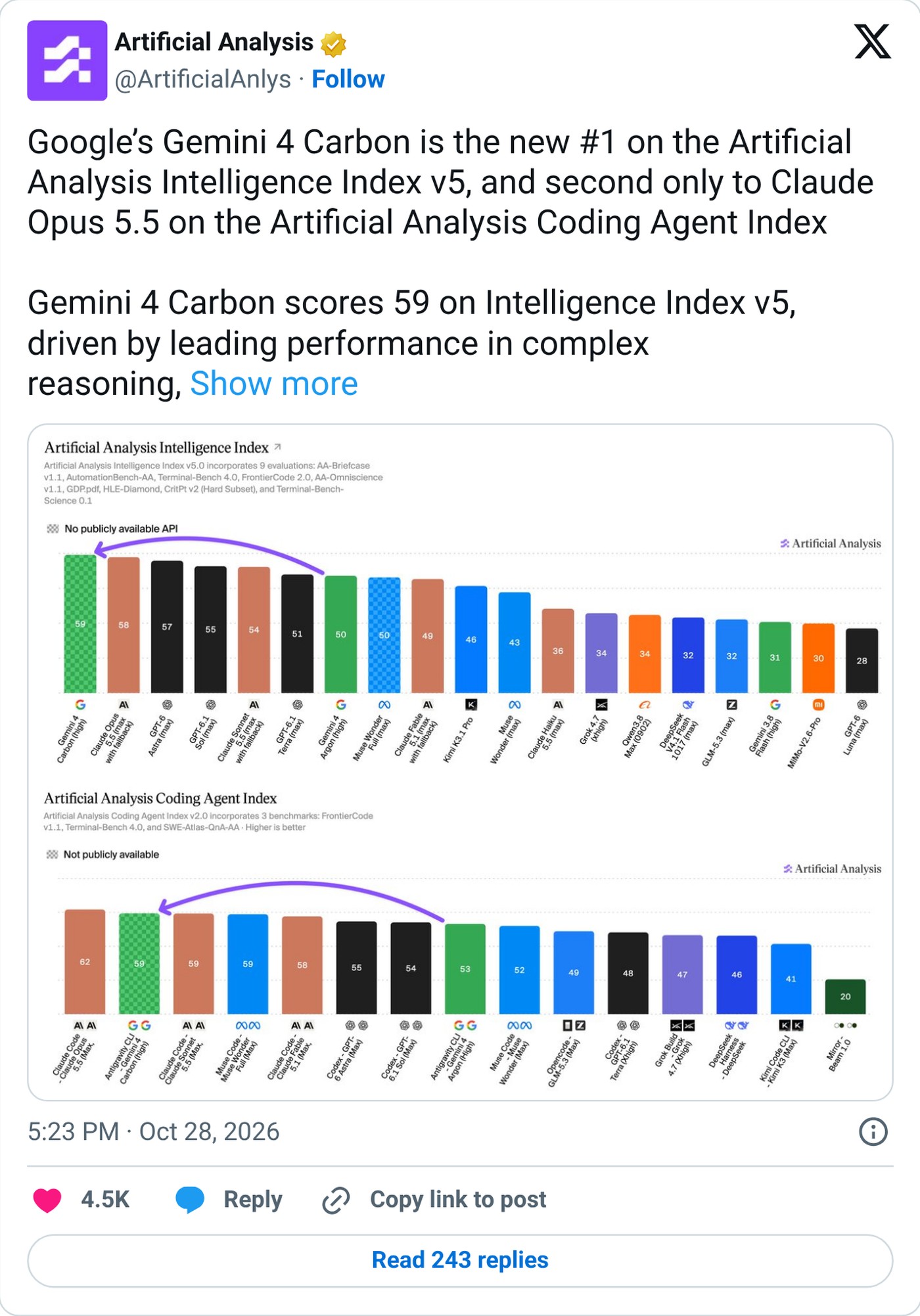
The headline number is a ranking. Google says Carbon scores 59 on version 5.0 of the Artificial Analysis Intelligence Index, putting it first, ahead of Anthropic’s Claude Opus 5.5 and OpenAI’s GPT-6 Astra, as The Verge noted. That index was rebuilt this week around tests with mostly private questions, which makes it harder for a model to score well on material it has already seen. Artificial Analysis said Carbon is also second only to Claude Opus 5.5 on its separate coding agent index, so the lead is not universal.
Security is where Google is pressing hardest. Carbon scored 88.2% on SEC-bench Pro, which measures whether a model can find real vulnerabilities in real software, 54.8% on ExploitGym, which tests whether it can turn a flaw into a working exploit, and 71.0% on Collinear’s CWE-bench for patching the root cause. Google says those external tests were run without guardrails, so customers working under the restrictions that come with deployment may not see the same results. On its own benchmarks, the company says Carbon writes secure code at more than twice the success rate of Gemini 4 Argon, and that Google’s Chrome team found it produced high-quality patches more than 10 times better than “another lab’s large frontier model,” which it did not name.
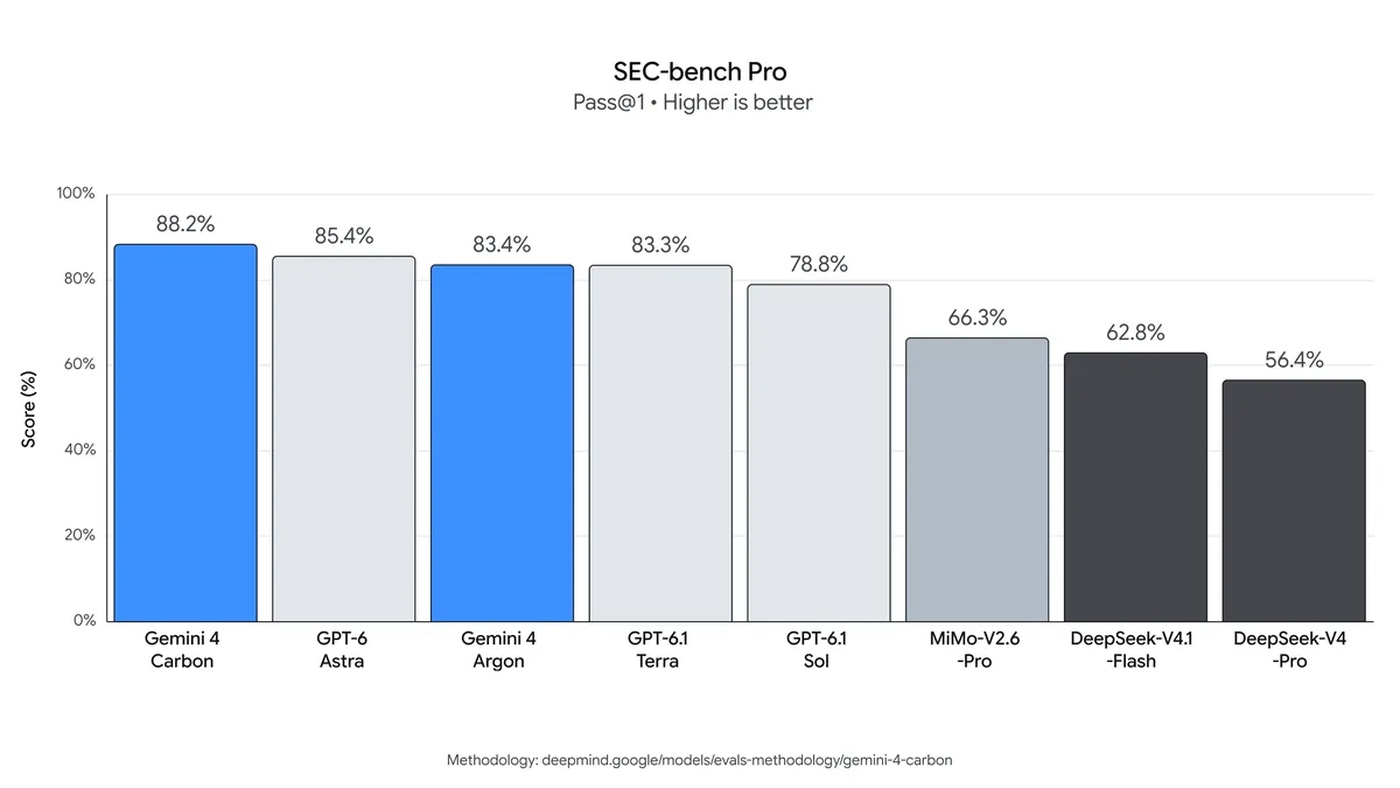 Image: Google
That mix of skills explains the cautious rollout. A model that finds and exploits bugs well is useful to the people defending software and to the people attacking it. Google says it is taking part in the U.S. government’s voluntary process for pre-release model testing and wants feedback from the first group of defenders before it widens access. Argon followed the same path: Google introduced it on Sept. 30 for Fairwind partners and widened availability on Oct. 13, VentureBeat reported. We covered Argon’s debut at the time.
 Screenshot: @ArtificialAnlys on X
Beyond security, Google is pitching Carbon as a model for long jobs. The company says its internal teams have watched it “run for days to persist through dead ends” on multistep engineering work such as tracking down and fixing subtle bugs across large codebases. It also climbed 89 points on WebDev Arena to fourth place, at 1768.
Google spent much of its announcement on behavior rather than raw ability. It says Carbon cut successful cheating on Terminal-Bench 4.0 to zero, with attempts to cheat at 0.4%, and that high-severity misalignment alerts in live coding work with Google’s own teams fell by almost 80%. It says the model makes about half as many unsupported claims as Argon and resisted every attack in Gray Swan’s indirect prompt injection benchmark, a 0.0% attack success rate against 0.7% for Argon. Those are Google’s figures, and outside testers have not yet had broad access to check them.
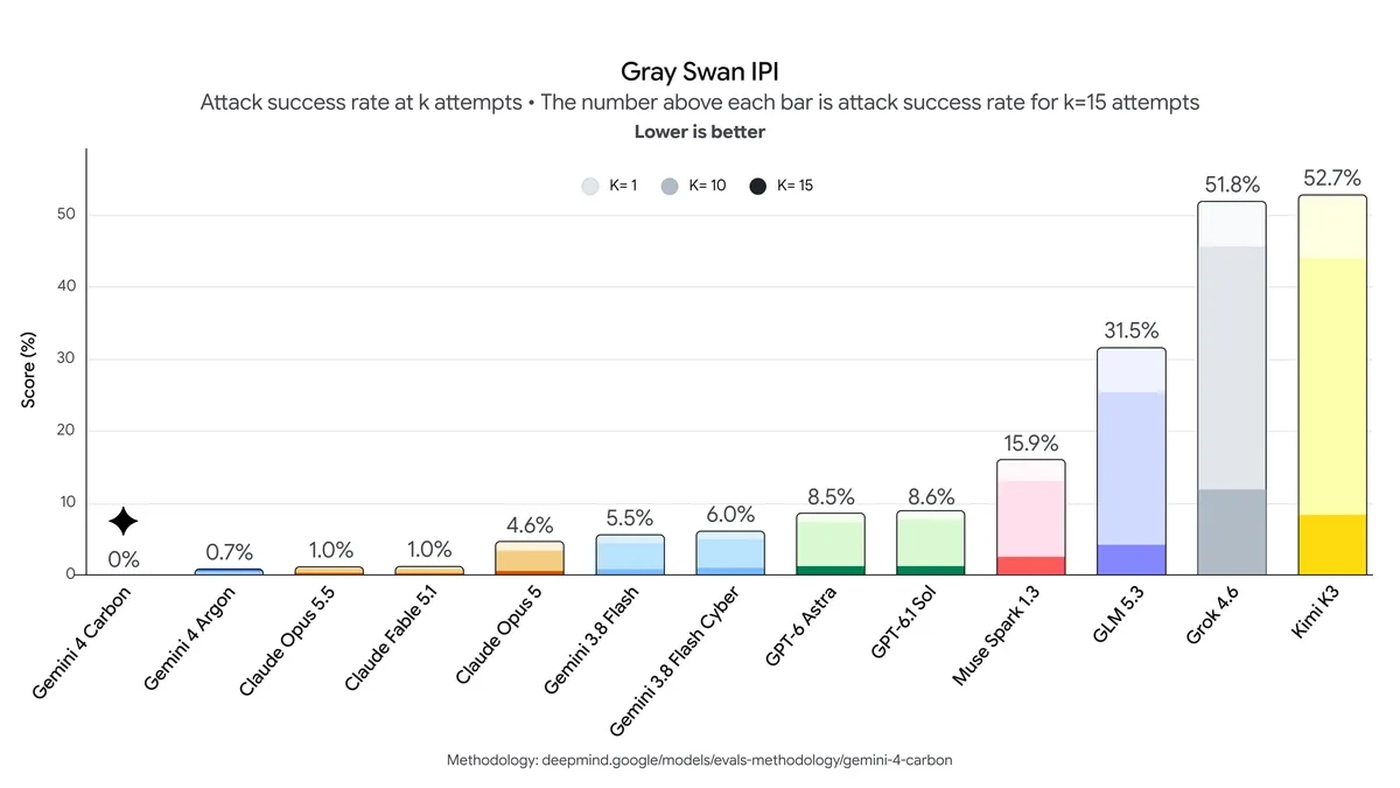 Image: Google
When Carbon does open up, the price will be familiar. It launches at Argon’s introductory rate of $2 per million input tokens and $10 per million output tokens, with cached input 95% cheaper. After the introductory period, Google says, the price rises to $4 and $20.
The model also showed up on Alphabet’s earnings call a few hours later. Chief executive Sundar Pichai told analysts that Carbon outperforms Argon “on almost every domain,” CNBC reported, and said the Gemini app has reached one billion users. Google has not given a date for wider availability.