Did You Know
Did You Know: There Is Now a Touchscreen Woven Into a Sleeve, and It Survives 50 Machine Washes
Researchers in Singapore threaded 54 light-emitting, touch-sensing fibers into the forearm of a garment. The result plays video, runs a calculator and reads your temperature, then goes in the wash.
SINGAPORE · Noah Park, Did You Know · Oct 25 2026
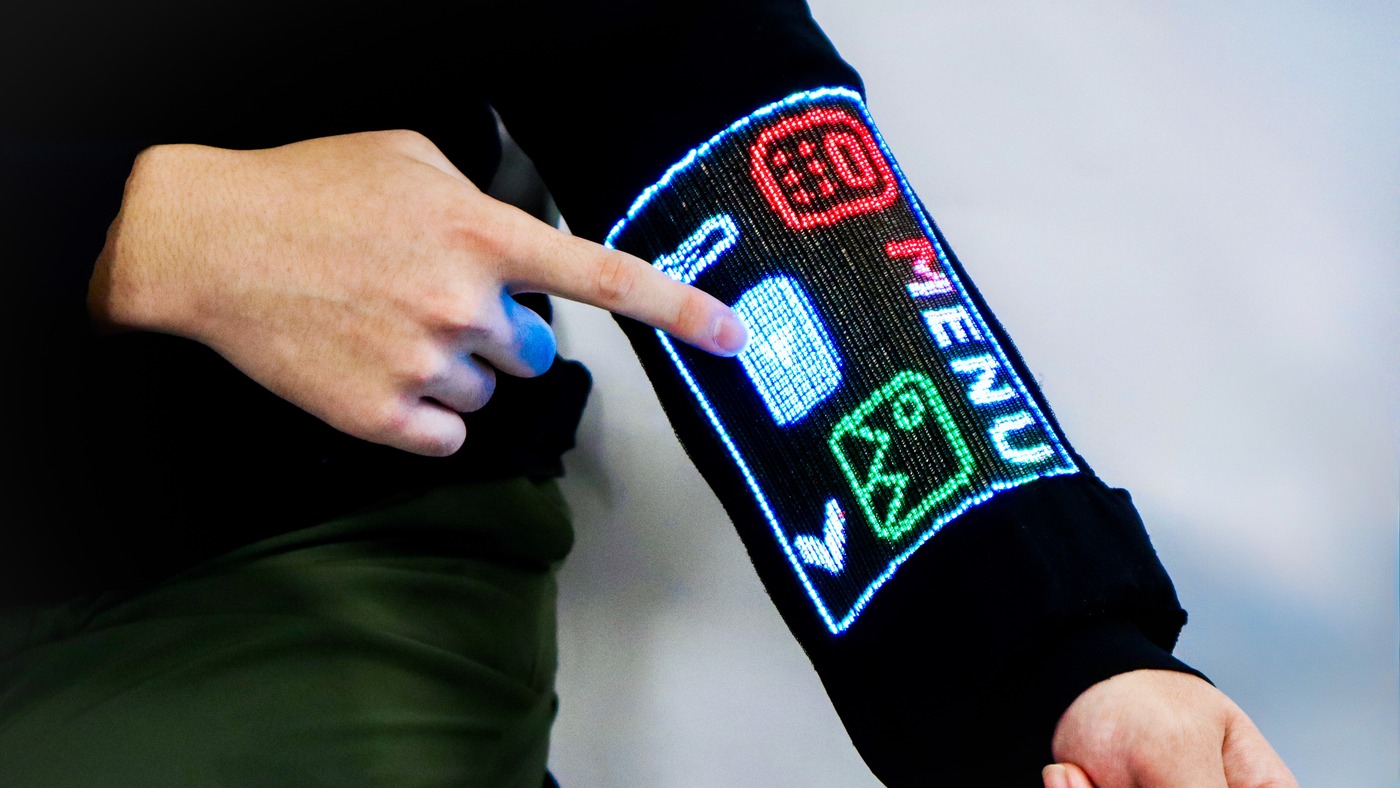
SINGAPORE - Did you know there is now a working touchscreen that you can put through the washing machine with the rest of your laundry? Researchers at the National University of Singapore have threaded 54 thin fibers into the forearm of a sleeve and turned it into a full-color display that responds to a fingertip. It plays video, shows a photo gallery and runs a calculator. After 50 cycles in an ordinary washing machine with detergent, the team says, its light output and touch response were nearly unchanged.
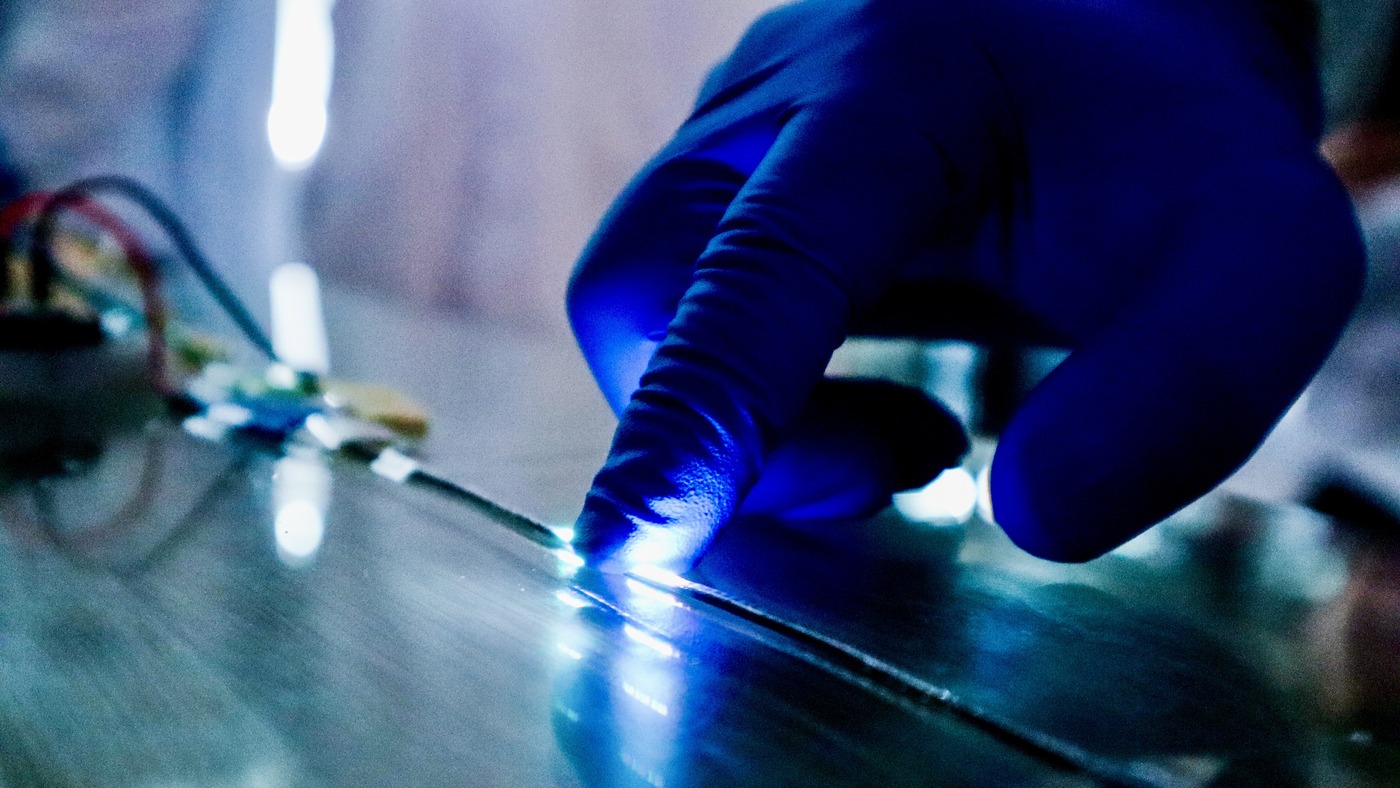 Image: National University of Singapore
The work, led by Assistant Professor Tural Khudiyev of NUS’s Department of Materials Science and Engineering, was published in Nature on Oct. 21 under the title “Touch-sensing digital pixel fibre enables interactive garment GUI.” The university calls it the world’s first touchscreen built into a garment. Shanshan Yao of Stony Brook University’s mechanical engineering department, who co-reviewed the paper, and wrote an accompanying News and Views piece for the journal, put it plainly: the authors “have turned everyday clothing into a graphical user interface.”
The surprise is that the screen is not a flexible panel stitched onto cloth. The display is the thread itself. Each fiber is about a millimeter thick and is drawn out to 10 meters long, with a strip of tiny digital LEDs running down its core. Beneath the LEDs sits a touch-sensing layer: pressing the fiber completes a circuit, and the resulting signal tells the system how far along the thread the finger landed, so the nearest pixel can light up. According to the paper, a single linear circuit inside the fiber works as both the display’s backbone and a computational bus.
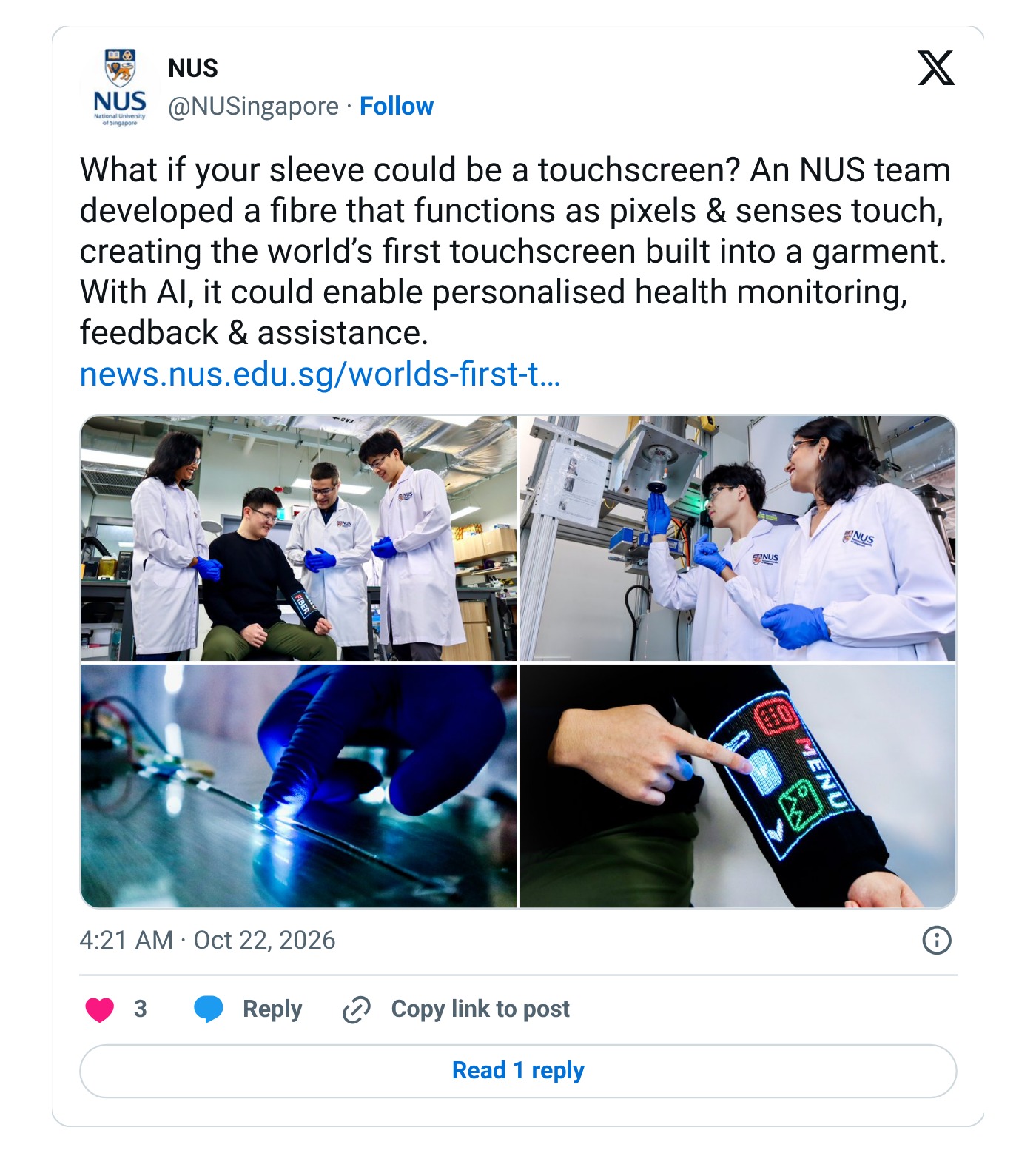 Screenshot: @NUSingapore on X
Wiring thousands of chips along something as thin as yarn was the hard part. Flat circuit boards are laid out in two dimensions, and a fiber has only one. The NUS team used a laser to strip the insulation from fine wires at exactly the points where each chip’s pads would sit, then used controlled surface wetting to guide molten solder so it bonded only at those programmed spots. The university says the method joined more than 5,000 chips through more than 20,000 electrical connections. The finished LED strips were then fed into a furnace and drawn into fiber, sealed inside a softened cladding as they went, a process known as thermal drawing.
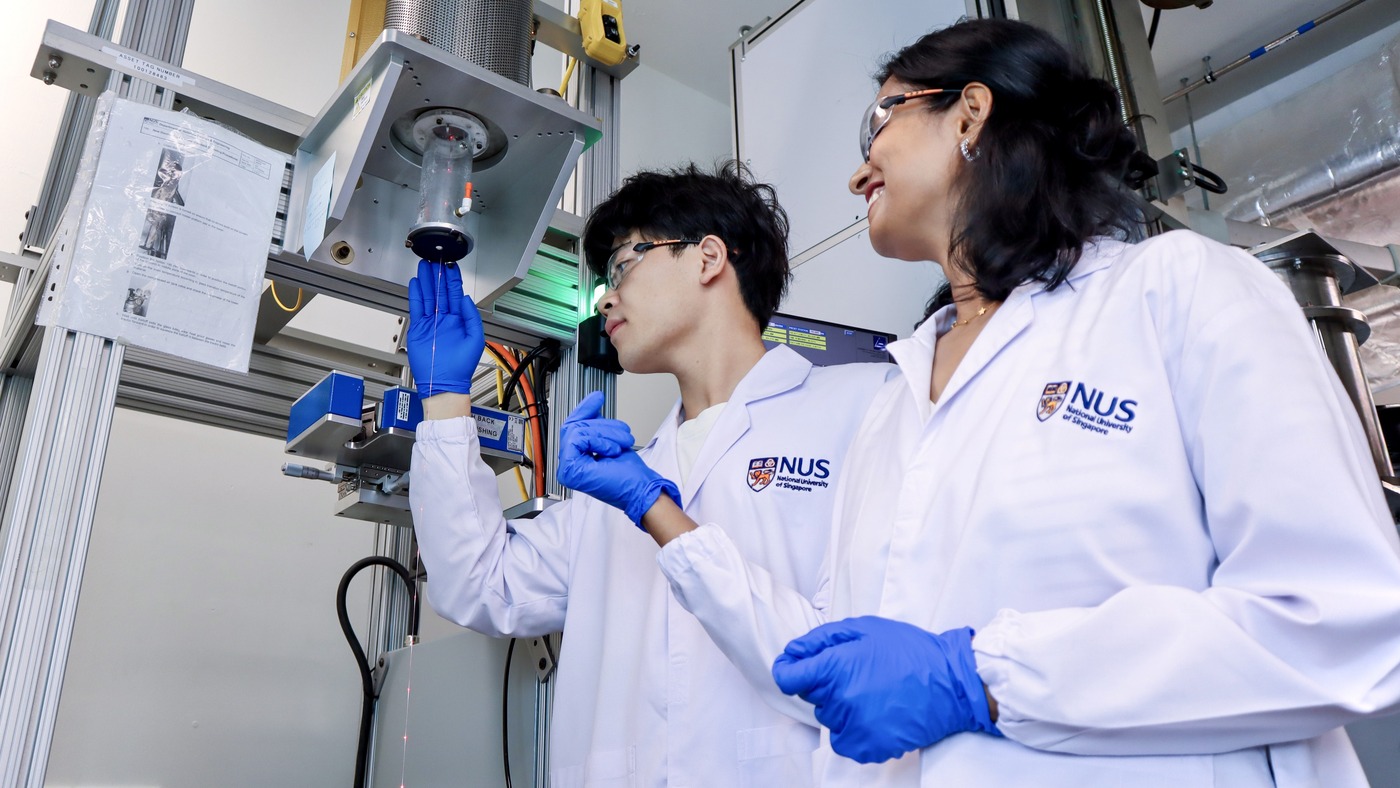 Image: National University of Singapore
The numbers on the sleeve itself are modest, and that is part of what makes the result striking. Each of the 54 fibers carries 96 LEDs, giving a 96 by 54-pixel display that measures 168 by 105 millimeters. That is 5,184 pixels in total, fewer than the original Game Boy’s 160 by 144 screen. It refreshes at 30 frames per second with 8-bit color. Each fiber has its own control channel, so a fault in one line leaves its neighbors working, and the system can register several touches at once.
*Video: National University of Singapore on YouTube, "Introducing the Garment GUI!"*The team wove in other fibers made the same way, carrying a microphone, a speaker and sensors that track motion, find magnetic north, measure temperature and gauge ambient light. Together, NUS says, they let the sleeve do what early smartphones could: work as a compass, respond to voice commands, receive images over Bluetooth, play video at 30 frames per second (25 with synchronized audio), rotate the screen and adjust its own brightness. Worn with the temperature fiber under the arm, it reads and displays the wearer’s body temperature.
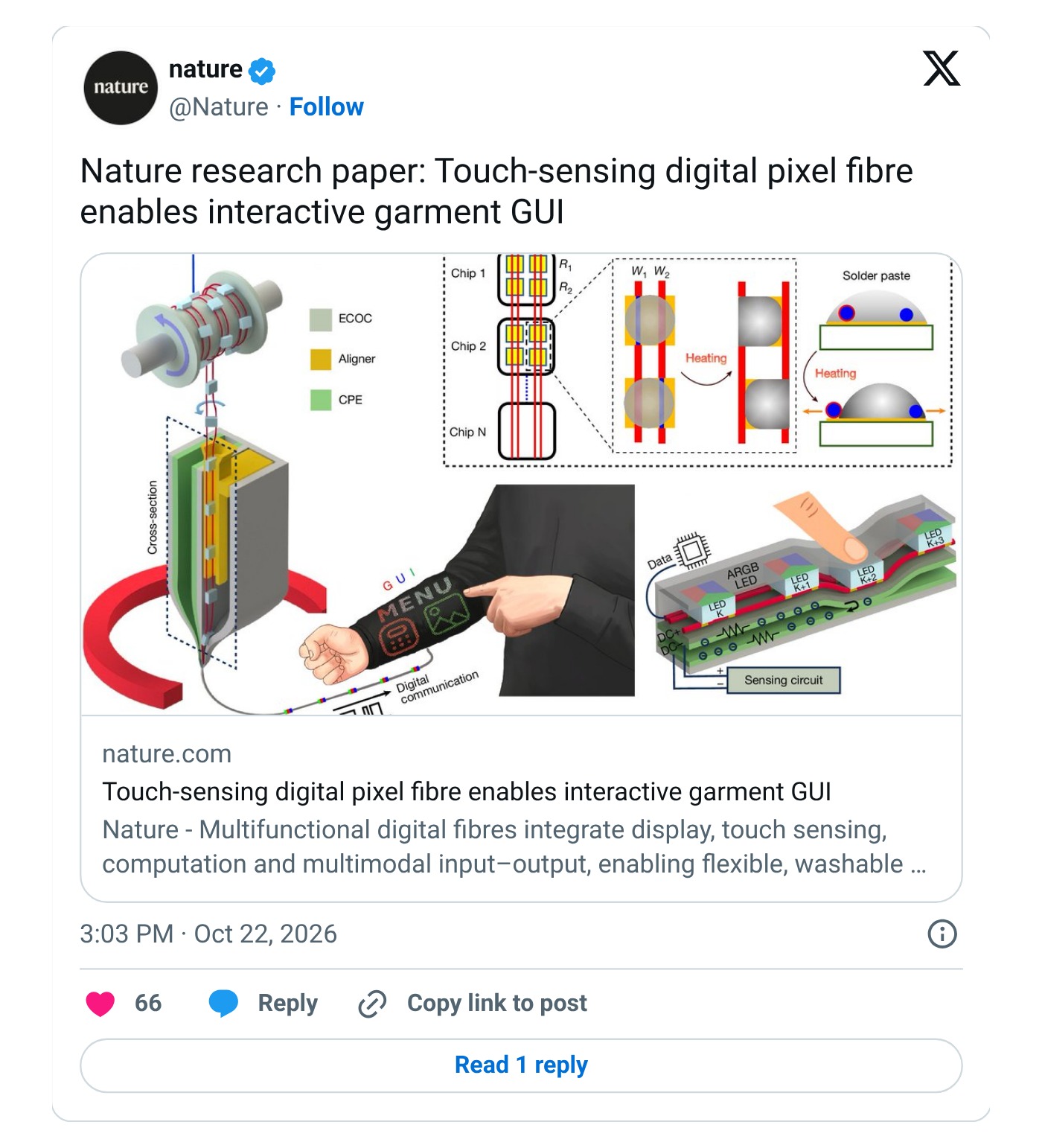 Screenshot: @Nature on X
It also still behaves like fabric. Light output and touch response were also nearly unchanged after the fibers were bent around a 5-millimeter radius 1,000 times, and the researchers report that it is as breathable as cotton, polyester and denim and stays within established safety limits for contact with skin. The work was funded by Singapore’s Ministry of Health through its National Medical Research Council, and the team has posted its analysis code publicly on GitHub.
This is a lab prototype, not a product, and NUS has not announced any commercial partner or price. The team says smaller chips and thinner fibers, both compatible with its method, are the route to sharper and larger displays, and that thinner fibers could be knitted, woven and embroidered on standard industrial machines. “Healthcare is one particularly promising application,” Khudiyev said in the university’s announcement, describing garments that collect physiological data through fiber sensors and let the wearer check it on the clothing itself. For now, the most surprising screen of the month has the resolution of a 1980s handheld, and it can go in the laundry.