AI
Elvis Presley's Rights Holders Sue Suno, Saying the AI Music App Clones the King's Voice on Request
A 51-page federal complaint invokes Tennessee's ELVIS Act and lists 859 songs, seeking up to $128.85 million in statutory damages. The publisher behind many of Eminem's records filed its own copyright case the same week.
San Francisco · Jordan Hale, AI · Nov 9 2026
SAN FRANCISCO - Type a sentence, get a song. That is the pitch for Suno, the AI music generator that more than 100 million people have used, according to a new lawsuit. Now the people who control Elvis Presley’s music say the app will also hand you the King. A group of Presley rights holders filed a 51-page complaint against Suno in federal court in San Francisco on Friday, accusing it of cloning Presley’s voice and copying his recordings without a license, The Verge reported.
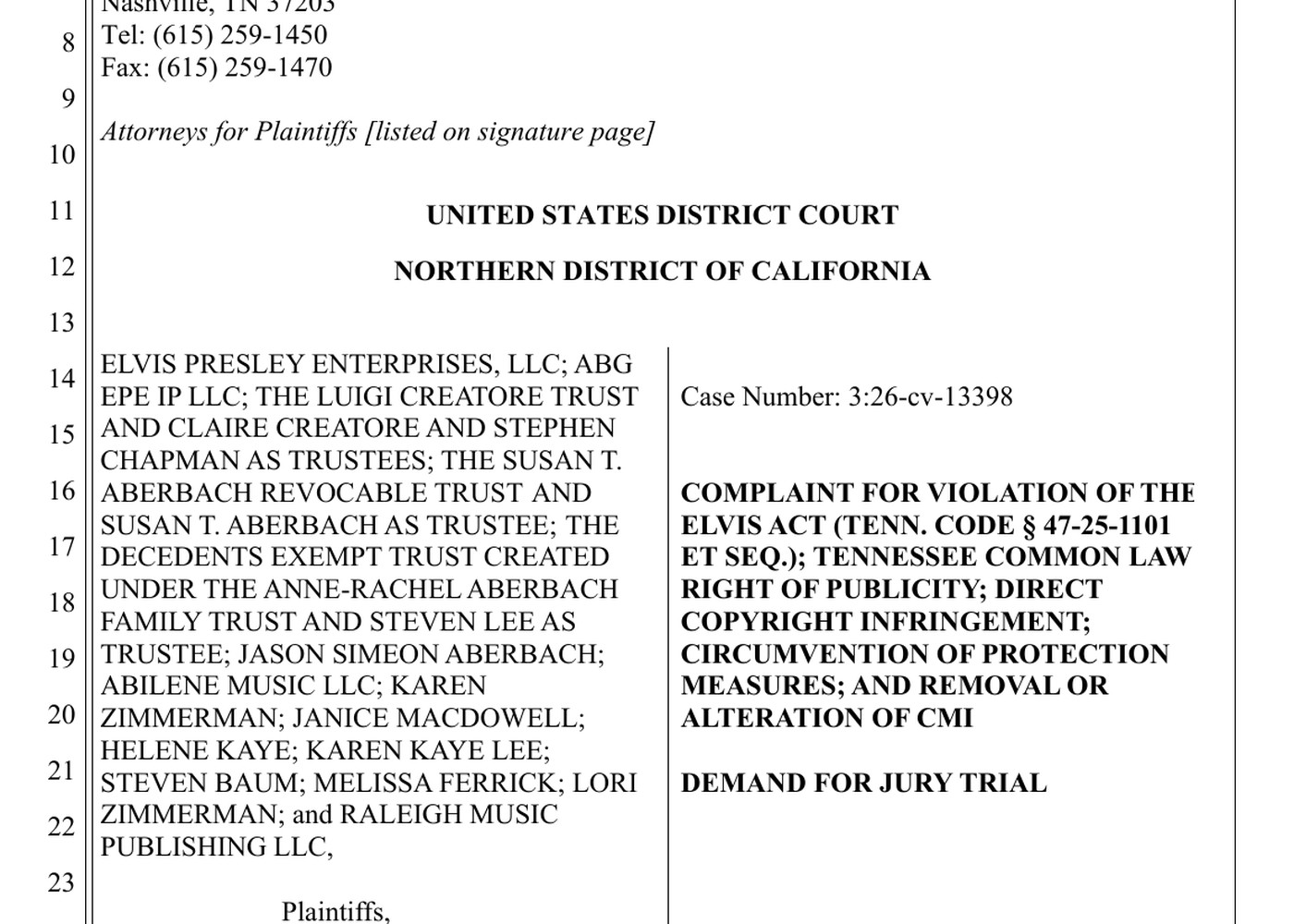
The plaintiffs include Elvis Presley Enterprises, an Authentic Brands Group entity and Raleigh Music Publishing, along with several family trusts and songwriters’ heirs. The complaint, filed in the U.S. District Court for the Northern District of California, claims violations of Tennessee’s Ensuring Likeness, Voice and Image Security Act, known as the ELVIS Act, along with the state’s common-law right of publicity, direct copyright infringement and two claims under the Digital Millennium Copyright Act.
 Screenshot: U.S. District Court, Northern District of California
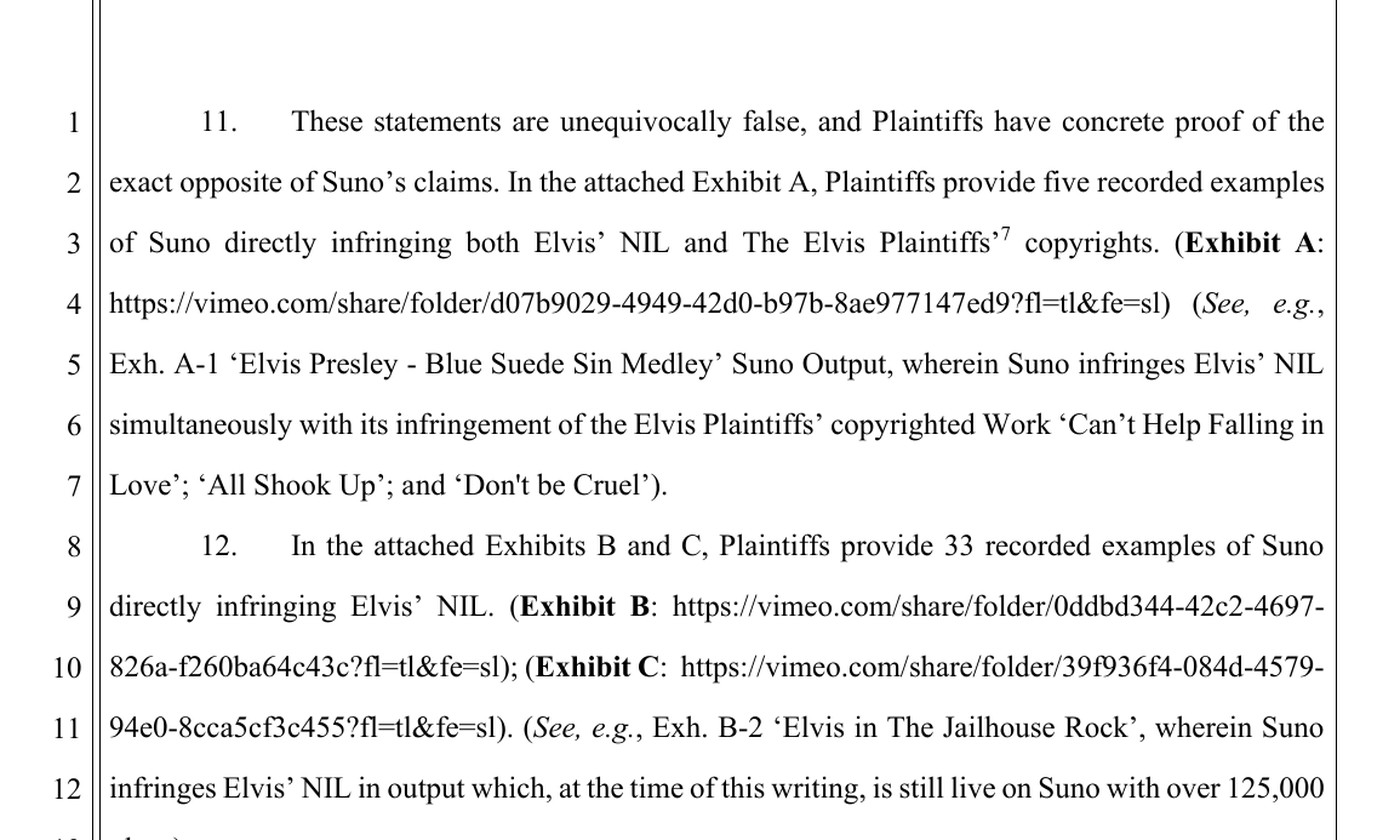
The filing goes straight at Suno’s public promises. It quotes the company’s statement, made in a motion to dismiss in a separate case, that Suno “has never allowed prompts for specific artists or copyrighted songs,” a line taken from an August blog post by chief executive Mikey Shulman. The plaintiffs call those statements “unequivocally false” and attach recorded examples. They say Exhibit A holds five Suno outputs that copy both Presley’s likeness and songs such as “Can’t Help Falling in Love” and “All Shook Up,” and Exhibits B and C hold 33 more that imitate his voice. One track, “Elvis in The Jailhouse Rock,” was still live on Suno with more than 125,000 plays when the complaint was written, the filing says. Exhibit D covers Suno versions of “If I Can Dream,” and Exhibit E covers a Raleigh-owned song, “Through the Valley.”
 Screenshot: U.S. District Court, Northern District of California
The money at stake is spelled out. The rights holders list 859 works in an exhibit and ask for up to $150,000 for each one willfully infringed, which the complaint puts at $128,850,000 in statutory damages. They also want punitive damages and a permanent injunction. The filing describes a “freemium” service with paid tiers that add audio uploads and commercial rights to the tracks users generate, and it cites more than 2 million paid subscribers and a June funding round that raised over $400 million at a $5.4 billion valuation.
The lawyers did not hold back on tone. “Suno has mechanically encoded itself with artists’ identities, hard-work, creativity, and time, and harnessed them all for a consistent conveyor belt of cold hard cash,” the complaint says. “The next Elvis won’t pick up a guitar.”
 Image: Suno
The same legal team represents Eight Mile Style, which controls hundreds of Eminem recordings and filed its own suit alleging that Suno lets users generate songs and lyrics that mirror the rapper’s tracks, Variety reported. Eminem is not a plaintiff himself.
Suno rejects the claims. “Suno exists to help people create new, original music, not to trade on anyone’s name or likeness, and we prohibit any unauthorized use of an artist’s work,” spokesperson Cat McCormack told The Verge. “To protect against this, we do not allow prompts for specific artists’ names and songs and work with third-party providers to screen uploaded audio files and lyrics for potential misuse.”
The two new cases join a stack that already includes suits from Sony Music, Universal Music Group, Round Hill Music and a proposed class action led by Jason Isbell, whose filing argued users could slip past Suno’s filters by describing an artist’s “tone and phrasing” or by putting spaces between the letters of a name. Warner Music Group settled with Suno last year and licensed music that helped power its label-backed v6 model. For anyone who has typed a prompt into the app, the question is now a practical one: whether “sing it like Elvis” is a feature, or a claim a jury gets to decide.