Business
Musk Says SpaceX Has Closed $40 Billion in Debt for AI Chips and Warns That Most Neoclouds Will Not Survive
Bloomberg reported that the deal had not yet priced as of late Sunday, after a week in which investors grew warier of lending to the AI buildout and SpaceX's own credit protection hit a record.
Starbase, Texas · Elena Vos, Business · Oct 26 2026
STARBASE, Texas - Elon Musk said on Sunday that SpaceX had closed $40 billion in debt to buy graphics processors for artificial intelligence, and used the moment to argue that most of the smaller companies renting out AI computing power are about to run out of money.
“As of the past few weeks, debt markets have almost entirely shut off access to money for any company that doesn’t have substantial revenue independent of AI data centers,” Musk wrote in a post on X, replying to the investor Chamath Palihapitiya. “SpaceX closed $40B of debt for GPUs, but we’re investment grade and have Starlink & launch.” He went on to say that “the 200+ neoclouds are going to see guppy-level death and consolidation,” adding, “Some will make it through, but not many,” Bloomberg reported.
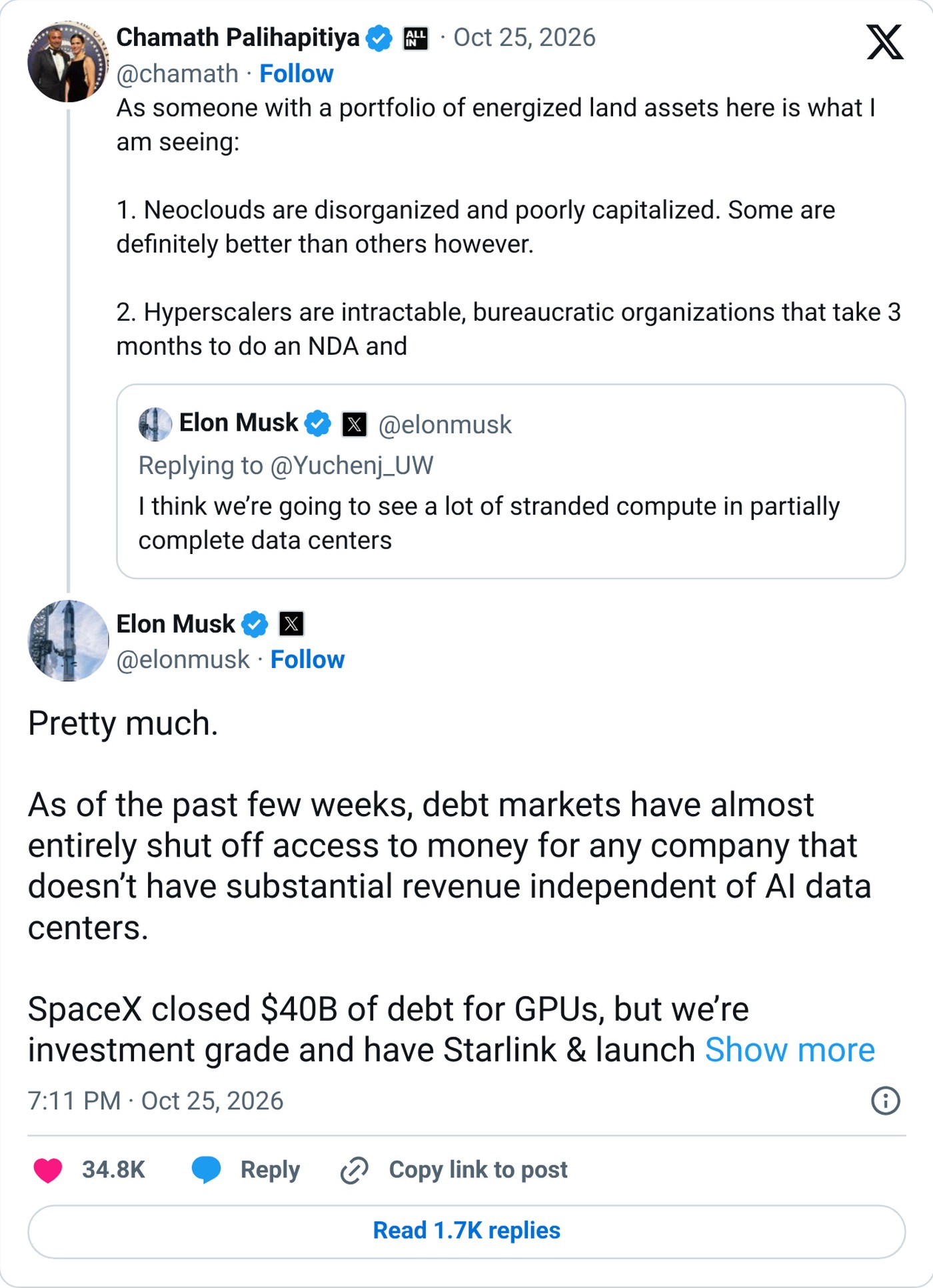 Screenshot: @elonmusk on X
In a follow-up, Musk said the money was “primarily callable debt for GPU purchases that will arrive in Q1 and Q2,” and “not a major factor this quarter.” Later in the evening he wrote that “SpaceX is not buying any neoclouds. Pointless.”
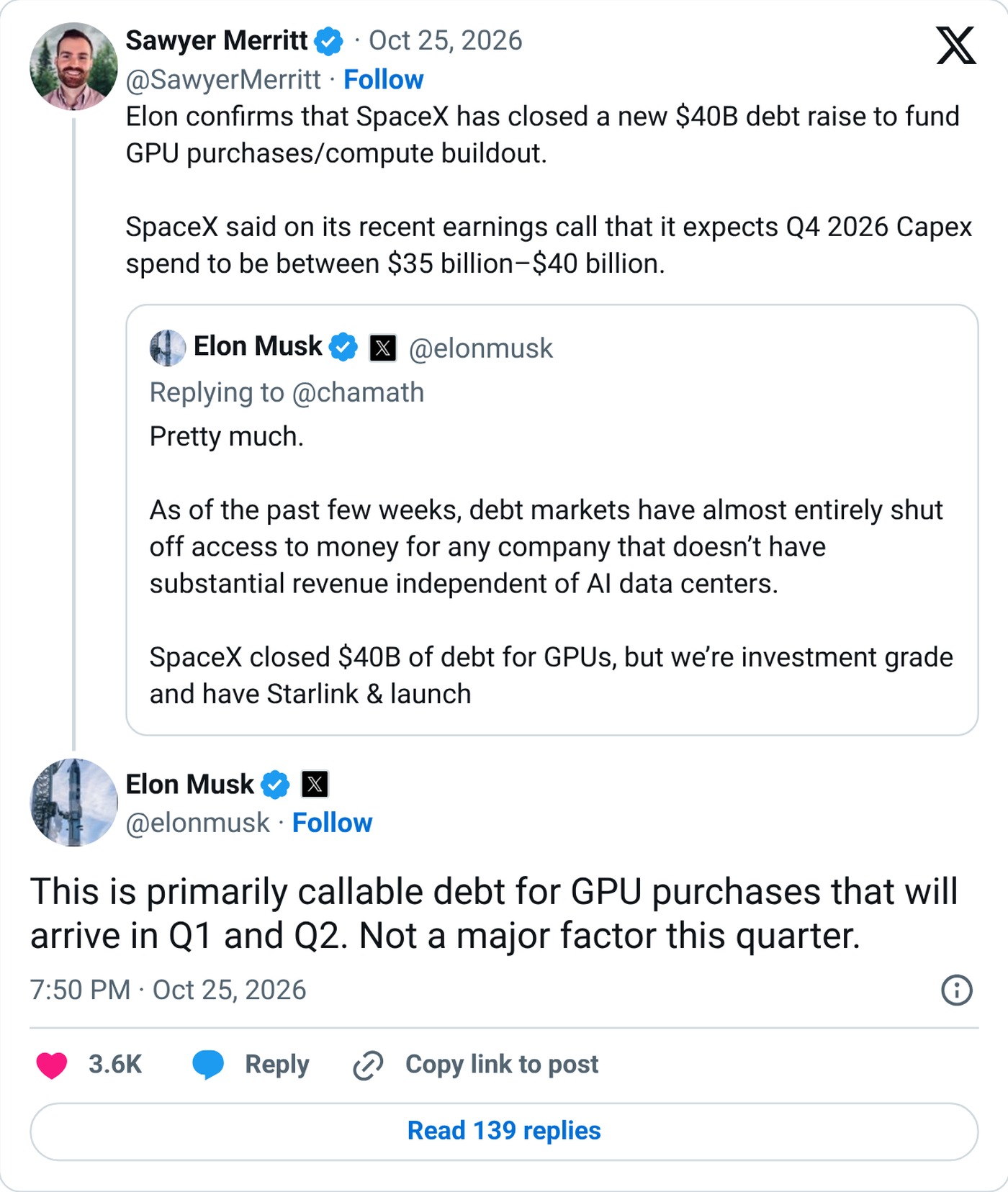 Screenshot: @elonmusk on X
What “closed” means is less clear. People familiar with the talks told Bloomberg that, as of late Sunday in New York, discussions over pricing were still going on and the deal had not priced, with the parties working to finish the package in the coming days. Reuters said it was not immediately clear what Musk meant by closed or whether investors had agreed to pricing, according to its report.
The structure has been reported in some detail. Bloomberg has said the debt is to be issued as private bonds by an entity kept off SpaceX’s balance sheet, which would protect the company’s investment-grade ratings. Bankers led by Goldman Sachs have been discussing it with investors led by Apollo Global Management, with Apollo-backed Atlas SP slated to manage the entity, and Pacific Investment Management Co. has considered investing. An earlier Bloomberg report, summarized by Investing.com, described three tranches, including a subordinated piece of $25 billion to $30 billion, and said credit market volatility had reopened talks over borrowing costs.
 Image: Starlink
That volatility has reached SpaceX too. Credit default swaps tied to the company, which investors use to insure against losses on its debt, rose to a record 266 basis points at Friday’s close, a level more typical of a junk-rated borrower, Bloomberg reported. The new structure is also meant to avoid a repeat of last year’s attempt by xAI, Musk’s AI company, to raise off-balance-sheet debt through a sale-leaseback. SpaceX ultimately had to record about $13 billion of that debt after it was judged a failed sale-leaseback, according to the company’s latest earnings report.
The AI business is now central to SpaceX. Its AI segment, which the company calls Super Intelligence, became its largest unit in the third quarter, with revenue rising to $7.56 billion from $813 million a year earlier, CNBC reported, and Bloomberg said the unit turned a profit for the first time, helped by selling computing power from its Memphis data centers to outside AI labs and cloud companies. Chief financial officer Bret Johnsen has said SpaceX expects $35 billion to $40 billion in capital spending in the fourth quarter.
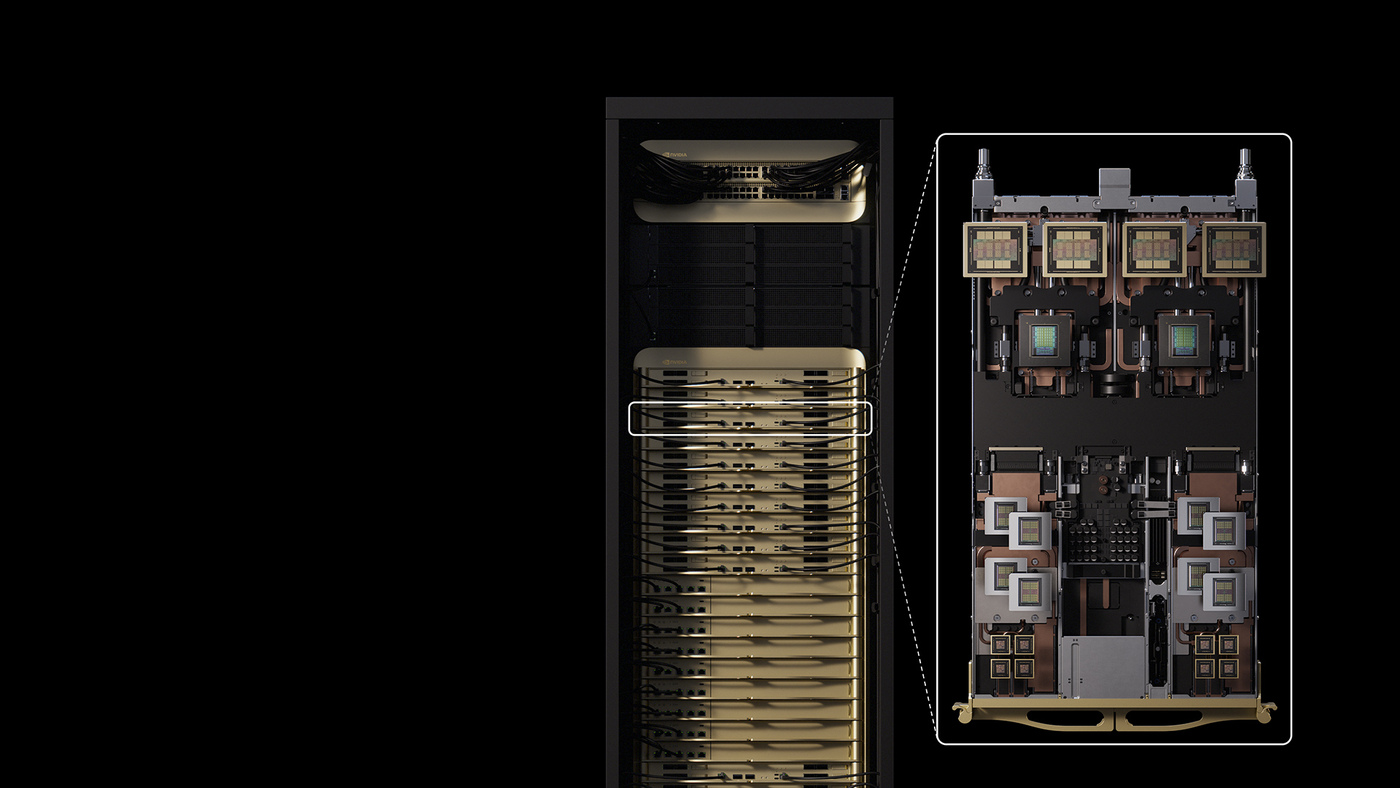 Image: Nvidia
The warning about neoclouds lands in a tense week for AI spending. Alphabet and Microsoft report quarterly results on Wednesday and Amazon on Thursday, CNBC noted, and investors will be looking for signs that the hundreds of billions going into data centers are turning into revenue fast enough to justify the borrowing.