Business
Rakuten and AST SpaceMobile Form a Joint Venture to Beam Broadband From Space Straight to Phones in Japan, Backed by About $1 Billion
Rakuten AST will build a Japanese-run satellite network that connects to ordinary smartphones, with up to 148 billion yen in government support and a target of service by the end of March 2029.
Tokyo · Elena Vos, Business · Nov 9 2026
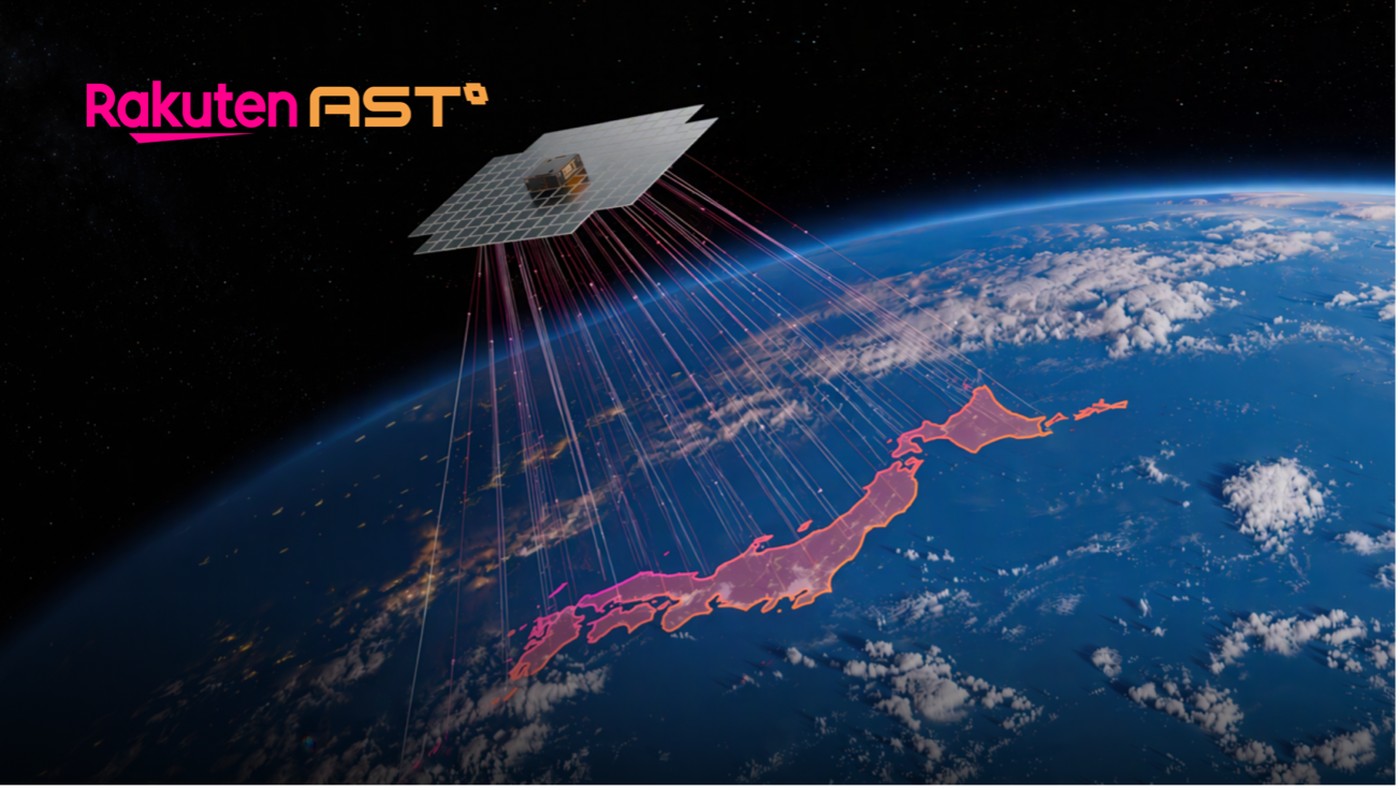
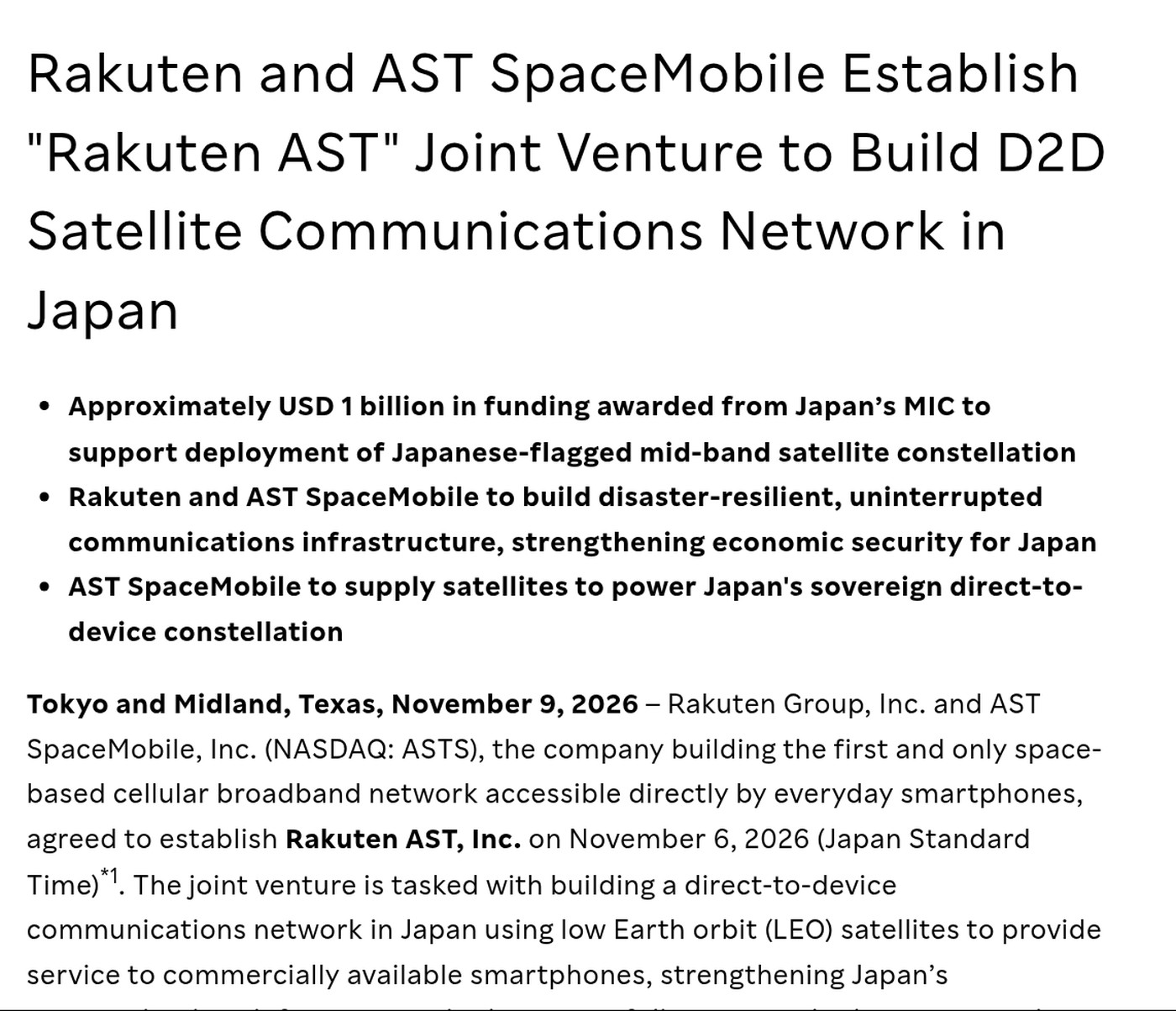
TOKYO - The phone already in your pocket could one day get a signal from orbit over a mountain pass or after an earthquake knocks out the towers, with no satellite dish or special handset. Rakuten Group and AST SpaceMobile said on Monday that they had agreed to set up a joint venture, Rakuten AST, to build a direct-to-device satellite network in Japan that works with commercially available smartphones.
The venture is the vehicle for Rakuten’s winning bid in J-LEO, a Japan Low Earth Orbit satellite communications project put out for public solicitation by the Ministry of Internal Affairs and Communications. Rakuten AST is expected to receive up to 148 billion yen, about $1 billion, in support over roughly three years, paid through the Communications and Information Network Association of Japan. The companies say they aim to start domestic operations by the end of March 2029.
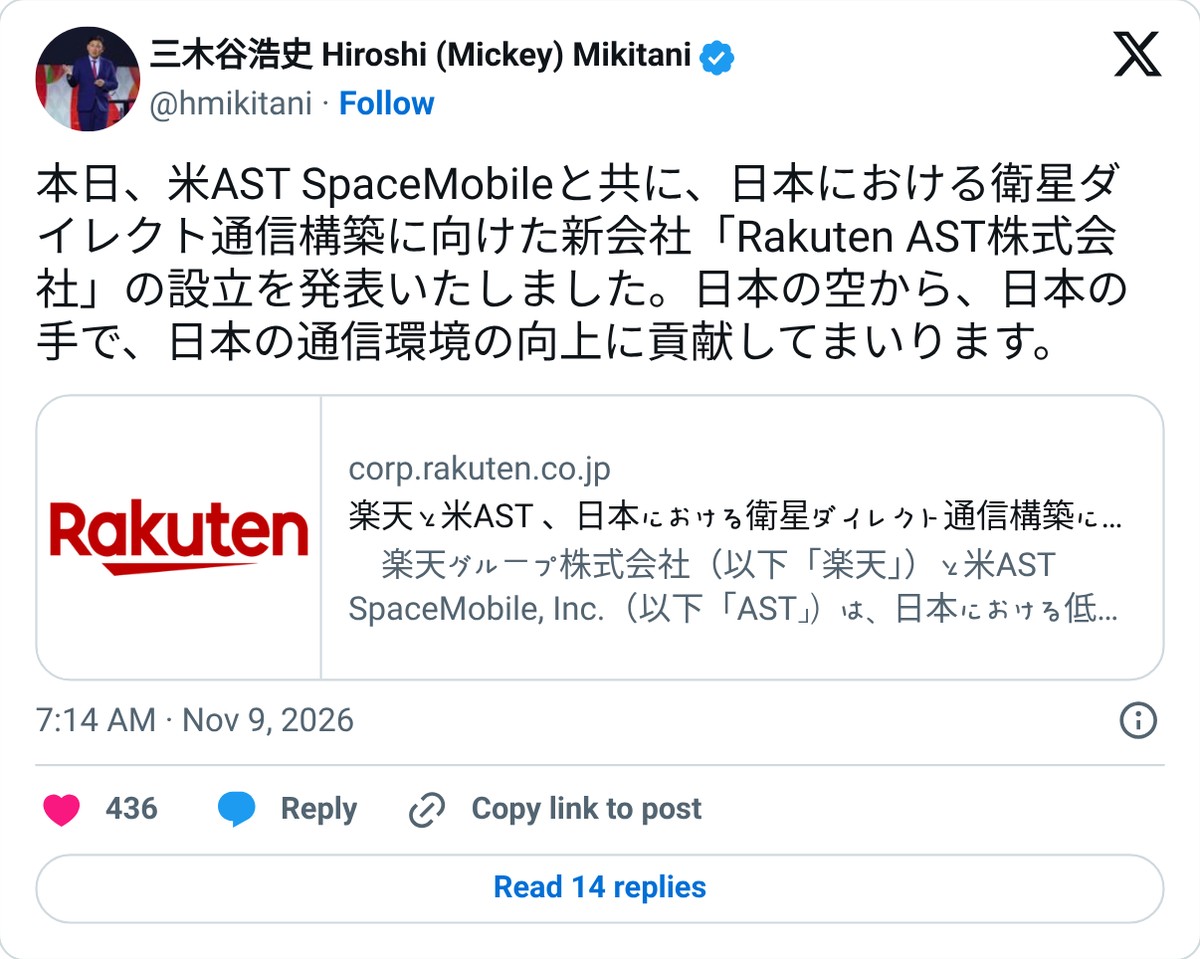 Screenshot: @hmikitani on X
Rakuten will hold 51% of the voting rights and a Japanese subsidiary of AST SpaceMobile the other 49%. The company will be based in Setagaya, Tokyo, with legal capital of 100 million yen, and will be led by Ryoji Osaka as representative director and chief executive. Its job is satellite procurement and the operation of satellite connectivity. AST, based in Midland, Texas, will supply the satellites.
The selling point for owners of regular phones is speed. Rakuten says the network will support high-speed internet such as video streaming and social media on off-the-shelf handsets. AST says its next-generation satellites will carry the largest phased array ever deployed in low Earth orbit, about 223 square meters, and are designed for peak speeds nearly double those of its first Block 1 BlueBird satellites, which reached a peak downlink of 98.9 megabits per second in tests with standard smartphones.
Control is the other half of the pitch. Because the base station equipment sits on the ground in Japan, Japanese carriers can manage the network themselves, and the plan includes a framework for emergency roaming among mobile operators during disasters. At a briefing on Monday, AST chief operating officer Shanti Gupta said the J-LEO constellation would use about 40 to 50 satellites and aim for coverage at least 70% of the time, Japanese outlet Mobile Laby reported. The network will use Rakuten Mobile’s 1.7GHz mid-band spectrum and fly at about 690 kilometers, with orbits tilted to 43 degrees instead of the 53 degrees AST uses now, so the satellites spend more time over Japan. Mikitani said he wants to open the network to other carriers’ customers in a major disaster, and AST is in talks with Mitsubishi Heavy Industries about launches, the outlet reported.
 Screenshot: Rakuten
“This project is a key pillar of Rakuten Mobile’s network strategy,” said Mickey Mikitani, Rakuten Group’s chairman and chief executive. Abel Avellan, AST SpaceMobile’s founder, chairman and chief executive, called it “a significant milestone” that “validates the importance of space-based cellular broadband connectivity.” On X, Mikitani wrote in Japanese that the service would improve Japan’s communications “from Japan’s skies, by Japanese hands.”
Rakuten AST also plans to offer capacity to AST customers outside Japan, subject to regulatory approval, and Rakuten Mobile will work with AST on AI-driven spectrum management and services for industries like logistics, construction and agriculture. Separately, Rakuten Mobile still plans to begin commercial-environment testing of its existing satellite-to-phone service, built on its 2020 partnership with AST, within 2026. Mikitani told reporters the test would carry no extra charge for now, but hours will be limited at first because AST had only 13 satellites in orbit, Mobile Laby reported. AST says it has agreements with about 60 mobile operators covering more than 3 billion subscribers, including AT&T, Verizon and Vodafone. For Rakuten’s customers, the timetable is the story: a test service this year, and a Japanese-run network from space by spring 2029.