Business
Qualcomm's Phone Chip Revenue Falls 26% as Memory Costs Hit Smartphones, While Car Chips Jump 89%
The chipmaker beat estimates for its fiscal fourth quarter but guided light, and the stock slid 7% after hours. It says revenue outside phones will grow more than 60% next year, with a new SpaceX deal in the mix.
San Diego · Elena Vos, Business · Nov 5 2026
SAN DIEGO - The memory squeeze on smartphones now shows up plainly in the results of the company whose processors and modems power a large share of the world’s Android phones. Qualcomm said on Wednesday that revenue from handset chips fell 26% in its fiscal fourth quarter, to $5.14 billion from $6.96 billion a year earlier.
Phone makers are raising prices because memory costs are rising, and that is hurting demand, CNBC reported. Qualcomm raised its own prices in September. In its results, the company said the chip industry faces “a broad-based increase in input costs across wafer fabrication, assembly, test, advanced packaging, memory and other materials,” and that it expects the full benefit of its pricing actions to reach chip gross margins in the second half of fiscal 2027.
For the quarter ended Sept. 27, revenue was $10.32 billion, down 8%, or $10.44 billion on an adjusted basis, down 7%. Adjusted earnings of $2.17 a share edged past the $2.16 analysts expected, according to LSEG figures cited by CNBC. The outlook was softer. Qualcomm guided to $10.4 billion to $11.2 billion in revenue for the December quarter and adjusted earnings of $2.15 to $2.35 a share, against analyst expectations of $2.27. The stock slid 7% in extended trading.
 Screenshot: @Qualcomm on X
There were signs of a floor in phones. Qualcomm said handset sales are starting to grow again from quarter to quarter and that Android shipments in China have bottomed, CNBC reported, though the company expects the handset market to be flat in 2027.
The rest of the business is moving the other way. Automotive revenue jumped 89% to $1.99 billion, and Internet of Things revenue, which covers chips for laptops, smart glasses and other connected devices, rose 4% to $1.89 billion. Licensing revenue fell 7% to $1.30 billion. During the quarter Qualcomm renewed long-term license agreements with Apple, Huawei and Transsion.
“Fiscal 2027 marks the start of our non-handset revenue inflection, including the ramp of our Data Center business,” Cristiano Amon, Qualcomm’s chief executive, said in the earnings release. “Non-handset revenues are projected to grow by more than 60% year-over-year, and we are reiteating our fiscal 2027 Data Center revenue target of $5B.”
Qualcomm said on X that it expects data center revenue in the December quarter to exceed $650 million. Amon said supply, not demand, is the limit in data centers. “We don’t have a demand issue; it’s a supply issue,” he said, according to CNBC. “If I had more supply, I would probably be doing better.”
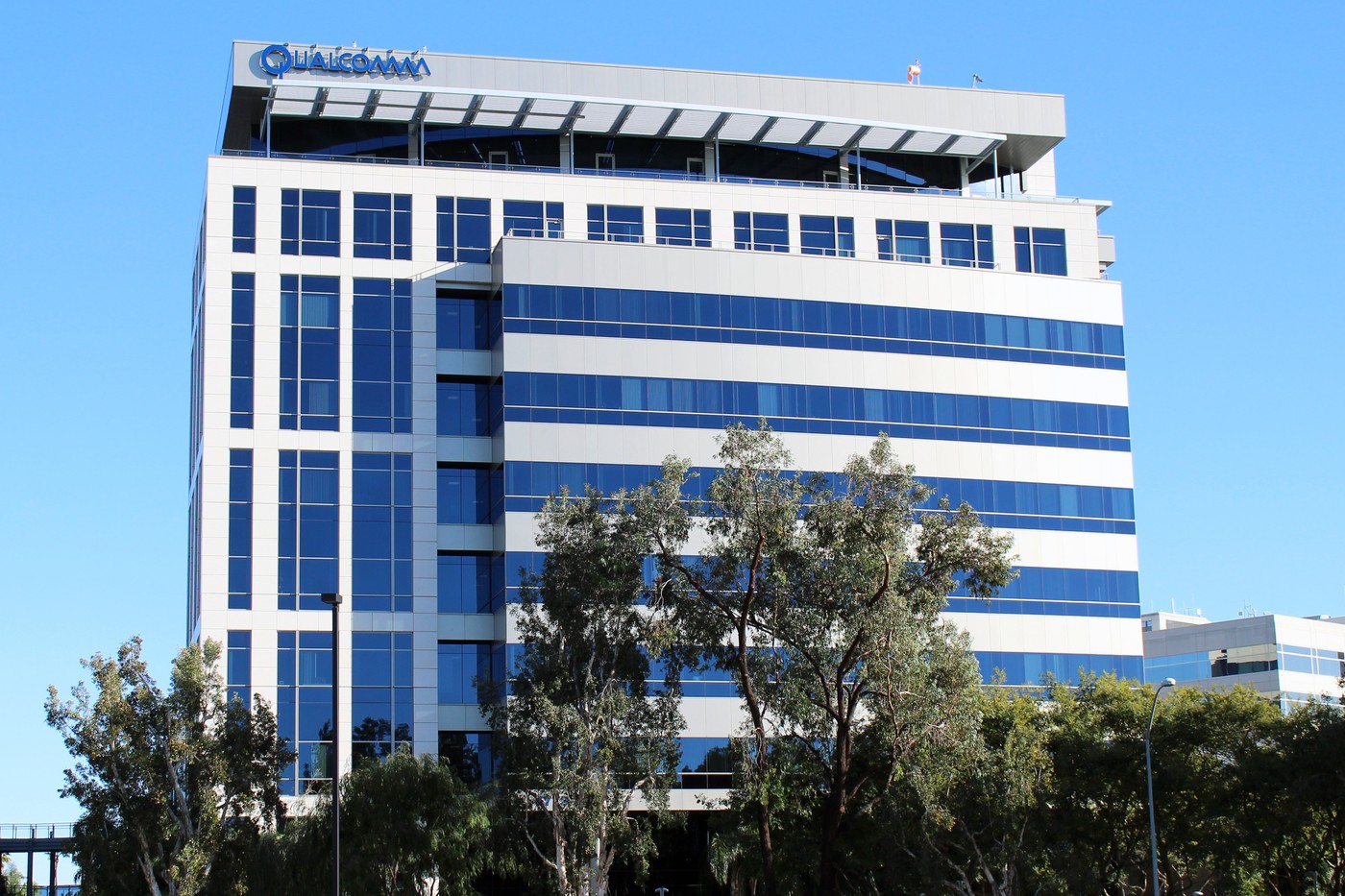
 Image: Qualcomm
Earlier on Wednesday, Qualcomm announced that SpaceX had picked its Dragonwing QRU100 and QDU100 platforms for Starlink Mobile’s planned nationwide terrestrial 5G network in the United States. SpaceX plans to begin deployment in 2027, with “tens of thousands of sites” over the multiyear agreement. “We shouldn’t live in a time where phone calls are still dropping whether you’re at home or on-the-go,” said Michael Nicolls, senior vice president of Starlink.
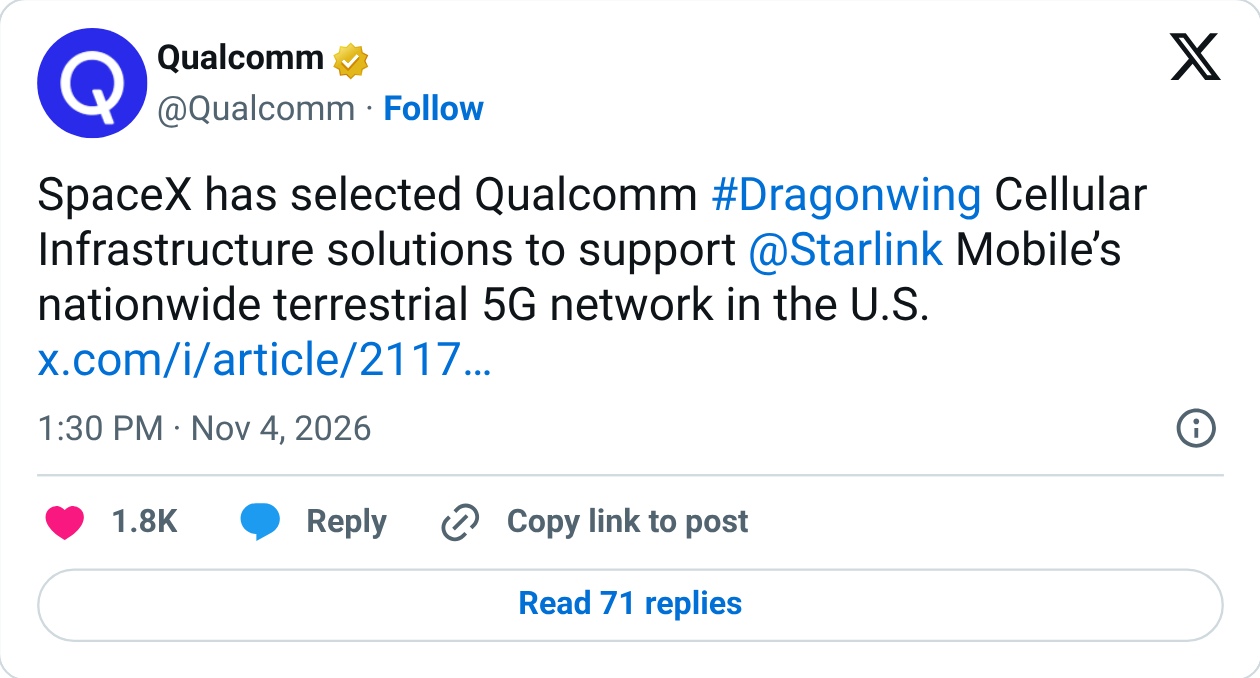 Screenshot: @Qualcomm on X
For the full fiscal year, Qualcomm reported revenue of $43.1 billion, down 3%, and earnings of $12.70 a share. That per-share figure includes a $5.7 billion income tax benefit, or $5.32 a share, from the release of a valuation allowance.