Opinion
Opinion: OpenAI and Anthropic Are Playing Different ARR Games. Wall Street Will Not.
A $20 billion gap between OpenAI's $50 billion run rate and last month's $70 billion headlines is mostly an accounting choice. Before either company lists, investors need one scoreboard.
LOS ANGELES · Marcus Reid, Opinion · Oct 9 2026
LOS ANGELES - On Friday morning, the AI trade got a reminder that a headline number is only as honest as the footnotes. OpenAI told investors its September annualised revenue was approaching $50 billion. Late last month, media outlets had put the figure near $70 billion. The Financial Times, Reuters and The Irish Times all say the gap is mostly about how you count, not about ChatGPT suddenly losing a third of its customers.
That distinction matters. It also does not fully rescue the industry from the mess it invited.
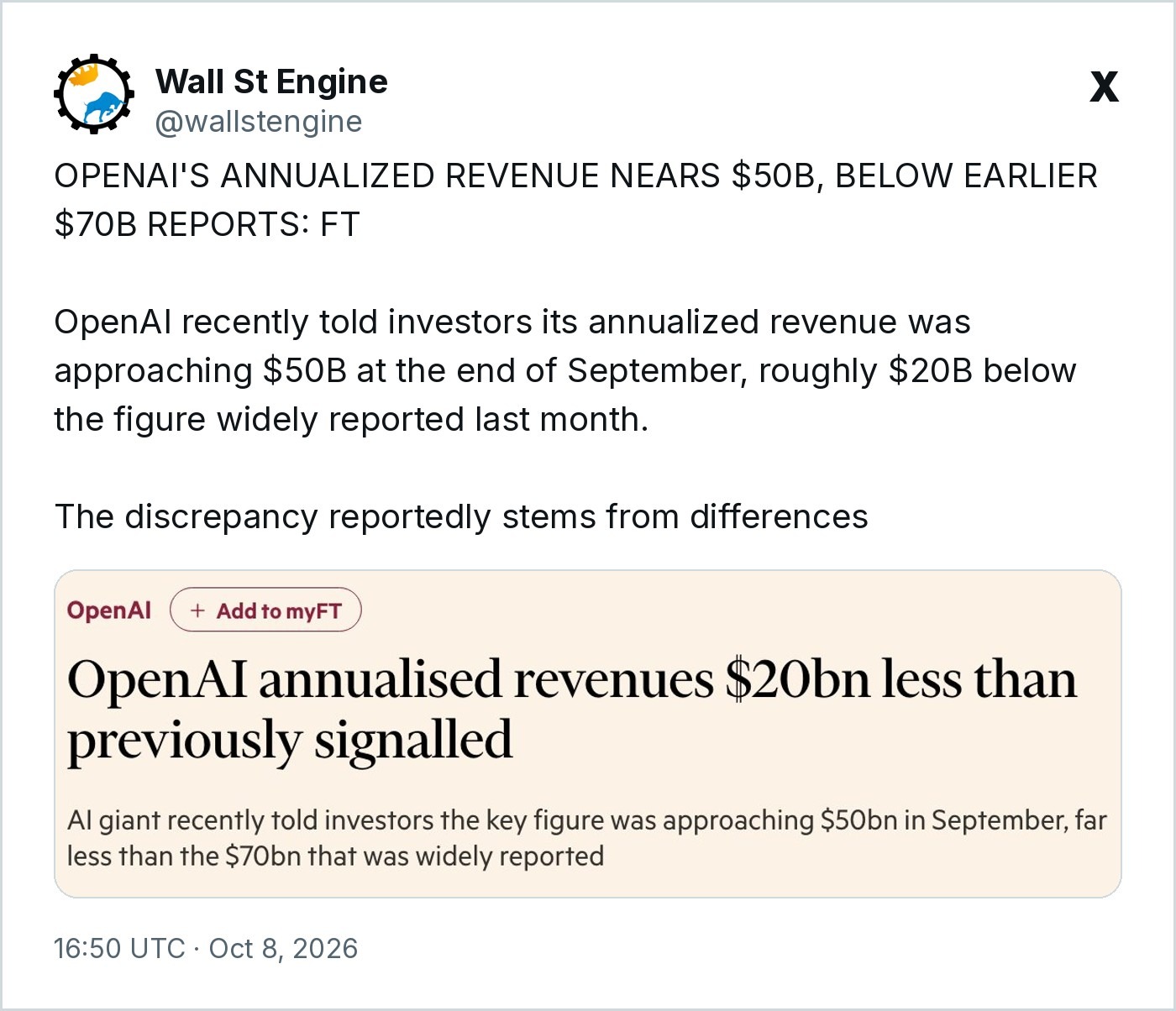
OpenAI excludes revenue from sales through cloud partners. Anthropic includes it. Investors who wanted an apples-to-apples comparison “grossed up” OpenAI’s number, and the adjusted figure became the story. When OpenAI later told backers that revenue had grown more than 70 percent from that inflated base, the $70 billion estimate followed. The company’s own documents put the run rate near $50 billion. Same business. Different scoreboard.
Annualised revenue, or ARR-style run rate, is usually one month multiplied by 12. It assumes the next eleven months look like the last one. Startups love it because it makes growth look permanent. Public markets are less romantic. When OpenAI and Anthropic eventually list (OpenAI has already delayed a fall IPO that many expected, while Anthropic is widely tipped for next month), underwriters and the Securities and Exchange Commission will force a clearer view of what is subscription, what is API, what is cloud-partner pass-through, and what is one-off.
Until then, the industry is asking investors to fund data centres, chip orders and SoftBank-scale leverage on a metric that can swing $20 billion depending on whether you copy Anthropic’s spreadsheet. SoftBank’s Masayoshi Son is separately seeking up to $100 billion from Gulf investors for a new AI fund, the FT reported Friday, after completing a $30 billion OpenAI cheque and selling $11.1 billion of junk bonds last month. That is a lot of borrowed and sovereign money riding on numbers that still need a legend.
My ask is not that OpenAI or Anthropic change how they manage their private books tomorrow. Private companies can report what their investors agree to. My ask is that both companies, and the reporters who amplify their figures, stop letting rival definitions travel as if they were the same fact. If Anthropic’s cloud-partner revenue is real demand, say so and show the take rate. If OpenAI’s partner sales sit outside its run rate, say so in the same sentence as the number. A $50 billion business that grew more than 70 percent is still extraordinary. Pretending it was $70 billion, then walking it back, teaches the market that AI ARR is a mood.
The IPOs will settle this the hard way. Until then, treat every billion-dollar run-rate headline as a question: according to whose rules?