Opinion
Opinion: Microsoft's 60,000-Person Buyout Is Kinder Than a Layoff. It Still Shows Where the Money Is Going.
Letting people choose to leave is a better way to shrink a company. But a voluntary exit offer to a quarter of the workforce, two days before earnings, is also a budget decision about AI.
Redmond, Wash. · Marcus Reid, Opinion · Oct 27 2026
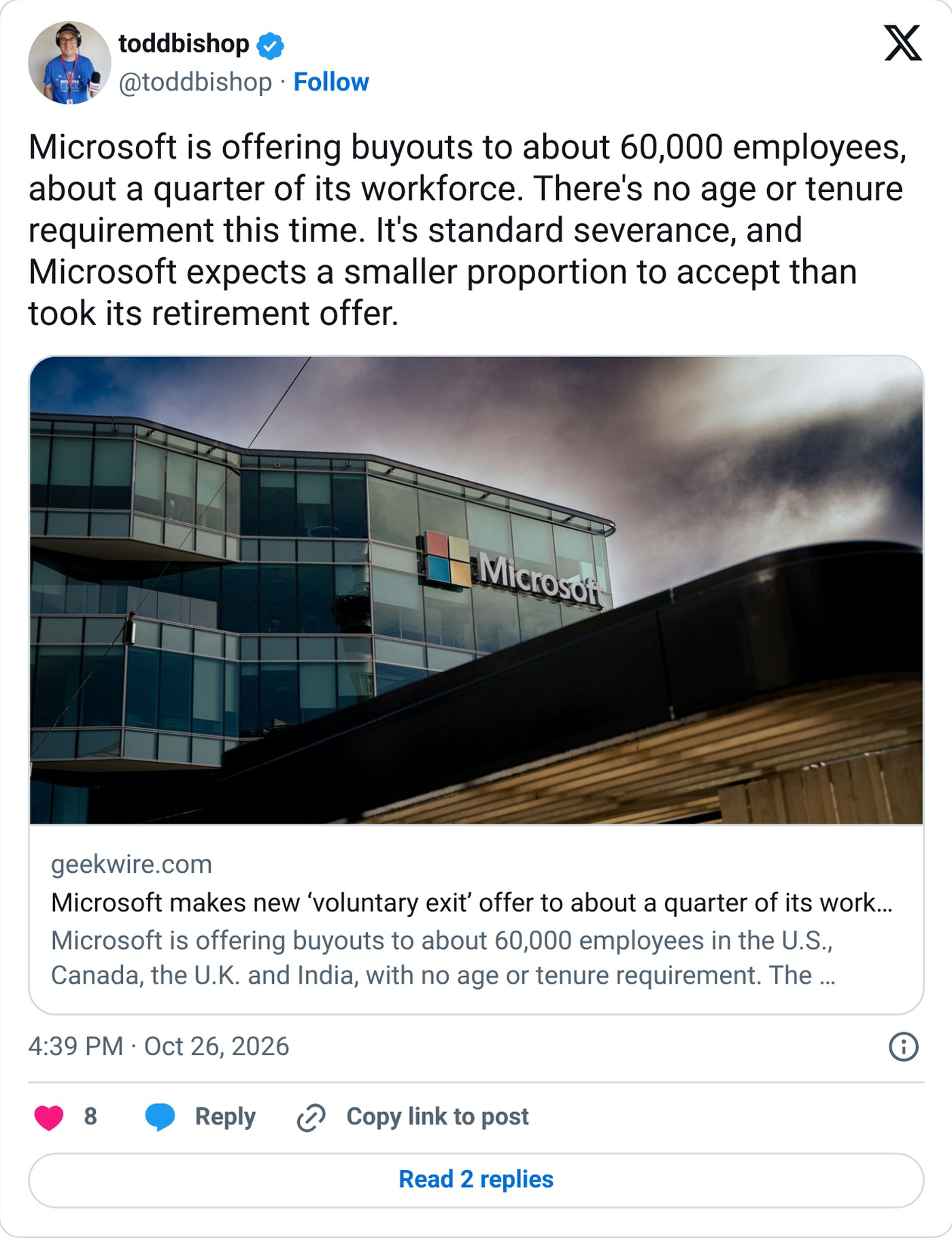
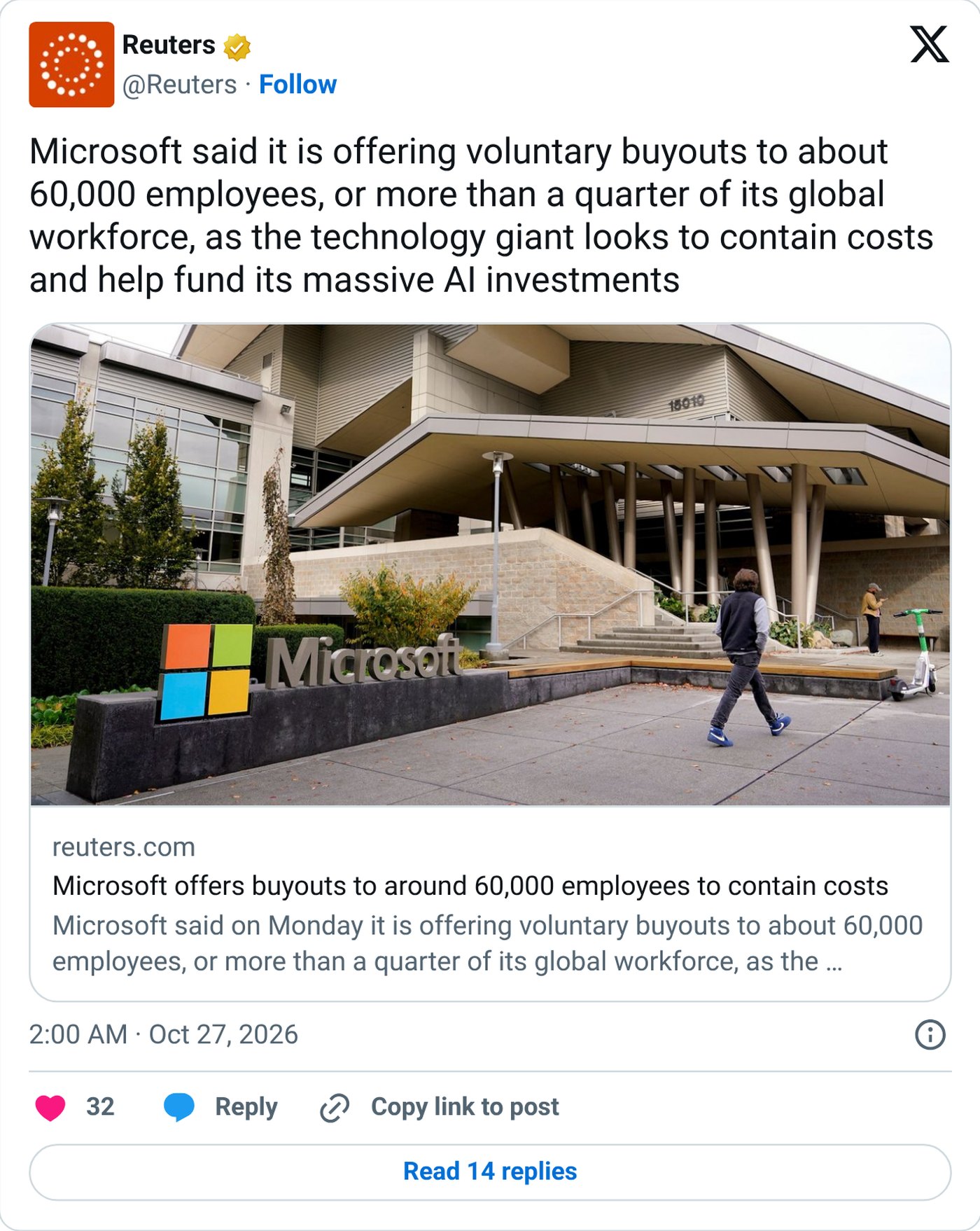
REDMOND, Wash. - Give Microsoft credit for one thing. On Monday it chose to ask before it cuts. The company introduced a Voluntary Exit Offer for eligible employees in participating teams in the United States, Canada, the United Kingdom and India, at internal level 70 and below. About 60,000 people are eligible, roughly a quarter of its 223,000 staff, GeekWire and CNBC reported. That is a lot of email inboxes lighting up at once.
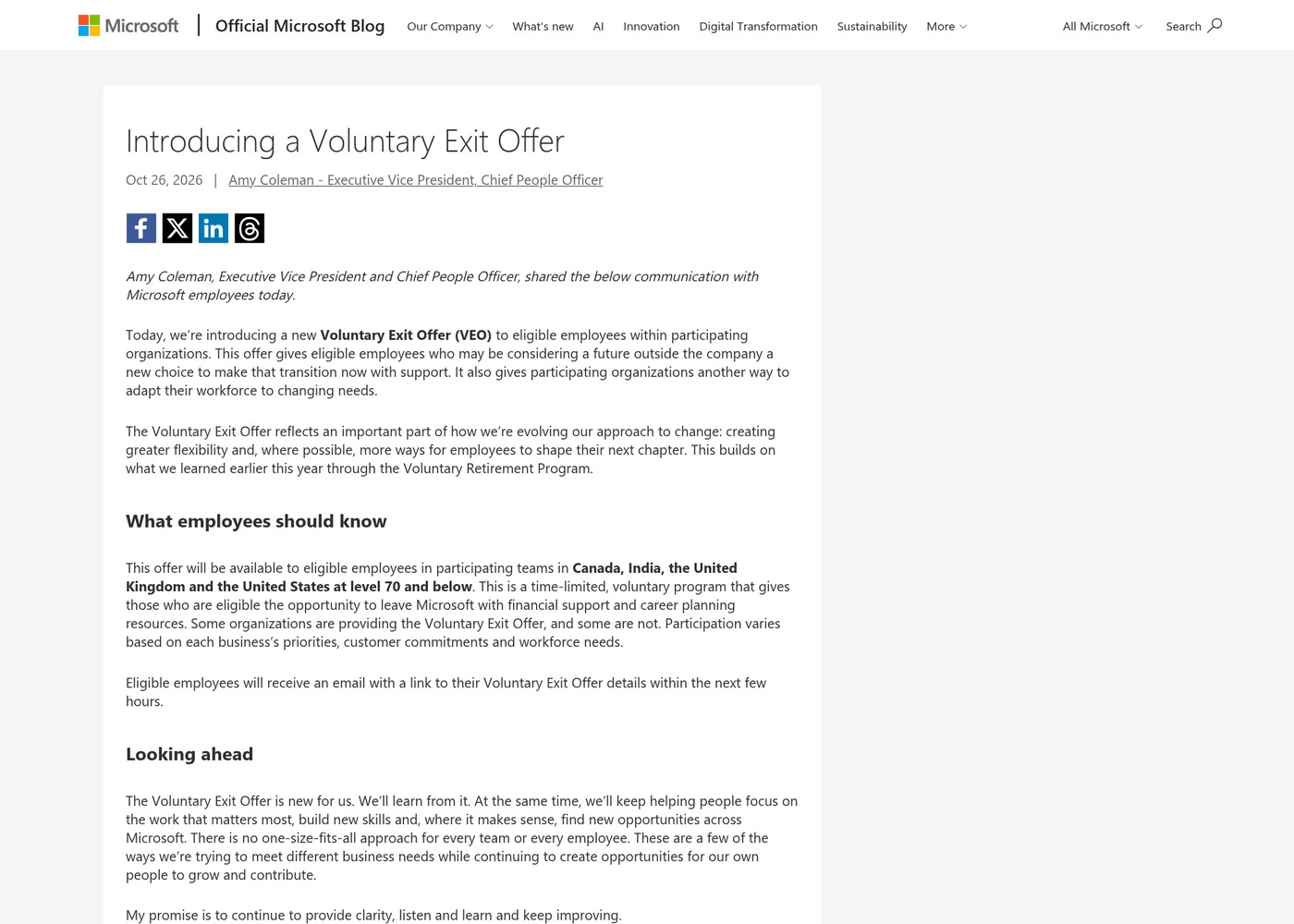 Image: Microsoft
The offer itself is decent, if not generous. According to GeekWire, the package matches Microsoft’s standard severance: base pay tied to tenure and level, continued stock vesting, a fixed period of healthcare and career transition services. There is no age or tenure test, and performance is not a factor. Employees have until early December to decide, and those who accept leave on Dec. 31, CNBC reported.
 Screenshot: @toddbishop on X
Compared with the alternative, this is the better way to shrink a company. A layoff lands on people. A buyout lets the person who was already halfway out the door, the engineer with a startup idea or the manager ready to move home, raise a hand and leave with a cushion. The people who want to stay are spared the dread of a surprise calendar invite. Chief people officer Amy Coleman wrote in her memo that the offer gives employees “a new choice to make that transition now with support.” That is a fair description, and other big tech companies that default to layoffs should take notes.
But do not mistake kindness for a change of direction. Microsoft told GeekWire the offer is not a replacement for layoffs, which it said will remain part of its approach depending on business conditions. It cut 4,800 jobs in July and more in September. And the timing is hard to ignore. Capital spending for the September quarter was expected to top $50 billion, CNBC noted, against $34.9 billion a year earlier, as Microsoft builds data centers for its own AI products and for customers such as OpenAI and Anthropic. Microsoft reports earnings on Wednesday. A voluntary program lets the company trim payroll without the headlines of a mass layoff, right as investors ask how long the AI build-out can run before it pays back.
 Screenshot: @Reuters on X
There is also a quieter problem with who gets to decide. Microsoft is leaving it to individual business leaders whether their groups take part. Sales is out, as are some engineering groups and corporate functions. That makes sense for the business, but it means the people most exposed are the ones whose teams leadership has decided it can live without. When a company that sells AI productivity tools tells a quarter of its workforce that the door is open, employees will read that as a message about which jobs it thinks software can absorb, whatever the memo says.
Microsoft says it expects far fewer takers than the roughly 30 percent who accepted its spring retirement offer. Maybe so. The test of this program is not the acceptance rate. It is whether, a year from now, the people who stayed are doing better work with better tools, or simply doing the work of the people who left. Microsoft should tell us which one it gets.