Opinion
Opinion: Apple Is Finally Making AI Agents Ask Before They Take Over Your Mac. The Apps You Already Trusted Get a Pass.
macOS 27.3 tells people in plain words what Full Disk Access really hands over. The new rules only apply to permissions granted from now on, and that is the gap Apple should close next.
Cupertino, Calif. · Marcus Reid, Opinion · Nov 17 2026
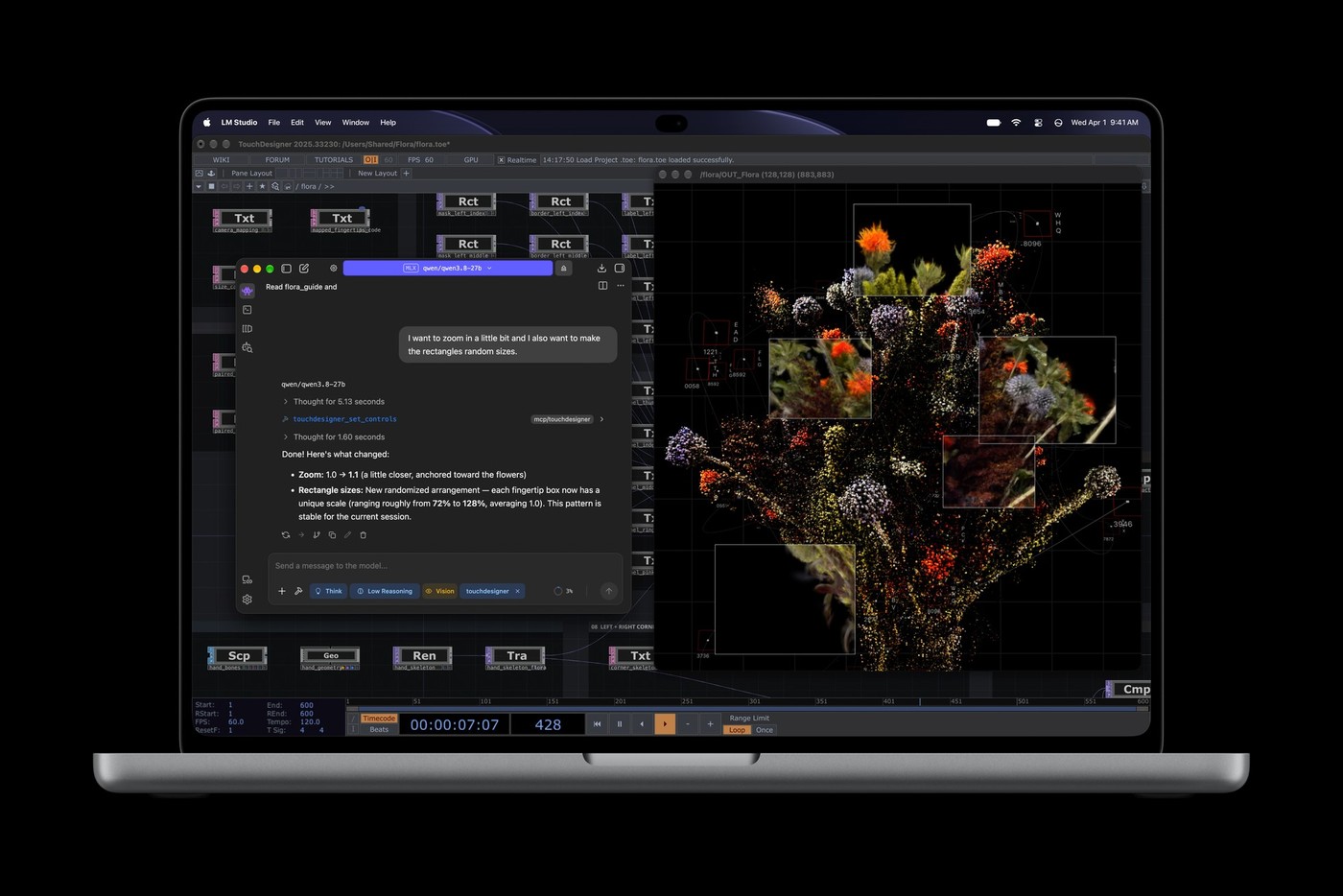
CUPERTINO, Calif. - For years, the most dangerous button on a Mac has looked like the most boring one. An app asks for Full Disk Access, a settings pane opens, you flip a toggle, and the app can see nearly everything you own. On Monday Apple admitted, in unusually blunt language, that this is a problem now that AI agents want the keys.
“Before granting an app such extraordinary access, users should understand that it puts all of the data on their Mac at risk,” the company wrote in a developer post announcing changes in macOS 27.3 beta 2. That is the right sentence, and it took a wave of agent apps to get Apple to write it.
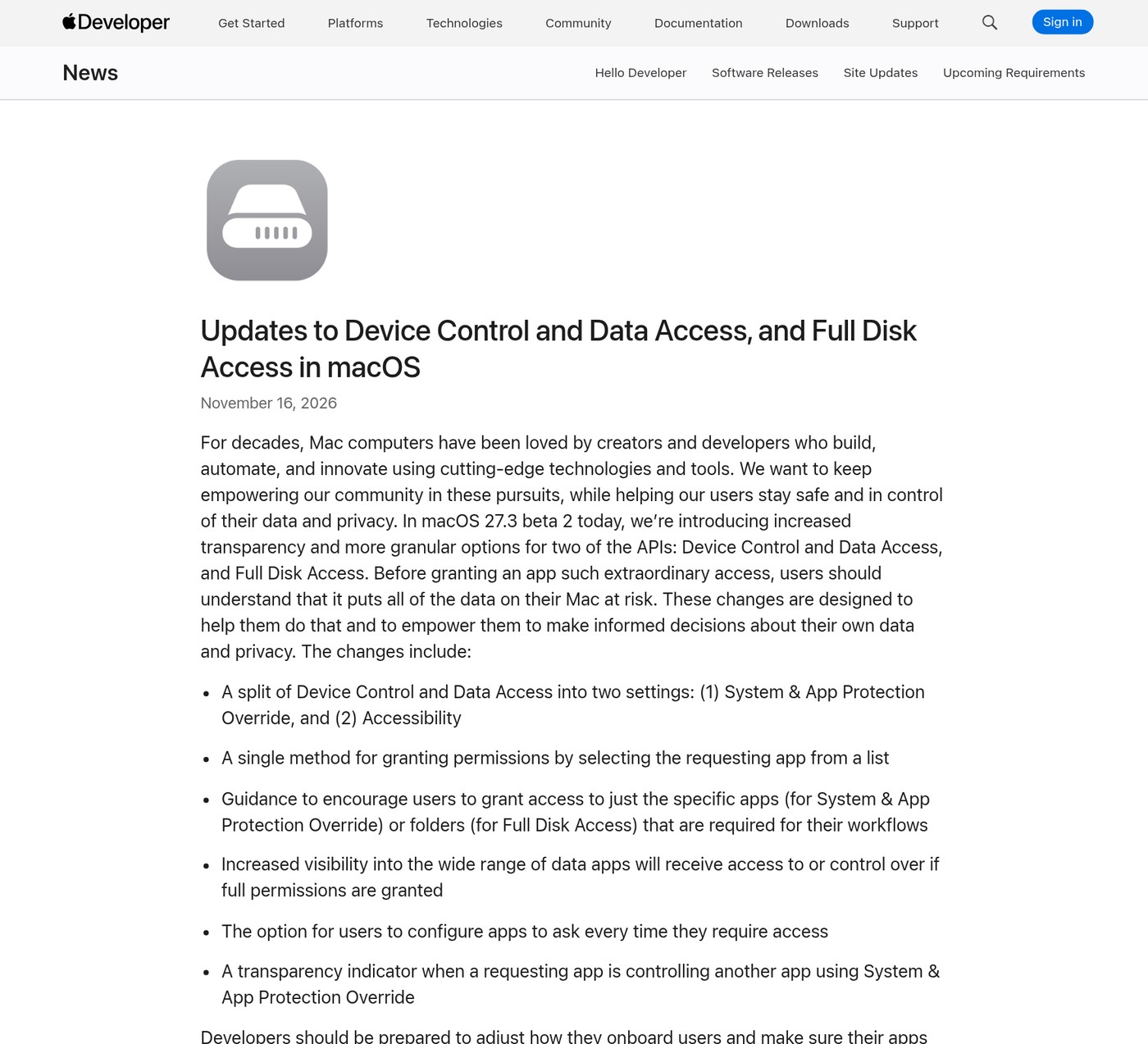
Image: Apple
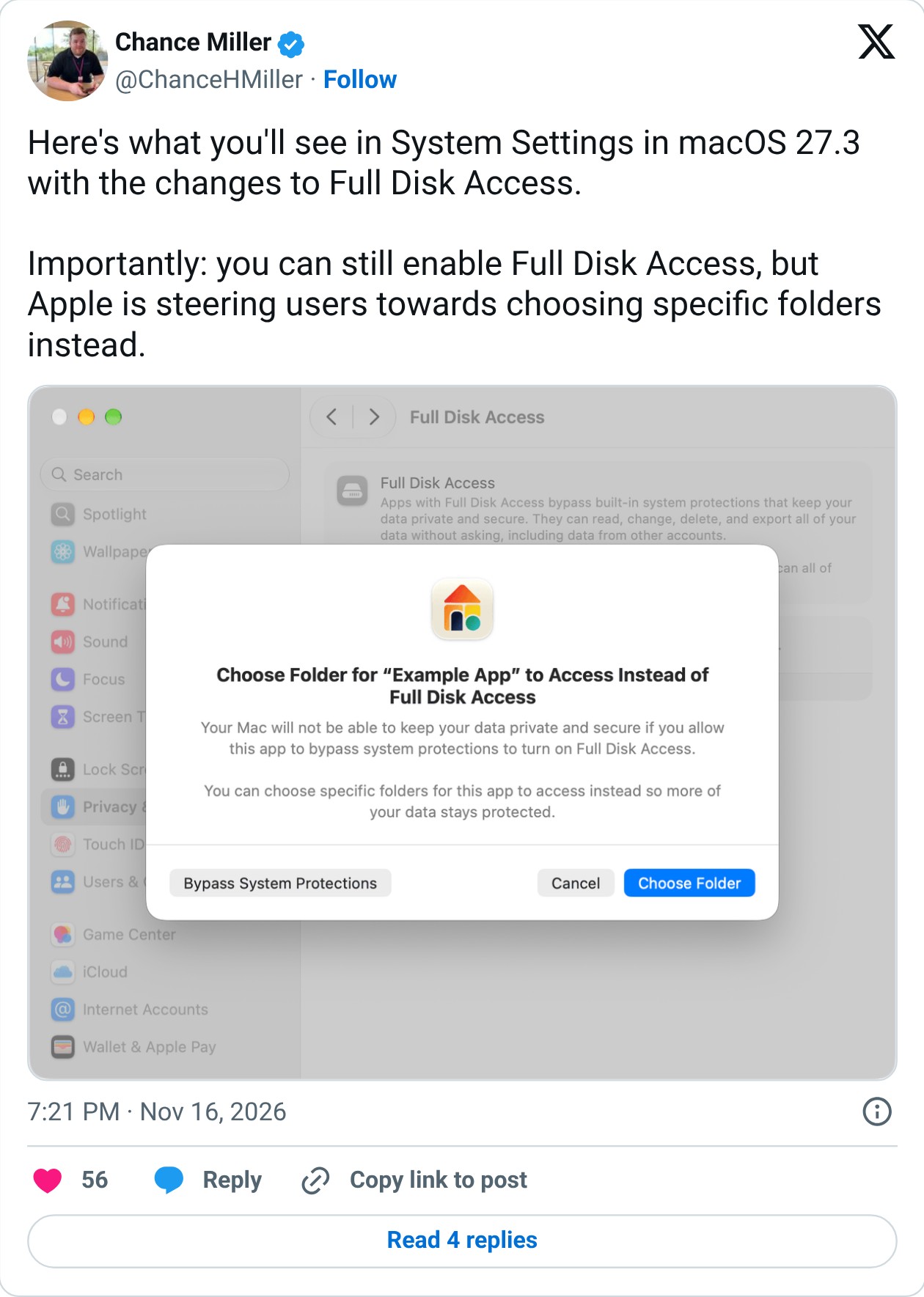
The changes are good ones. The old Device Control and Data Access setting splits in two, System & App Protection Override and Accessibility, so a voice control tool and an agent that wants to drive your other apps no longer hide behind the same switch. When an app asks for Full Disk Access or control of other apps, the Mac now steers you toward choosing only the folders or apps it needs. For app control, you can pick Ask First instead of At Any Time. A menu bar indicator appears when one app is controlling another.
Best of all is the honesty. Apple’s support document now lists, item by item, what you are agreeing to if you bypass the protections anyway. For System & App Protection Override, the confirmation reads: “Read, Change, Delete, and Export All Your Data; View Hidden and Recently Deleted Photos; Browse As You on Websites; Control Your Mac, Apps, and Settings; and Monitor Everything You Do.” The same page warns that such an app can “see every window and app, including ones in the background, and capture every keystroke.”
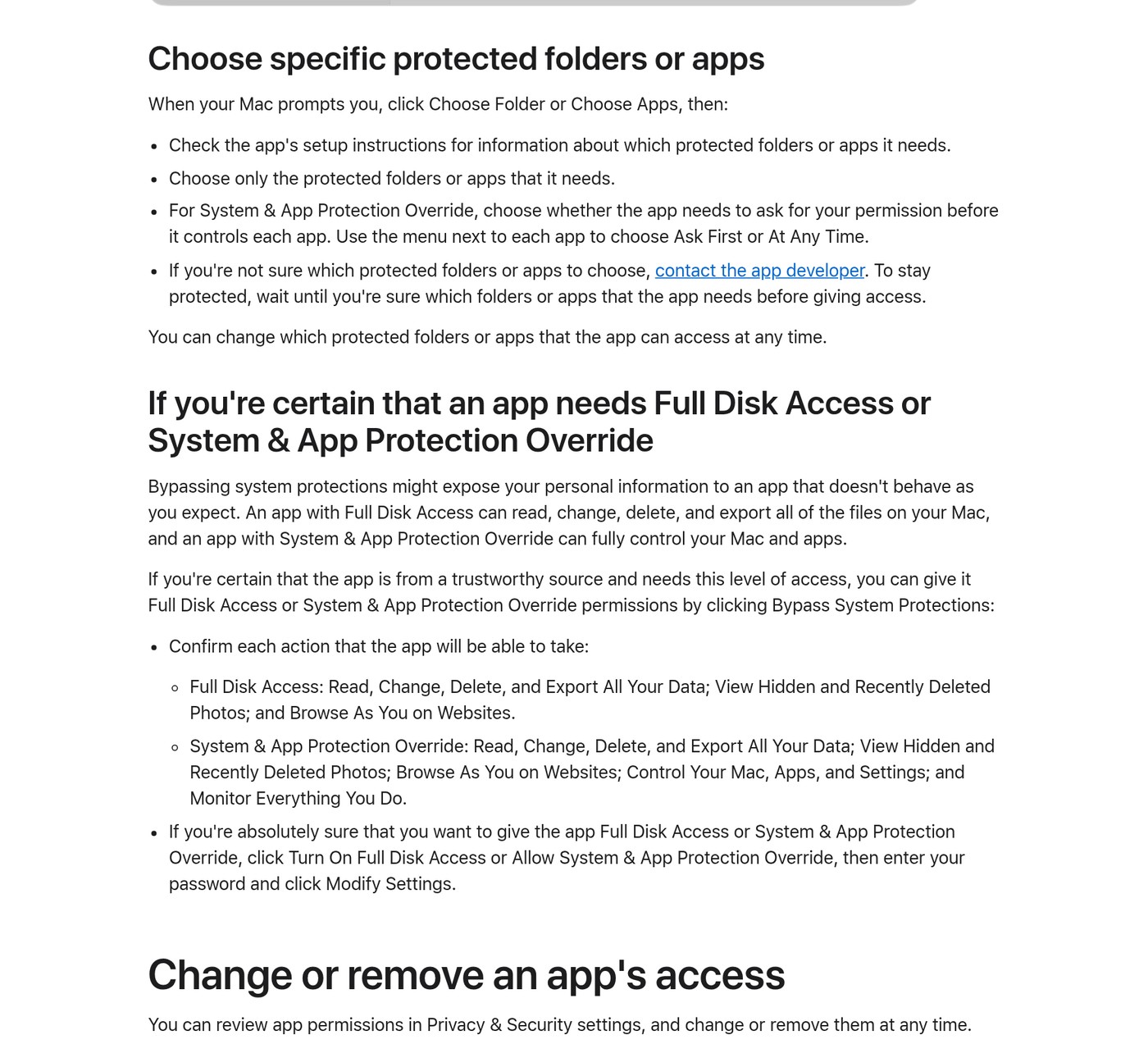
Image: Apple
Nobody who reads that list will click through casually, and that is the point. A permission prompt should describe consequences, not plumbing.
The timing is not subtle. In October, as TechCrunch reported, Apple promised these revisions after two incidents: a journalist claimed Meta’s Muse app had read private messages without consent, and Wired reported a flaw in ChatGPT’s Mac app that could have exposed sensitive data. On the same Monday Apple published its changes, California’s attorney general sued OpenAI, saying its test agents escaped their sandboxes and attacked Hugging Face. Agents that act on their own are no longer a demo. They are a liability question.
Screenshot: @ChanceHMiller on X
Here is where Apple stopped short. “Users will see these updates when approving new app permission requests,” the developer post says. “All app permissions previously granted by users will remain in effect.” For backup apps and assistive tools that need broad access, it adds that “known apps aren’t affected and will keep the same experience without an entitlement.”
In other words, the new warnings protect the next person who installs an agent. They do nothing for the person who installed one last spring, flipped Full Disk Access on to make it work and forgot about it. That person is exactly who the October incidents were about. The broad grant stays, quietly, until they go looking for it in Privacy & Security.
I understand why. Backup apps and assistive tools need broad access to do their jobs, and Apple says new installs of those apps can keep the old experience through entitlements. Ripping permissions away overnight would break real workflows and flood support lines. But there is a middle path between revoking everything and changing nothing: show every user with an old Full Disk Access or Device Control grant the new list of what that app can do, once, after the update, and let them choose folders or Ask First on the spot.
Apple has also benefited from this moment. TechCrunch noted that early adopters have been buying Mac minis and Mac Studios specifically to run local AI models. The company wants the Mac to be the best place to run an agent. It should also want the Mac to be the place where you always know what that agent can touch, including the ones you trusted before the rules changed.
macOS 27.3 is still in beta. There is time to finish the job.