Opinion
Opinion: Anthropic's 40% Government Discount Ends the $1 AI Deal. Paying by the Token Is Fairer, and Harder to Budget.
Washington's new Claude agreement swaps teaser pricing for consumption billing with no minimums. That is a better deal for taxpayers on paper, but only if agencies put a meter on it.
Washington · Marcus Reid, Opinion · Oct 28 2026
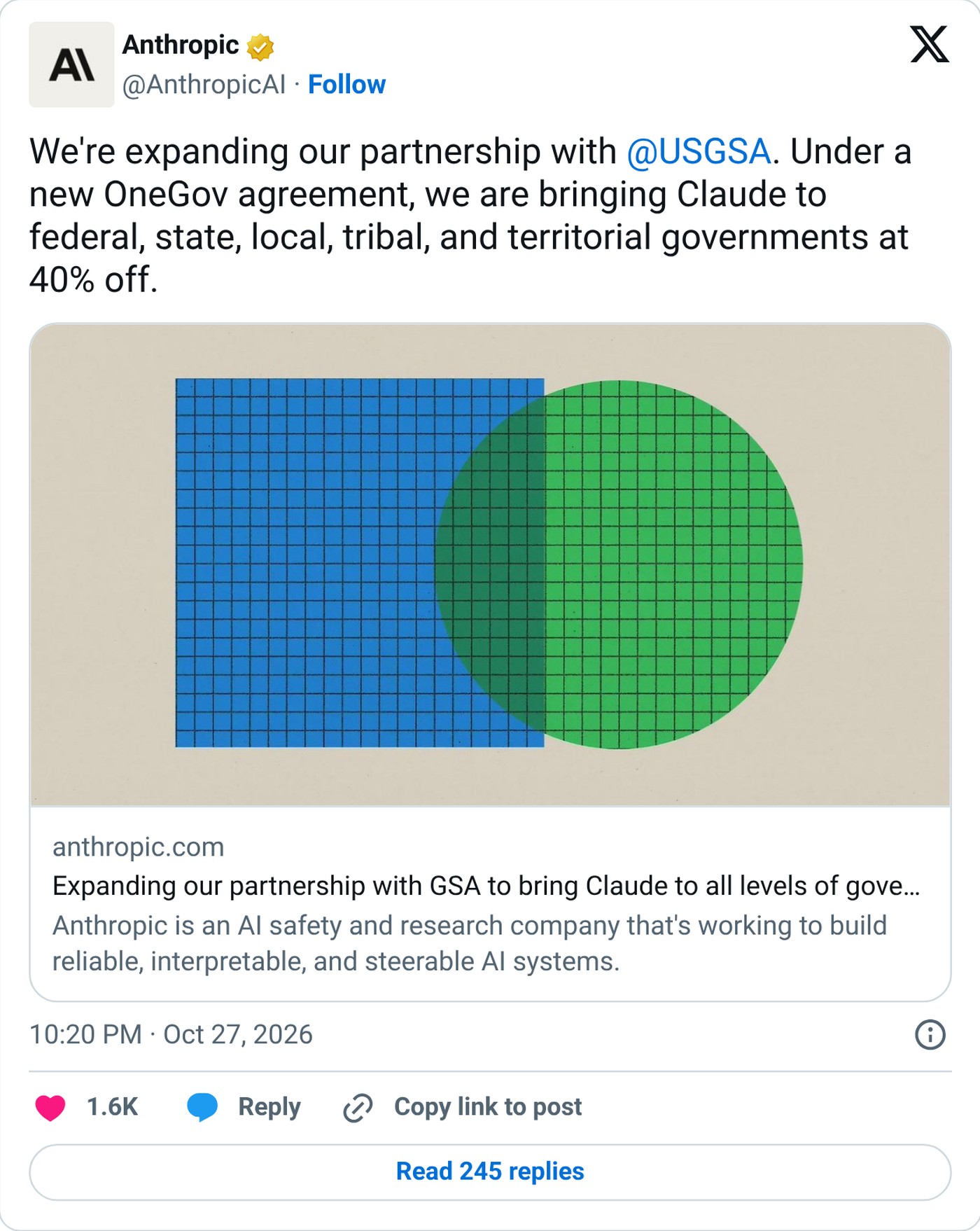
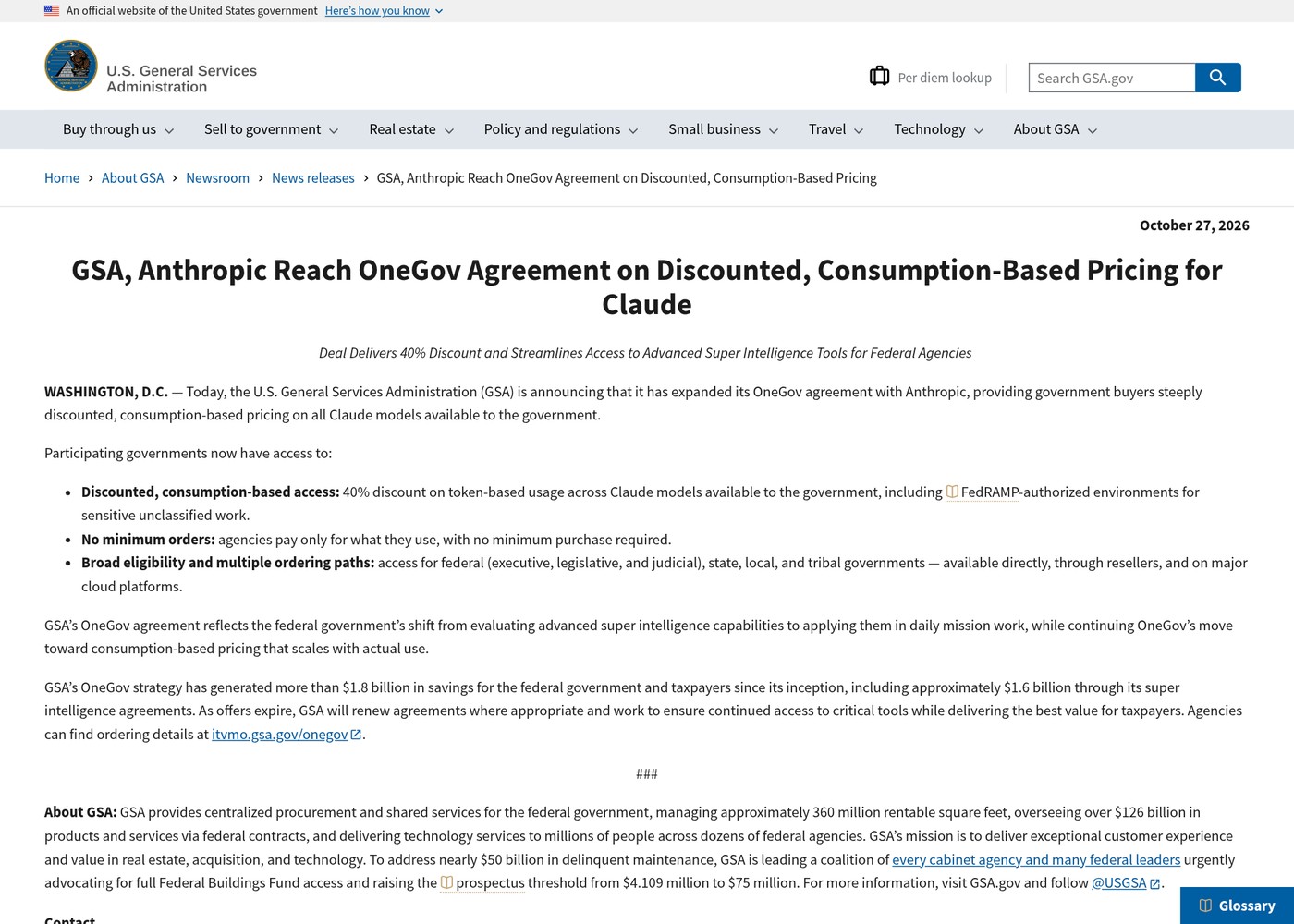
WASHINGTON - The era of the $1 AI deal for government is ending, and what replaces it is more honest. The General Services Administration said Tuesday that it has expanded its OneGov agreement with Anthropic, giving government buyers a 40% discount on token-based use of Claude models, with no minimum purchase. Federal, state, local and tribal governments are all eligible. Anthropic says the discount covers Claude Enterprise, Claude for Government and the Claude API, and estimates it will save the government $1 billion.
 Screenshot: @AnthropicAI on X
It helps to remember what came before. Anthropic’s original government offer was $1 per user for Claude for Government, a deal it had extended to the end of October, FedScoop reported. OpenAI moved to consumption-based pricing in its own OneGov deal last month. Google is still offering Gemini to agencies for $0.47 per agency, with that offer set to expire Nov. 15. Those teaser prices did their job. They got the tools onto government desks. They also told nobody what the tools would really cost.
The new model is closer to the truth. Agencies pay for the tokens they actually use, which is how most private companies now buy AI, and there are no unused seat licenses gathering dust. Anthropic says about 500 federal, state and local government organizations now use Claude, and that weekly active users of Claude for Government are up about eightfold since February. It points to a Utah pilot in which 34 developers across 10 state agencies used Claude Code, and 71% reported saving more than 20 hours by the end of four weeks. Those are the vendor’s numbers, but they describe real work: backlogs, forms and old code.
 Screenshot: GSA
Here is the catch. A discount on a bill nobody can predict is still a bill nobody can predict. Analysts at Gartner have warned that consumption pricing makes costs hard to forecast because vendors are not transparent about how tokens are counted and billed, FedScoop noted. “A small group of power users can drive a disproportionate share of costs, turning successful AI adoption into both a productivity win and a budgeting challenge,” Tracy Woo, a principal analyst at Forrester, wrote in August. Government budgets are set a year or more ahead. Token use can double in a quarter if a tool works.
That tension is not only an American one. On Monday the Dutch cabinet told parliament it expects about 25,000 fewer full-time central government jobs by 2035, with savings of 900 million euros in 2027 rising to 3.5 billion euros a year from 2035, according to NLnow and Bloomberg. The police and armed forces are exempt, and broader use of AI is part of the plan. The cabinet’s detailed AI goals and savings plans are not due until the first quarter of 2027. The savings target came first. The plan comes later.
 Screenshot: Anthropic
None of this makes the Anthropic deal a bad one. Forty percent off with no minimum commitment is better for taxpayers than a promotional price that has to be renegotiated every few months, and GSA says its OneGov program has produced more than $1.8 billion in savings since it began. But the discount should come with a few simple habits: a usage dashboard for every program, a spending cap that someone has to approve raising, and a public report on what the tokens bought. If governments are going to use AI to justify how many people they employ, they should be able to show the meter.