Business
Microsoft Rolls Out Seven MAI Models at Ignite, Pitching Near-Frontier AI at a Fraction of Rivals' Prices
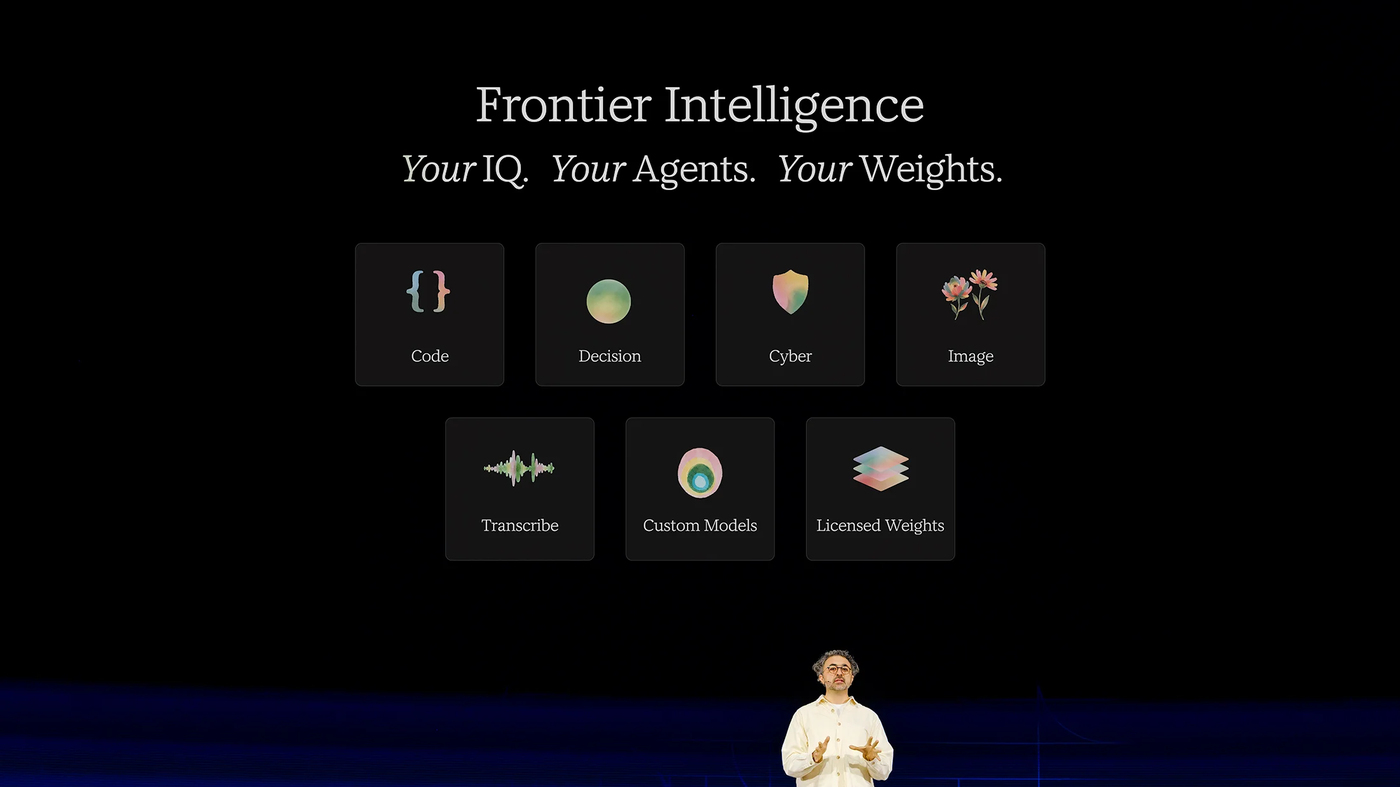
The lineup covers coding, cybersecurity, image editing, voice, transcription and model routing. Microsoft will also let companies license MAI model weights and run customized versions in their own Azure environments.
Redmond, Wash. · Elena Vos, Business · Nov 18 2026
REDMOND, Wash. - Microsoft used its Ignite 2026 conference on Tuesday to release seven new models from its in-house Microsoft AI group, known as MAI, and it measured almost every one of them against OpenAI and Anthropic on price. “As token spend skyrockets, we know that customers also want models at a price point that lets you run agents 24-7 doing real engineering work,” the company said in its announcement.
The centerpiece is coding. Microsoft says MAI Code 2 delivers 98% of the performance of OpenAI’s GPT-6.1 Sol at 40% of the price, and 96% of Anthropic’s Claude Opus 5.5 at 5% of the price, averaged across four coding benchmarks. A smaller MAI Code 2 Flash, built for routine edits and quick fixes, offers performance comparable to GPT-6 Luna and Claude Haiku 5.5 at 65% and 20% of their prices, the company said.
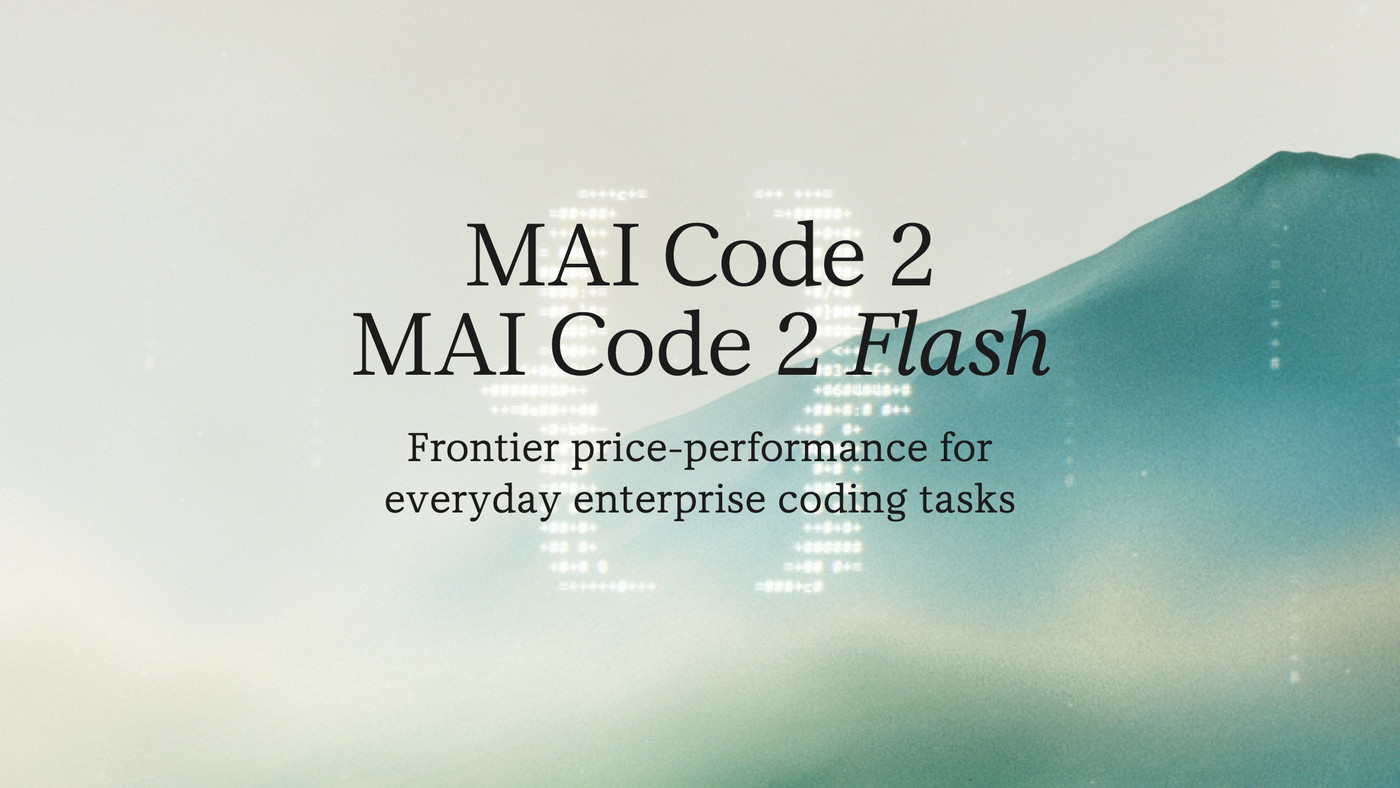
Image: Microsoft
Both coding models are available now in GitHub Copilot. According to GitHub’s changelog, MAI Code 2 is offered on Copilot Pro, Pro+, Max, Business and Enterprise, while Code 2 Flash also reaches the Free and Student tiers. The official Visual Studio Code account said both models are 50% off through May 17, 2027. Microsoft was candid about the limits: it said the models are “explicitly not yet tuned for harder problems, like fundamental science research and very long horizon agentic work.”
In security, MAI Cyber 2 Flash scored 92.3% on the CyberGym-E2E vulnerability discovery benchmark, against 91.5% for GPT-6 Astra, at less than 2% of the cost per task, according to Microsoft. The company said it found that 92 of the benchmark’s 905 tasks were based on the same open source projects and vulnerability reports as some of its training data, so it excluded those tasks for every model. The model is coming exclusively to Microsoft’s security products, including one code-named MDASH, where it will start replacing the current model for eligible customers in mid-December.
Screenshot: @MicrosoftAI on X
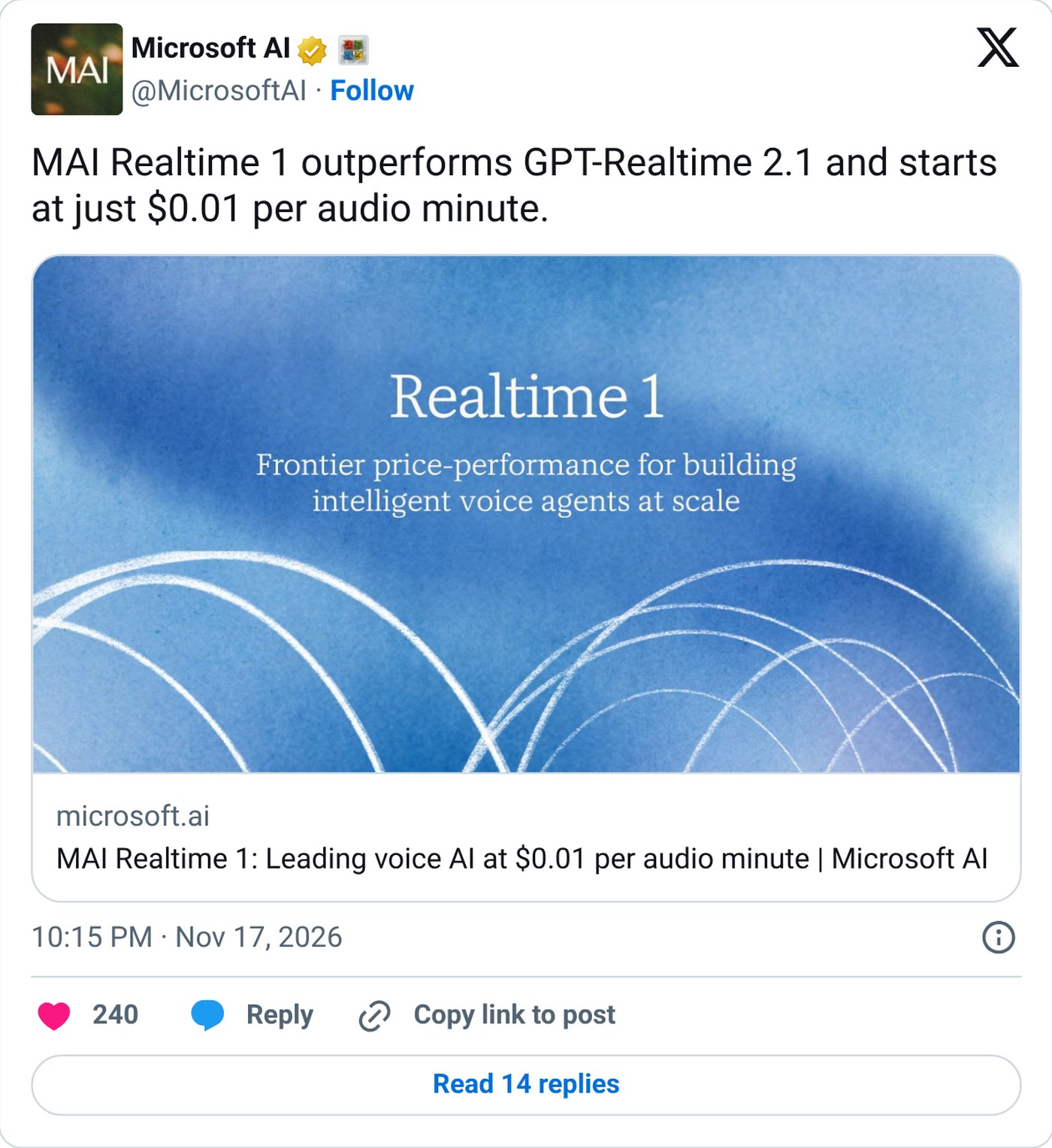
The rest of the lineup spans media and speech. MAI Image 2.7 ranks first on Artificial Analysis’s image editing leaderboard, ahead of GPT Image 2.6 Sunburst at one-fifth the price, Microsoft said, and a Flash version generates images for about $10 per 1,000. MAI Realtime 1, the company’s first live speech-to-speech model, starts at $0.01 per audio minute. Dragon Copilot Transcribe, built on MAI Transcribe 2, now handles 10 million doctor-patient encounters a month. Decision 1.1, a model that routes requests so larger and pricier models are used only when needed, is 50 times faster and 79 times cheaper than GPT-6.1 Sol, according to Microsoft.
Microsoft also said Maia 200, its second-generation AI accelerator, is now in production running its largest models, with 1.7 times more tokens per watt.

Image: Microsoft
The bigger strategic bet may be MAI Licensed Weights. Companies can take a frontier MAI model, customize it with their own data and run it in their own Azure environment, with control over who can access it. “No one wants to pour their IQ into someone else’s model,” Microsoft said, adding that AT&T built a custom MAI model for 5G network analytics that outperformed GPT-6.1 Sol at 50 times lower cost.