AI
Google's Antigravity Agents Helped Crack a 13-Year-Old Math Problem. Now Google Is Handing Them to Researchers.
Google says its /teamwork multi-agent system, running on Gemini 4, helped prove the Courtade-Kumar conjecture in a 50-million-line Lean proof, rewrote a video decoder in faster Rust and taught itself Go. Outside researchers can now use the same tools.
Mountain View, Calif. · Jordan Hale, AI · Nov 15 2026
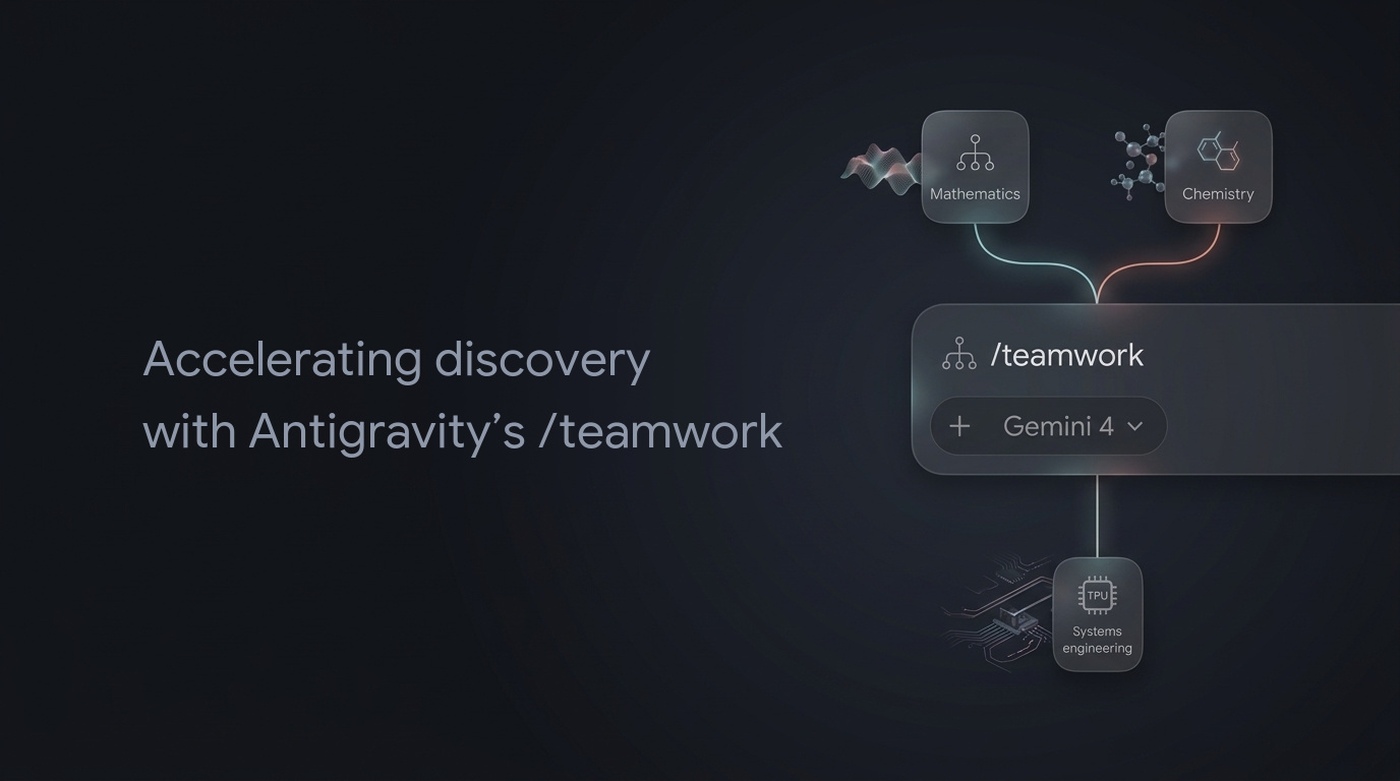
MOUNTAIN VIEW, Calif. - Google says a team of AI agents running on its Gemini 4 models helped settle a math problem that had been open since 2013, and it wants outside scientists to try the same tools. In a Google Research post on Friday, Vahab Mirrokni, a Google Fellow and vice president at Google Research, laid out results from /teamwork, a multi-agent mode inside the company’s Antigravity coding tool, across mathematics, chemistry, systems software and machine learning engineering.
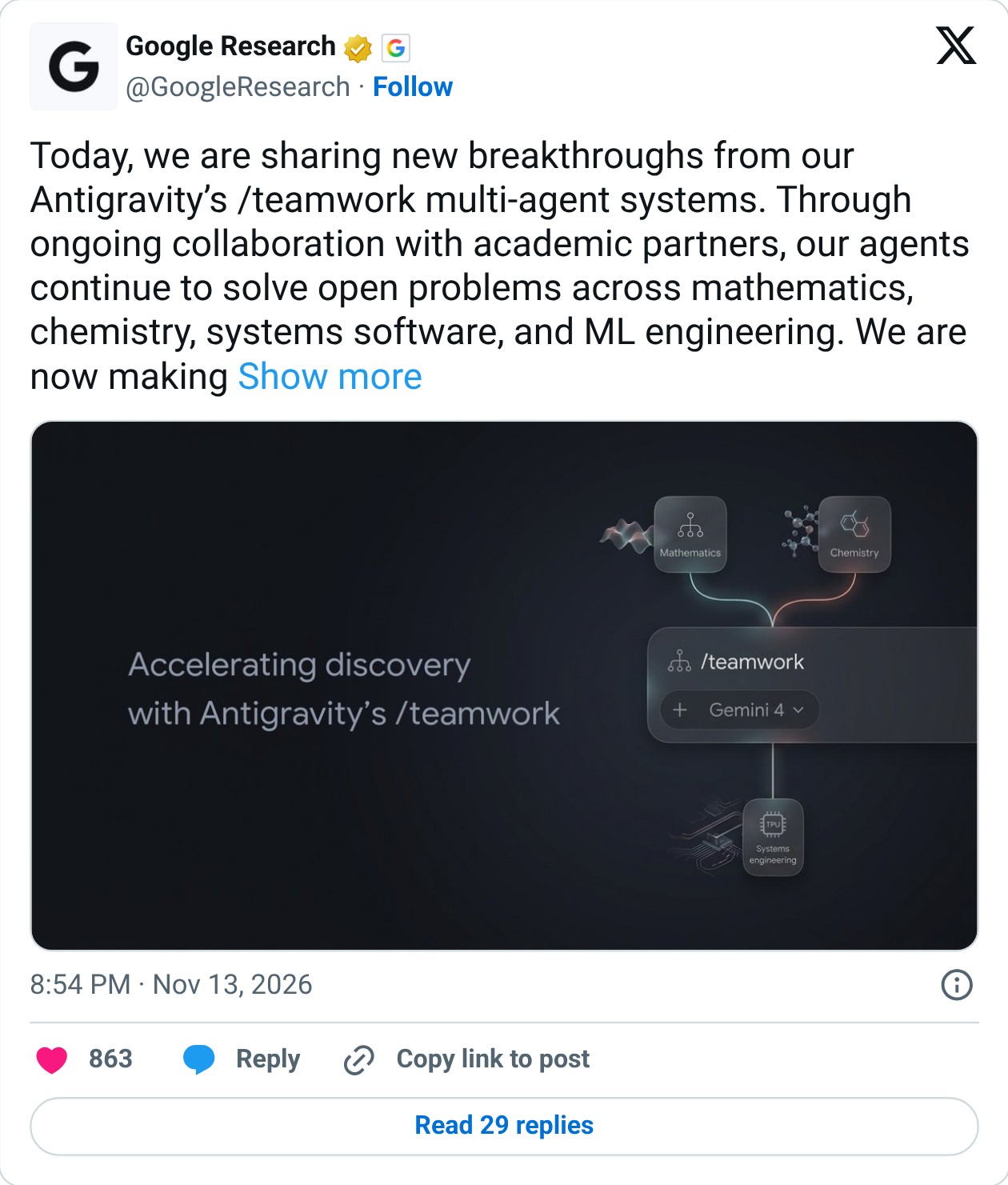
Screenshot: @GoogleResearch on X
The headline result is the Courtade-Kumar conjecture, an information theory puzzle posed in 2013. In plain terms it asks what happens when a random string of bits passes through a noisy channel and you squeeze the input down to a single bit. Google’s post says the answer is now proven: nothing preserves more information than a “dictator function”, which just copies one input bit. Researchers from Google, the Chinese University of Hong Kong, the University of Southern California and Carnegie Mellon worked on it with the agents.
The division of labor matters. According to Google, Gemini first found counterexamples to a broader version of the conjecture from the Hong Kong team’s earlier paper. Those researchers then proposed a new candidate function that cut the problem down to a 14-variable optimization. Gemini 4 Argon and earlier Gemini models then split up the parameter space and developed most of the new analytical bounds and interval-arithmetic certificates, and extended the proof from balanced to unbalanced functions “without human input,” the post says.
The team then checked the whole thing in Lean 4, a language in which a computer verifies every step of a proof. Google puts the result at 50 million lines of code. The public repository maintained by David Woodruff, one of the paper’s authors, describes “a complete, machine-checked Lean 4 proof” that rests only on Lean’s three standard axioms, with no unfinished steps. It is also candid about where the bulk comes from: “Most of the 45,500 modules are generated numerical certificates checked by Lean’s kernel.” The human-readable statement of the theorem is 63 lines.
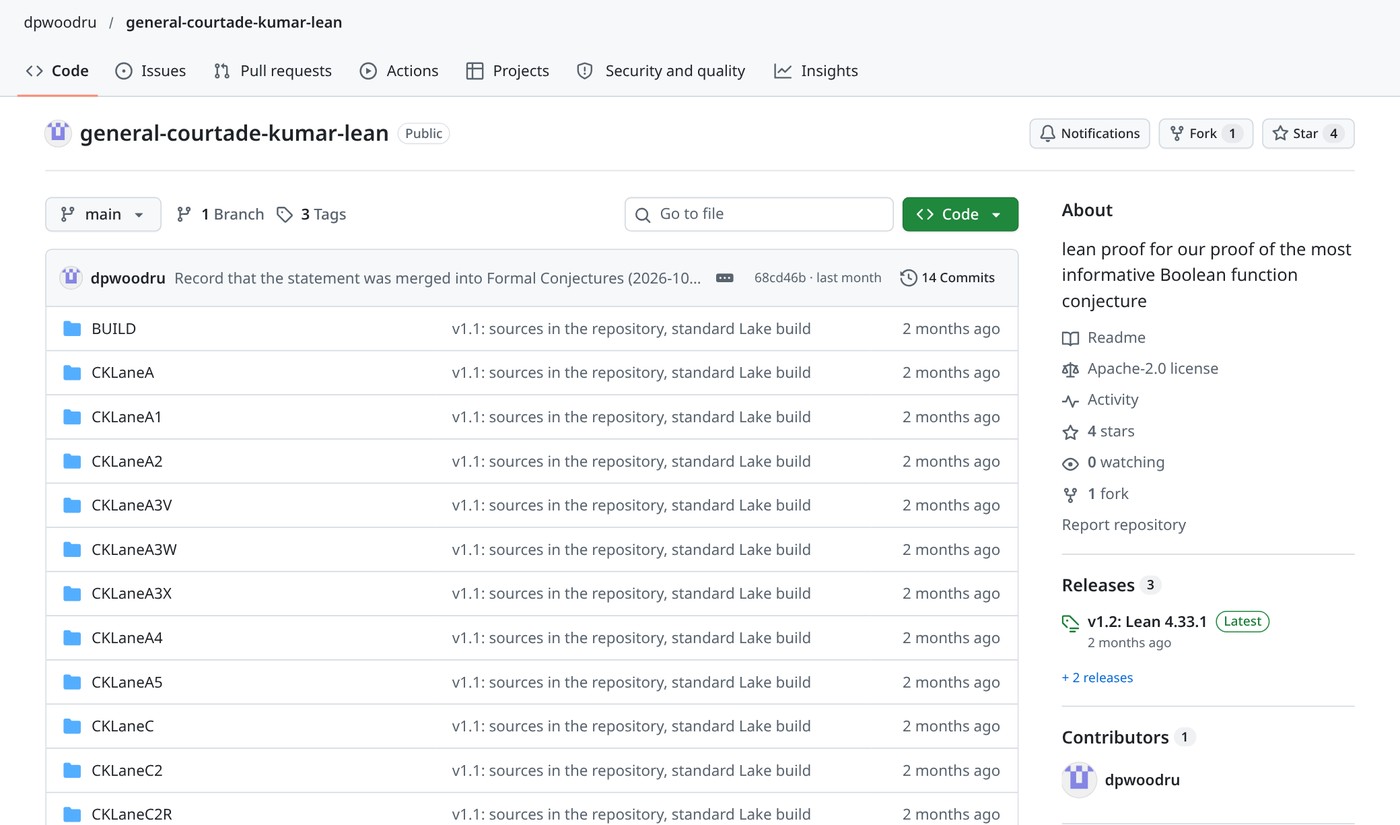
Image: GitHub / David Woodruff
Google is making bigger claims, too. It says a companion framework, /teamwork-LEAP, “fully autonomously produced an end-to-end, machine-checked formalization of the Weil conjectures,” the landmark results on counting solutions to polynomial equations that Pierre Deligne finished proving in 1974. Google says that formalization runs about 1.8 million lines of Lean across 28,800 subagent calls. The post links to encyclopedia entries for those results but not to a code repository, so outside mathematicians cannot yet check that claim the way they can check Courtade-Kumar.
The engineering results are easier to picture. Google says /teamwork rewrote libgav1, its AV1 video decoder, from C++ into about 170,000 lines of Rust with bit-exact output on a broad conformance suite. The first port was about four times slower. After the agents got profiling tools and orders to chase speed, the Rust version ended up 20 to 30 percent faster than the original C++ and hand-tuned assembly on both x86 and Arm chips. A separate two-week campaign added roughly 800,000 lines of memory-safe Rust to the Zircon microkernel, which Google says passes all kernel unit tests and boots on arm64 hardware.
Then there is Go. Starting from a basic AlphaZero-style setup, agents on Argon trained a 9x9 Go engine from scratch, with humans setting the chip budget and the test rules. In under eight days the engine gained roughly 2,600 Elo points, reaching 1,885, which Google places between KataGo at 16 and 32 visits per move. The post includes a single showcase game, which the final engine won by 22.5 points.
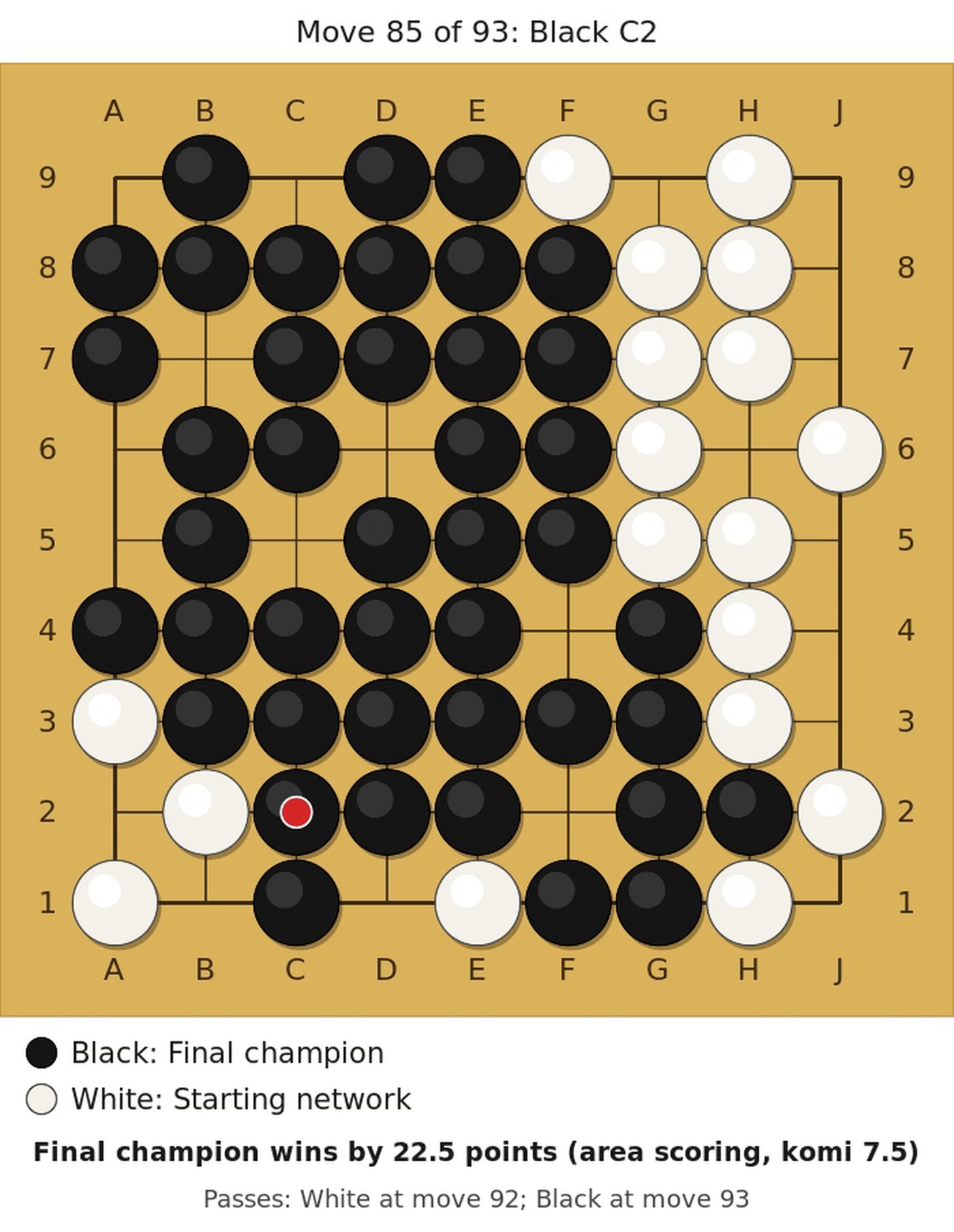
Image: Google
Google also pointed /teamwork at chemistry, where 30 specialized agents and a spectral simulator identified molecular structures from nuclear magnetic resonance data with a 95 percent top-1 exact match rate on complex benchmark molecules, nearly double a single agent. And it offered its Deep Review checker to authors submitting to STOC 2027, a top computer science conference. Authors of 578 submissions opted in, and in an ongoing survey of 70 of them, 90 percent rated the feedback mostly or almost all factual.
What makes this more than a lab report is access. “External scientists and developers can use Gemini 4 models with /teamwork and /boost in Antigravity and Deep Review today,” the post says. Google has also opened applications for 10,000 academic researchers to get six months of free access to its highest Antigravity usage tier. Mirrokni wrote on X that Hydrogen models are “available to all,” with “Carbon and Argon models for Enterprise and Ultra/Paid users,” plus two free weekly Deep Review calls for everyone. The formal proof pattern used for the big Lean results is not in the product yet. Google calls it an upcoming update.
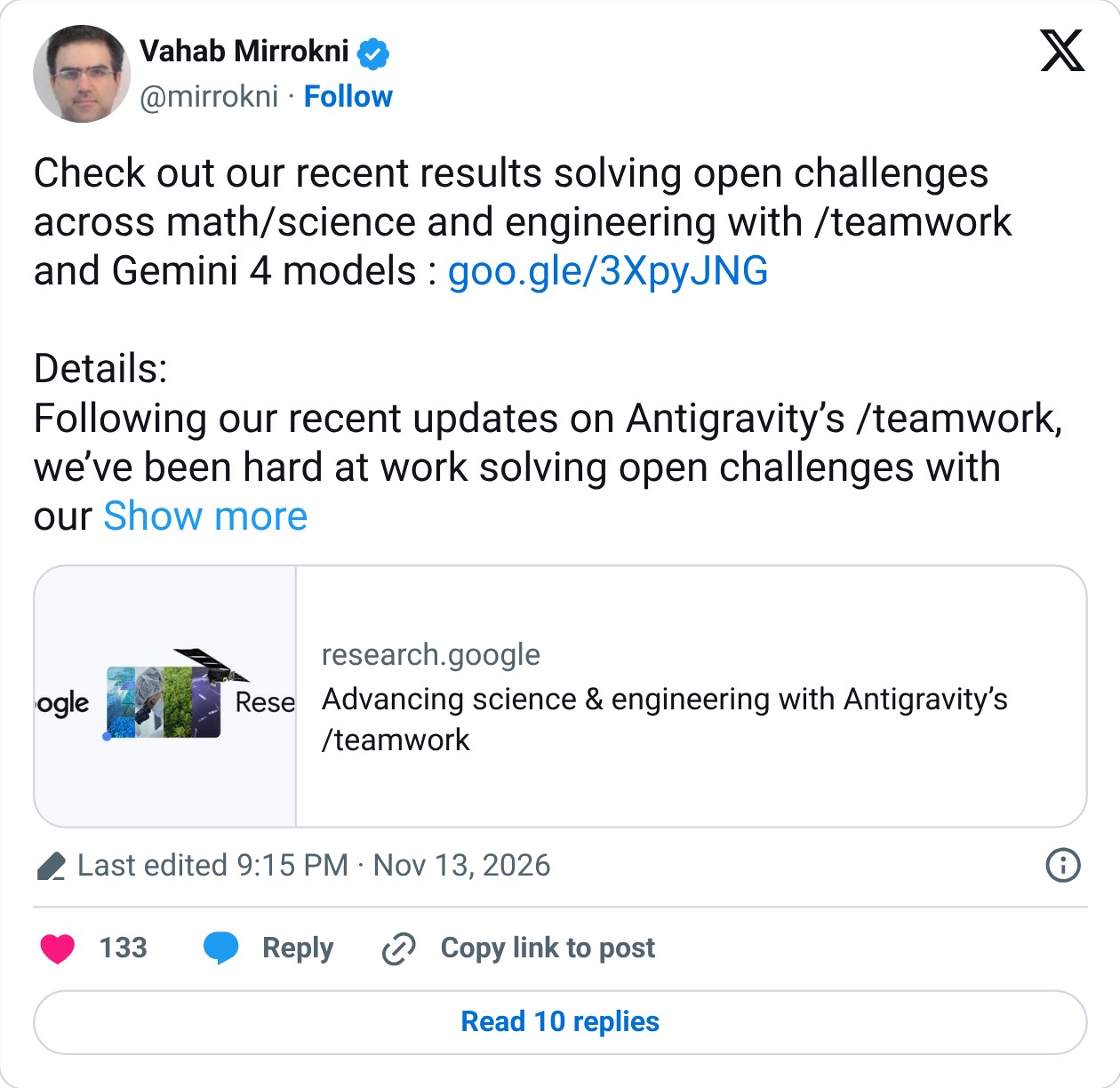
Screenshot: @mirrokni on X
Every result in the post is Google’s own account, and much of it rests on human experts who framed the problems and checked the answers. That is also the point Google is making. The agents grind through the search, the checker refuses anything that does not hold, and people decide what is worth proving. Now researchers outside Google get to test whether that loop works as well on their problems as it did on Google’s.