AI
Google's Gemini Decisions API Scores Up to 1,000 Questions in a Single Pass, for 10 Cents per Million Tokens
The new Gemini Decision 1 model picks from fixed answers instead of writing text, returns probabilities in about a quarter of a second, and already routes queries inside Google's own products.
Mountain View, Calif. · Jordan Hale, AI · Nov 11 2026
MOUNTAIN VIEW, Calif. - Google on Wednesday introduced the Gemini Decisions API, a developer endpoint built for a narrow but very common job: choosing an answer from a fixed set of options. It runs on a new model, Gemini Decision 1, which is available now through the Gemini API in Google AI Studio, according to Google’s announcement.
Most large language models answer by generating text one token at a time. Gemini Decision 1 does not. A developer sends it one input, which can mix text, images, audio, video and PDFs of up to 256,000 tokens, along with as many as 1,000 separate questions. The model scores the candidate answers in a single forward pass and returns probabilities, plus a confidence score from 0 to 1 for each answer, so software can hand unclear cases to a fallback or a human reviewer. Google says a request takes 150 to 250 milliseconds end to end.
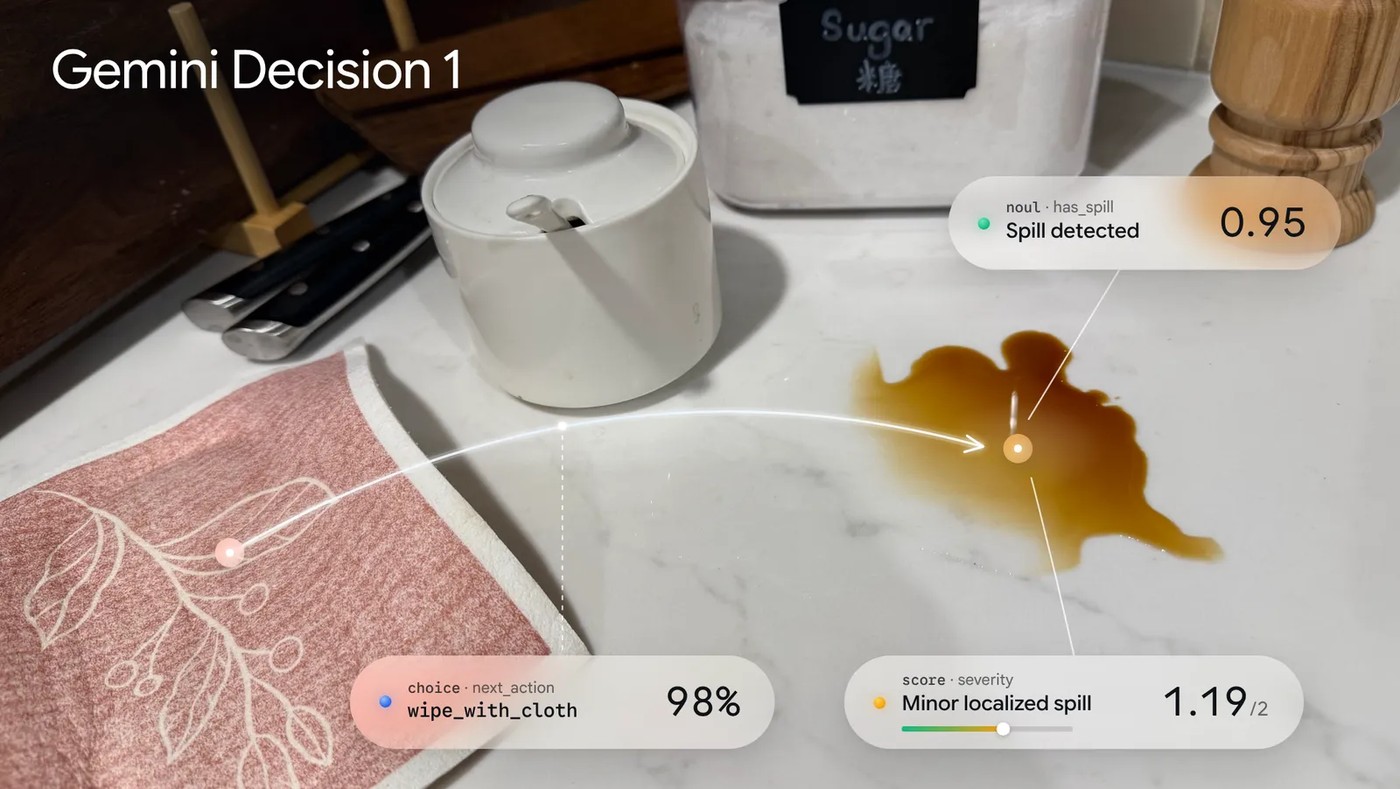 Image: Google
The API supports three kinds of question. A yes-or-no check estimates the probability that a condition holds. A multiple-choice question picks from 2 to 255 options and returns probabilities for every candidate. A rubric question grades an input on an ordered scale. Google’s sample request looks at a photo of an office counter before a 9 a.m. client meeting and asks, in one call, whether there is a spill, which cleanup action fits and how severe the mess is.
Price is the main pitch. Gemini Decision 1 costs $0.10 per million input tokens, and output is free because the model generates no output tokens. The shared input is billed once per request no matter how many questions are asked. Google says that makes it nearly five times cheaper across its benchmark suite than Gemini 3.5 Flash-Lite running through the Interactions API, and that the new model posted the lowest calibration error on tests covering agent routing, reasoning, ranking and multimodal understanding. A no-cost tier is available for prototyping in AI Studio.
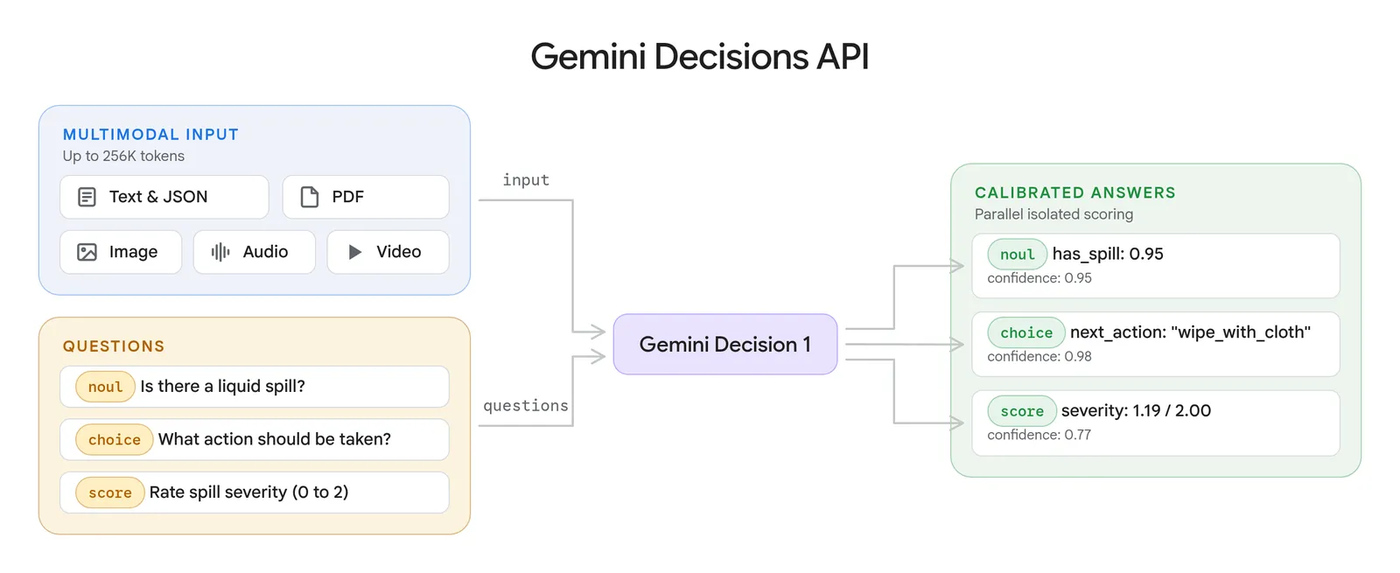 Image: Google
Google says teams inside the company already use the API as a fast control layer. Gemini Notebook uses it to send each incoming query to the right model tier and thinking level, which Google says cuts latency by up to 40 percent on everyday questions. A new rapid canvas experiment in Stitch, Google’s design tool, uses it to generate playable wireframes of a product flow in seconds. CC, a Google Labs agent for households, uses it to pick an emoji reaction from more than 200 options, and Google Search uses it to detect adversarial behavior around MCP tools.
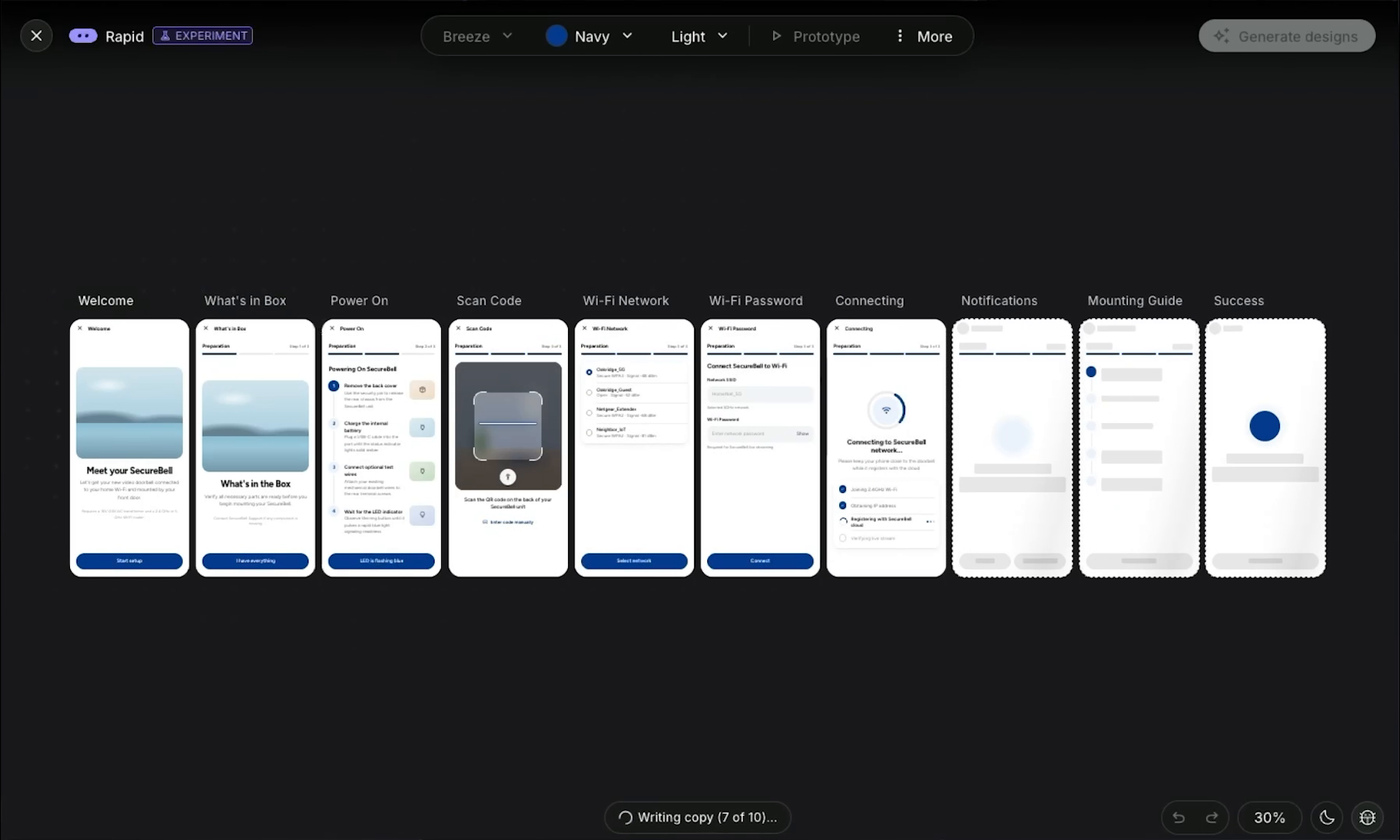 Image: Google
Integrations are rolling out with OpenRouter, LangChain, Vercel, LiteLLM, Pydantic AI, Pipecat, LiveKit and OpenCode, alongside Google’s own google-genai SDKs, with support for Gemini in Google Cloud coming soon, the company said. Sundar Pichai, Google’s chief executive, announced the launch on X.
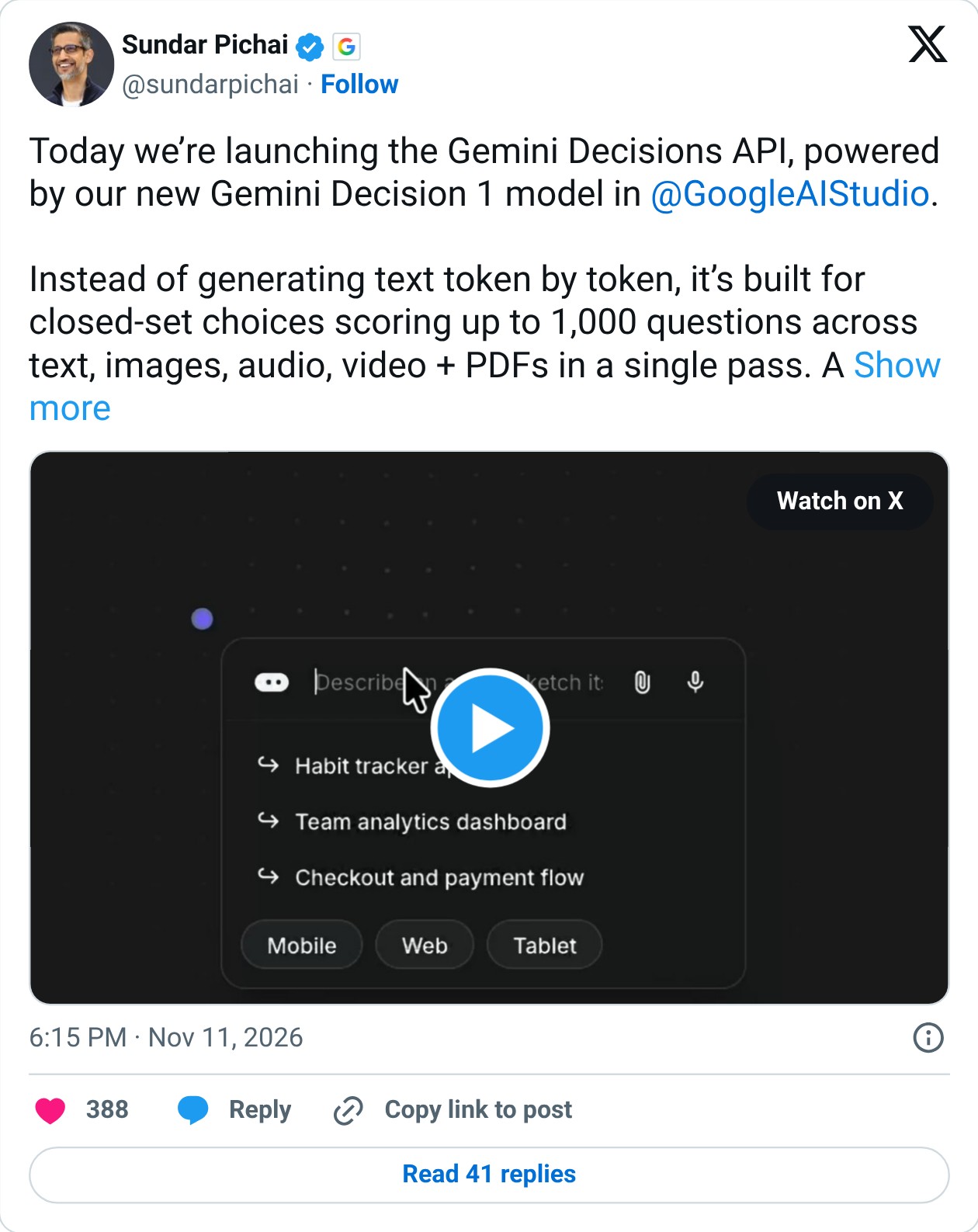 Screenshot: @sundarpichai on X