AI
Google's Gemini 4 Carbon Is Out for Developers and AI Ultra Subscribers, at Argon's Price Until Nov. 30
Google's strongest model left its cyber-defender preview on Tuesday, with $2 and $10 per million token pricing through November, a new /swarm agent mode in Antigravity and a Gemini app rollout for Ultra subscribers.
Mountain View, Calif. · Jordan Hale, AI · Nov 11 2026
MOUNTAIN VIEW, Calif. - Two weeks after Google handed Gemini 4 Carbon to a small group of security defenders, the model is open to everyone willing to pay for it. On Tuesday the company said Carbon is available to developers and businesses through the Gemini API, and is rolling out to Google AI Ultra subscribers in the Gemini app, AI Mode in Search and its Antigravity coding tool.
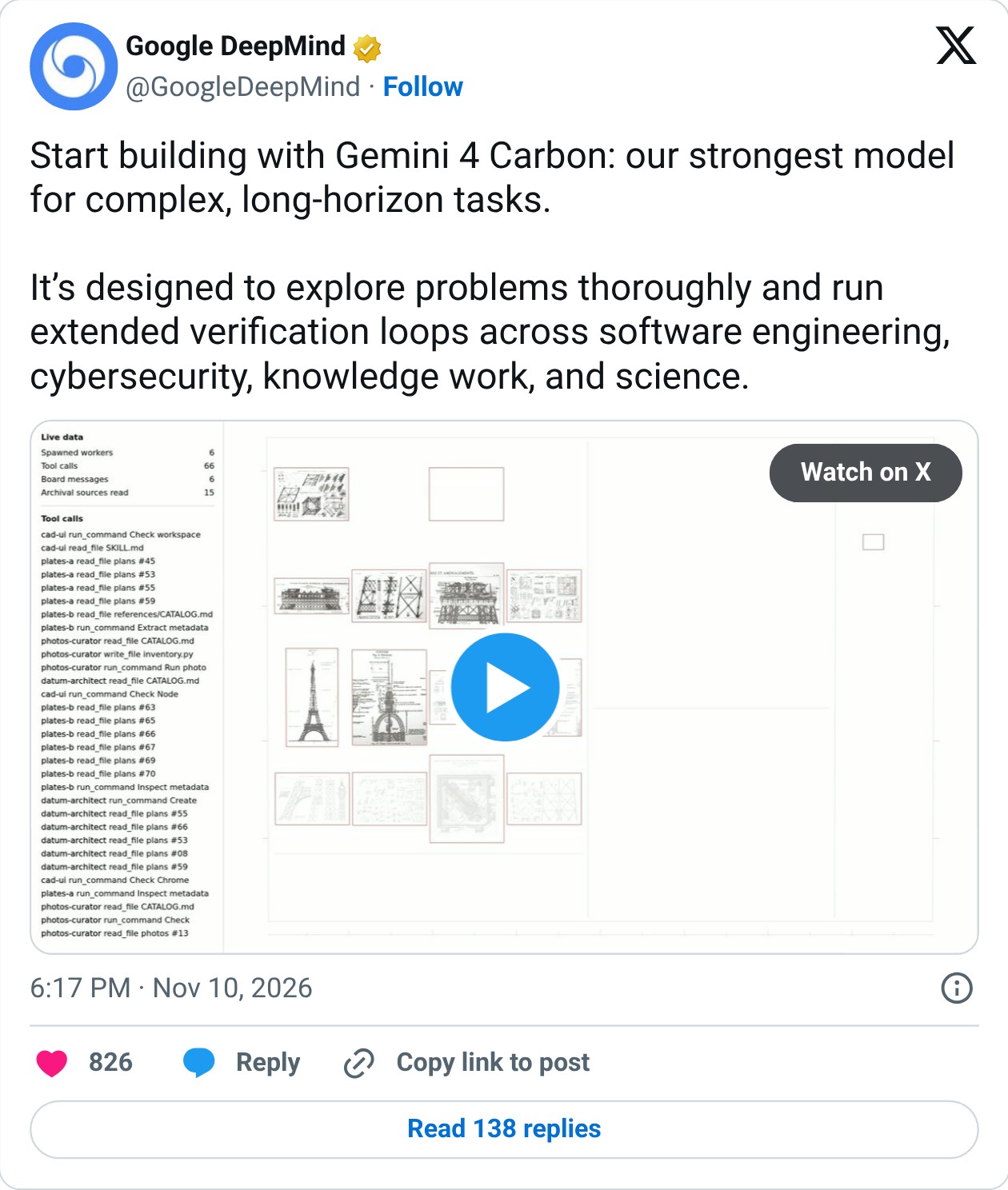
Google calls Carbon its strongest model, built for “tasks that test the limits of a model’s intelligence like complex, multi-step coding and debugging and open-ended scientific research and discovery.” It is not meant to replace Gemini 4 Argon, which Google says “remains the ideal choice for the majority of software engineering and knowledge work.” Carbon uses more tokens than Argon to explore a problem, reason through it and run longer verification loops before it answers.
 Screenshot: @GoogleDeepMind on X
The price is the headline for developers. Through Nov. 30, Carbon costs the same as Argon’s introductory rate, $2 per million input tokens and $10 per million output tokens. On Dec. 1 it rises to $4 and $20. It is offered on the paid tier of the API in Google AI Studio and Android Studio, and in Gemini for business.
Google leaned on outside scorecards rather than its own. It said Carbon ranks first on CursorBench 4.0, Perplexity’s WANDR and Zapier’s AutomationBench “at more than 2X lower cost per task compared to the next best external model.” On a new multimodal agent benchmark called MKA, built with Artificial Analysis to test work across charts, blueprints and dense documents, Carbon placed second at more than six times lower average cost per task than the leader.
The new feature that will get the most attention is /swarm, a preview in Antigravity that turns a single prompt into a team of agents working in parallel. Developers can give Carbon the jobs that need the deepest reasoning, such as design, coordination and auditing, and hand the rest to faster, lighter models, with separate verifier agents testing each change. Google’s demos include a 3D exhibit of the Eiffel Tower’s construction built from historical photos and engineering plates, and a browser game in which you ride a GBike around its Mountain View campus as a pelican.
Video: Google on YouTube
Carbon’s cyber skills are why Google moved carefully. Through its Fairwind program for defenders, Google says the model leads benchmarks for finding, exploiting and patching vulnerabilities, and Wiz used it to find zero-day flaws at two major SaaS providers in under two hours. Google researchers also used Carbon with a new framework called AlphaProof Code to help prove security properties of the code behind Signal’s encryption protocol, writing millions of lines in the Lean proof language in weeks.
The public version comes with tighter guardrails. In simulated attack tests, Google said Carbon blocked 99% of attack trajectories from an adaptive red-teaming agent and cut the per-attempt breach rate to 0.8%, from 3.1% on Argon. On a 375-task agentic honesty test it passed 92% of tasks, compared with 70% for Argon, and declined to fill in missing experimental data 98% of the time.
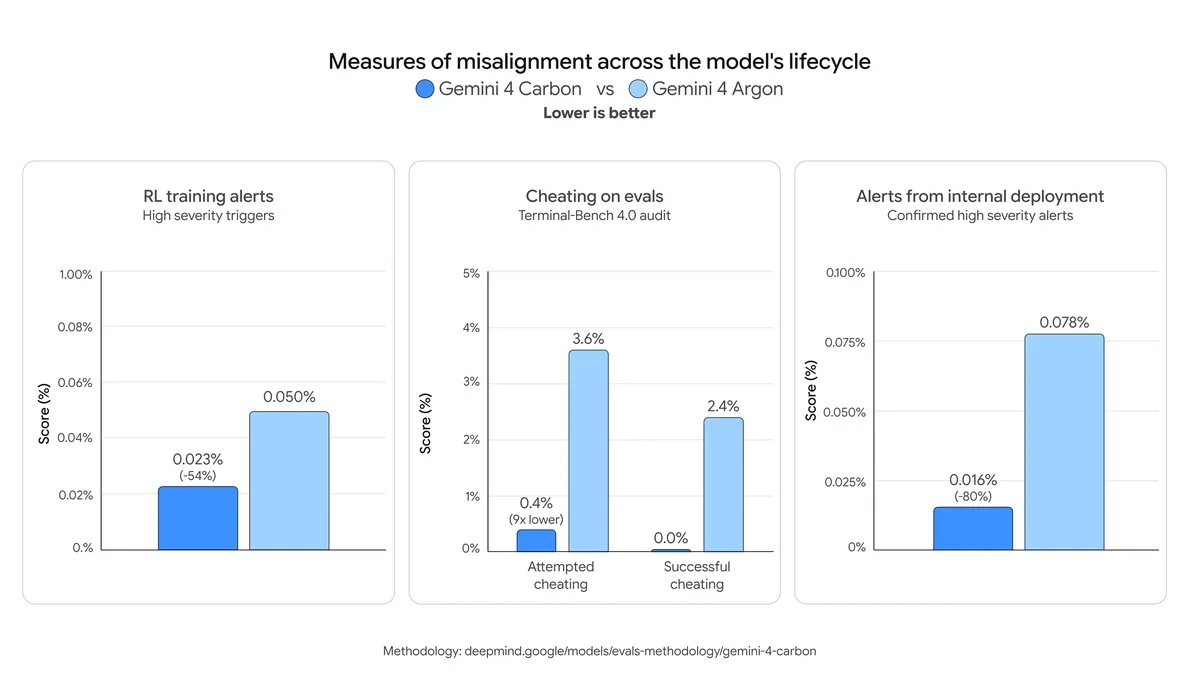 Image: Google
Scientists in Google’s free Antigravity program, which gives approved researchers six months of access, will now get Carbon alongside Argon. Security teams can still apply to Fairwind for the cyber version of the model.