
Business
Fractile Raises $720 Million for AI Chips With Memory Stacked on Top, at a $7 Billion Valuation
The London and Bristol startup has not shipped a chip yet. Thrive, Founders Fund, Lightspeed, Redpoint and the British government are betting it can make AI answer far faster, starting next year.
London · Elena Vos, Business · Nov 12 2026
LONDON - Fractile has not shipped a single chip, and it is now one of Britain’s most valuable technology startups. The company, based in London and Bristol, announced on Wednesday that it has raised a $720 million Series C led by Thrive Capital, Founders Fund, Lightspeed and Redpoint. Balderton, which joined the round, put the post-money valuation at $7 billion. The British government, which invested through its Sovereign AI fund and the British Business Bank, said the round values the company at more than 5 billion pounds.
The list of backers is long. Reuters reported that other investors include Google’s venture arm CapitalG, BlackRock, DST Global, Elad Gil, Balderton and SV Angel. Georgian, another participant, listed Dragoneer and T. Rowe Price among the new investors, with Accel, Conviction and Felicis returning.
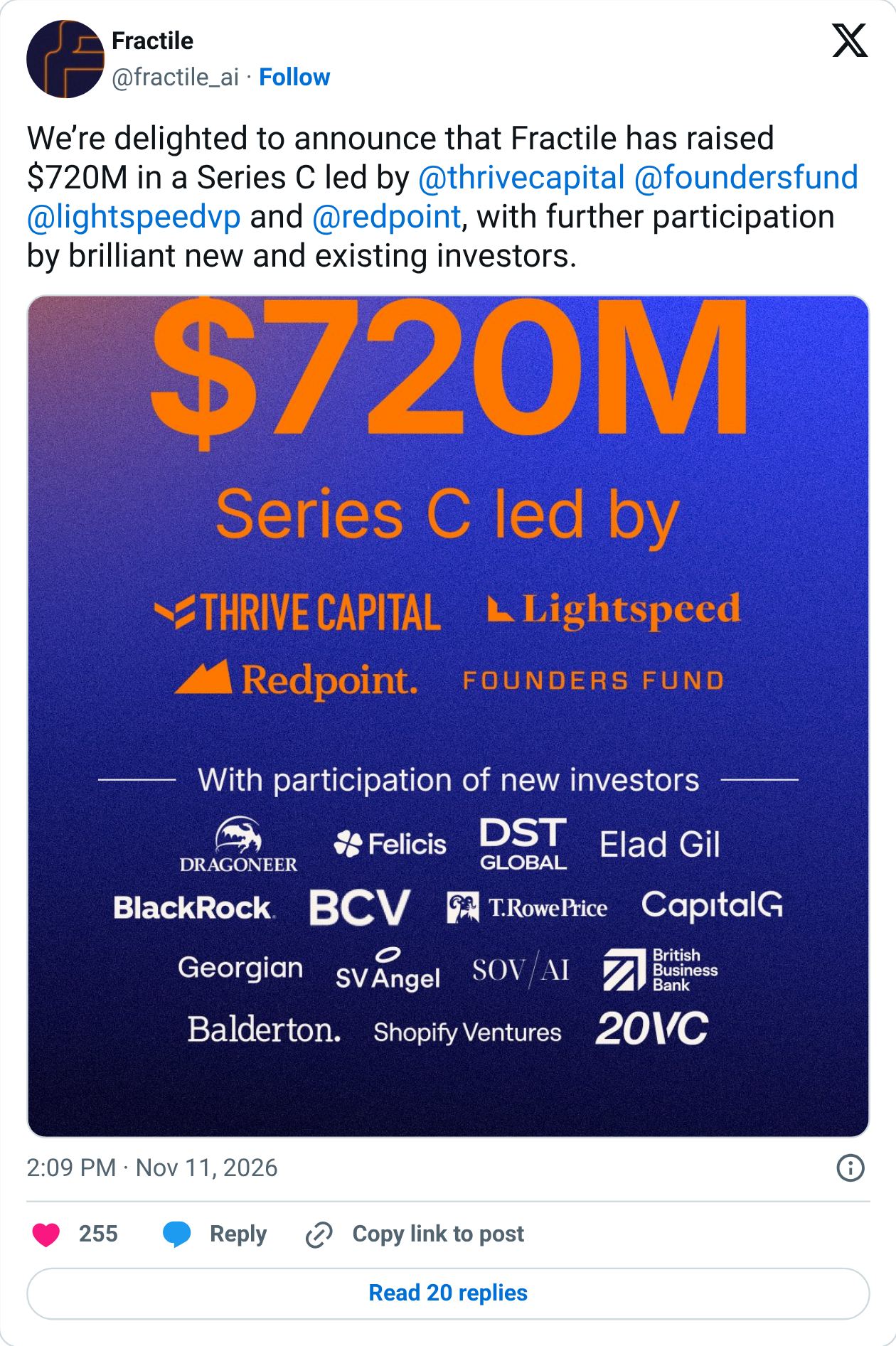
Screenshot: @fractile_ai on X
The pitch is speed. Most AI accelerators pair their processors with high-bandwidth memory, or HBM. Fractile packages DRAM directly on top of its logic, which Balderton says “gives far higher memory bandwidth than HBM and much more capacity than SRAM, so large models can run at thousands of tokens per second, even at very long contexts.” The company designs its own chips, builds its own systems and software, and does its own machine learning research. TechCrunch noted that the stacked-DRAM design came after a pivot, and that Fractile’s full-stack approach includes a compiler meant to get language models running as fast as possible on its silicon.
Walter Goodwin founded the company in 2022 while he was a PhD student at Oxford’s Robotics Institute, according to Georgian. In a post on X, he said the money will “allow us to run faster in shipping the world’s fastest chips for AI.” His case rests on how AI agents scale. He pointed to an OpenAI effort on a Millennium Prize problem that he said ran 10,000 parallel agents for 80 hours at a cost of more than $10 million, and argued that “fewer agents, thinking for longer, scales better in every way except for the time that you wait for a response.” Faster inference hardware, in his telling, removes that wait.

Screenshot: @goodwin_ml on X
The timeline is the risk. In a LinkedIn post quoted by TechCrunch, Goodwin wrote that “there is still a lot of work ahead” and that the funding will let the startup “ship [its] first chips and systems next year.” Georgian said the platform ramp is targeted for the second half of 2027. Until then, Fractile competes on promises in a market that Reuters described as dominated by Nvidia and a handful of Asian chipmakers, and against well-funded startups such as Axelera, Etched and OLIX.
London is treating the round as industrial policy. “Fractile represents the very best of British ambition, bringing together world-class chip design, engineering and AI expertise to develop faster, cheaper and more energy-efficient hardware,” AI Minister Kanishka Narayan said. Business Secretary Jonathan Reynolds called it “a fantastic British success story.” Georgian noted that the government named Fractile in its AI Hardware Plan in June, which includes 150 million pounds to buy inference chips from British firms, and that Fractile has committed 100 million pounds over three years to its UK operations, including a new hardware engineering and testing facility in Bristol.
For investors, the bet is easy to state and hard to deliver. The round values Fractile at $7 billion before it has a product on the market. The first real test comes when customers can run frontier models on its chips and systems, which the company says will start next year.