AI
DeepSeek Ships V4.1-Flash-1017, a Quiet Update With Loud Coding Gains, and Opens Its Search Engine to Developers
The open-weight model, released under an MIT license with 763 billion parameters and a 1 million-token context window, now answers to deepseek-flash on the API. DeepSeek also opened its Search and Fetch APIs to everyone at $0.75 per 1,000 calls.
HANGZHOU, China · Jordan Hale, AI · Oct 18 2026
HANGZHOU, China - DeepSeek calls it a minor update. The numbers it published on Saturday suggest otherwise. DeepSeek-V4.1-Flash-1017, a refresh of the V4.1 Flash model the Chinese lab released in September, went live on Oct. 17 across DeepSeek’s website, its mobile app and its developer API, with open weights posted to Hugging Face and ModelScope the same morning.
API customers do not have to change a line of code. According to DeepSeek’s API change log, the existing deepseek-flash model name now routes to the new version, and both the calling method and the price are unchanged. The weights carry an MIT license, the most permissive terms in wide use, and the Hugging Face listing puts the model at 763 billion parameters with a recommended context window of 1 million tokens.
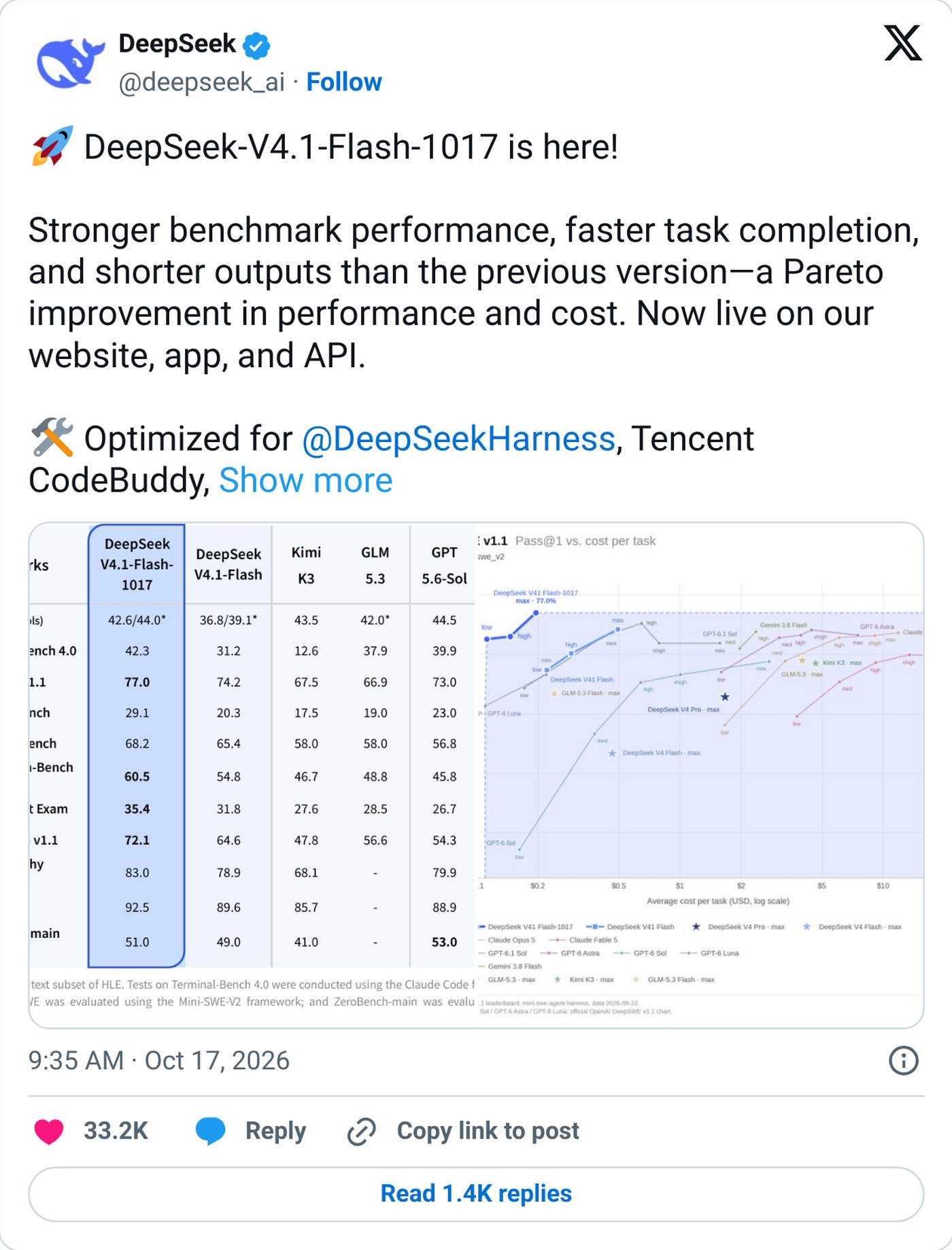 Screenshot: @deepseek_ai on X, Oct. 17, 2026
“Stronger benchmark performance, faster task completion, and shorter outputs than the previous version,” the company’s official account posted, describing the release as “a Pareto improvement in performance and cost.” In plain terms, DeepSeek says the model got better without getting more expensive to run, and in some workloads it got cheaper.
The biggest jumps are in agentic coding, the category every major lab is now chasing. On DeepSWE v1.1, a software engineering benchmark DeepSeek ran with the Mini-SWE-V2 harness, the score rose from 74.2 to 77.0. On Terminal-Bench 4.0, which DeepSeek tested inside the Claude Code harness, it climbed from 31.2 to 42.3, an 11-point gain for a point release. Humanity’s Last Exam without tools moved from 36.8 to 42.6, and Automation-Bench v1.0.6 went from 54.8 to 60.5.
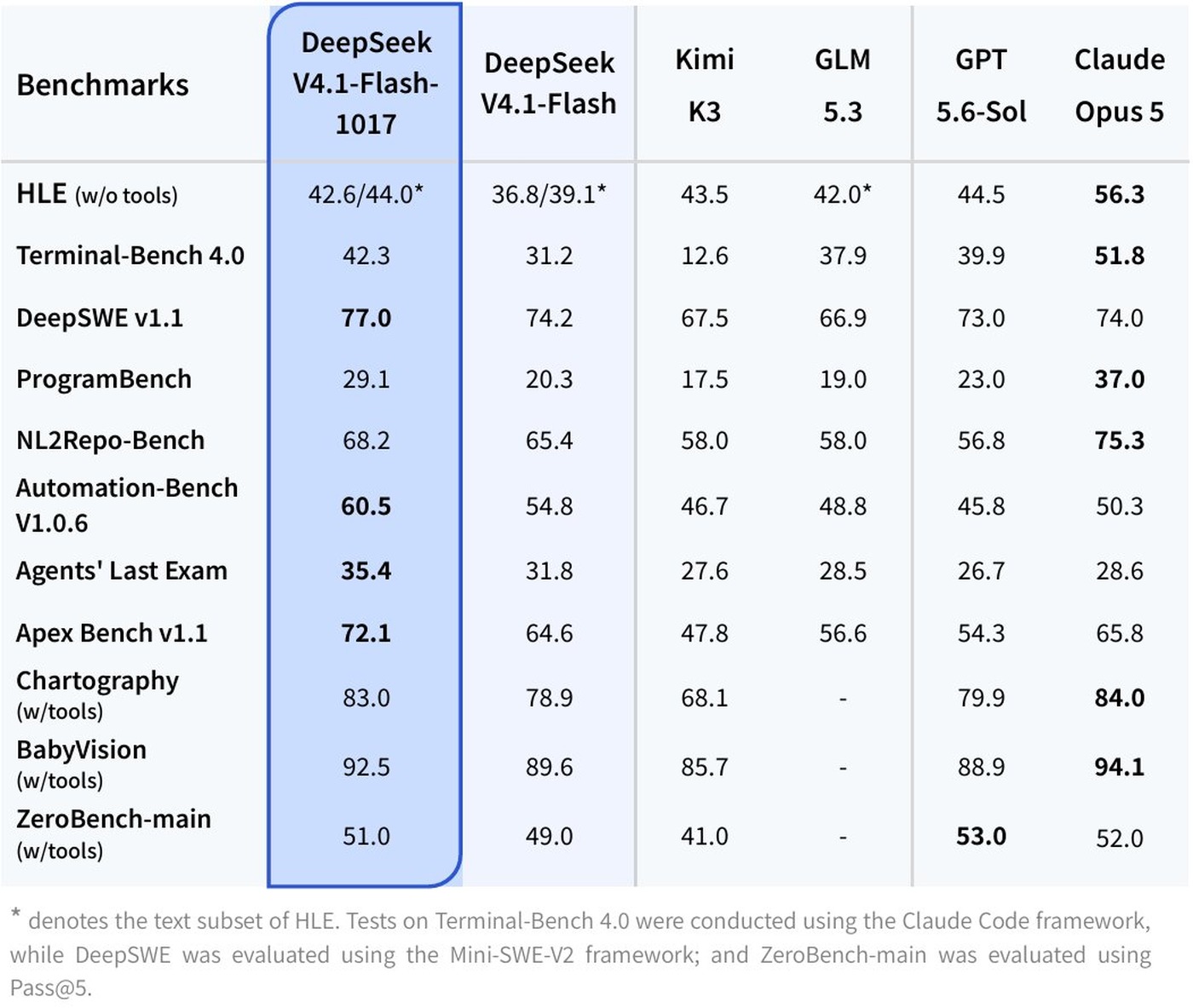 Image: DeepSeek
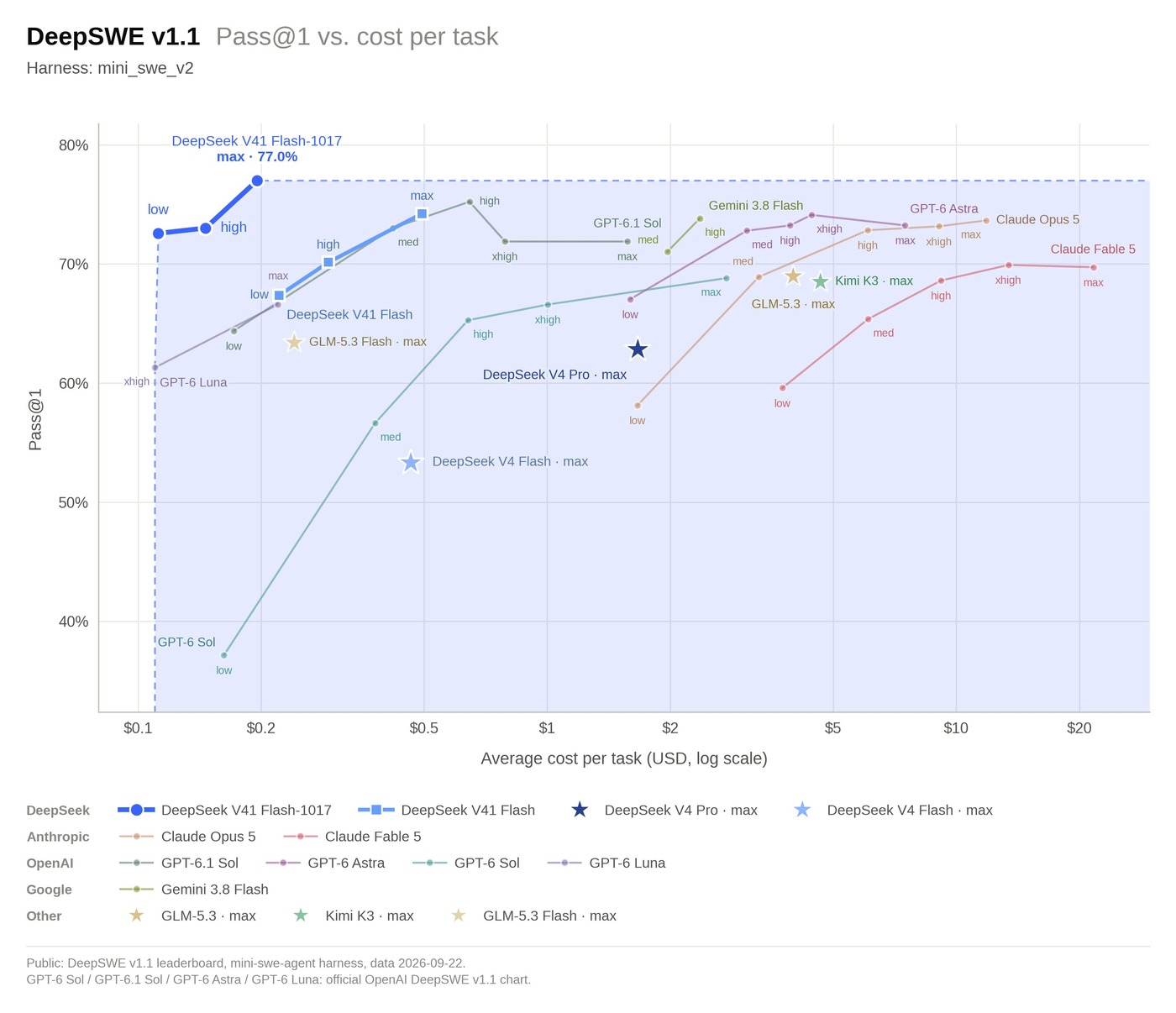
DeepSeek’s own table also lines the model up against much larger rivals. By its count, V4.1-Flash-1017 edges Claude Opus 5 on DeepSWE, 77.0 to 74.0, and beats GPT 5.6-Sol on Terminal-Bench 4.0, 42.3 to 39.9. Opus 5 still leads on Terminal-Bench, at 51.8, and on Humanity’s Last Exam. These are vendor-run results, and independent replications have not yet appeared. The company’s cost chart is the more striking claim: it shows the new model reaching 77.0 on DeepSWE at an average of roughly 20 cents a task, while most competitors on the same plot cost dollars per task.
The lab credits a post-training method it calls reinforcement learning with self-feedback, which it says improves end-to-end project work “from game creation to 3D modeling.” It also said the model was tuned for its own DeepSeek Harness coding tool, version 0.2.1-rc.1 or later, and for Tencent’s CodeBuddy and WorkBuddy. Bloomberg described the release as a faster, leaner model, and Reuters reported that it was available on the web, the app and the API.
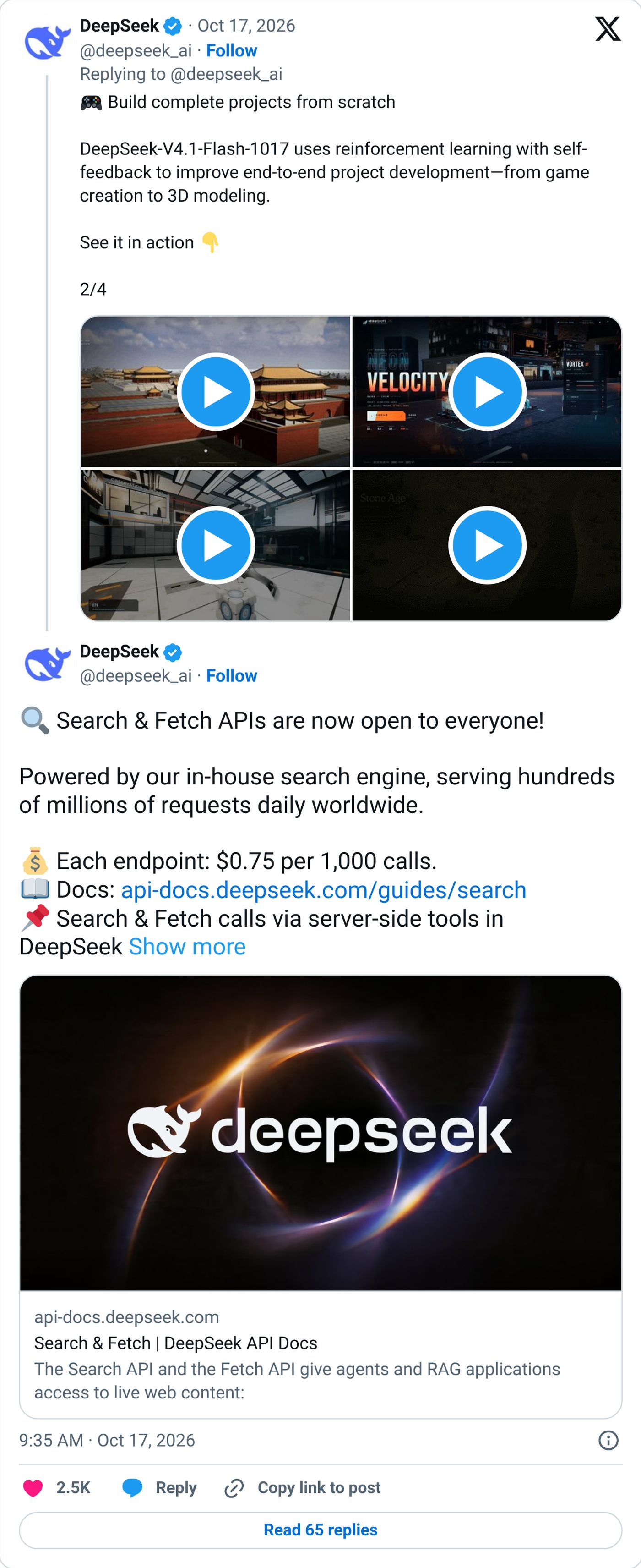 Screenshot: @deepseek_ai on X, Oct. 17, 2026
The second announcement may matter more to developers than the benchmarks. DeepSeek opened its Search and Fetch APIs to all users, exposing the in-house search engine that already powers search inside its chatbot. The company says that engine handles hundreds of millions of requests a day, indexes hundreds of billions of web pages and filters out SEO spam and low-quality AI-generated content. Each endpoint costs $0.75 per 1,000 calls, according to DeepSeek’s post on X, and Yicai reported domestic pricing of 5 yuan per 1,000 calls. That puts a cheap, model-native retrieval layer next to a cheap open model, which is precisely the bundle agent builders have been assembling by hand from separate vendors.
 Image: Hugging Face / DeepSeek
The release keeps DeepSeek’s pattern of shipping open weights that pressure closed models on price. Meta made a similar open-weight push on Thursday with Muse Spark Open. The difference is that DeepSeek’s update arrived on a Saturday, with no event, no keynote and no new model name, and it still moved the scoreboard.
Video: DeepSeek demo clips of V4.1-Flash-1017 building games and 3D scenes, Oct. 17, 2026
Sources: DeepSeek, DeepSeek-V4.1-Flash-1017 model card, Hugging Face, Oct. 17, 2026, https://huggingface.co/deepseek-ai/DeepSeek-V4.1-Flash-1017 (minor update, benchmark table, MIT license, 763B parameters, 1M-token context); DeepSeek API Docs, Change Log, Oct. 17, 2026, https://api-docs.deepseek.com/updates/ (deepseek-flash routing, unchanged pricing, benchmarks, harness tuning, search engine description); @deepseek_ai on X, Oct. 17, 2026, https://x.com/deepseek_ai/status/2111375640717033777 and https://x.com/deepseek_ai/status/2111375650414309859 (Search and Fetch at $0.75 per 1,000 calls); Reuters via Investing.com, “DeepSeek releases AI model update, opens search APIs to all users,” Oct. 17, 2026; Bloomberg via The Straits Times, “DeepSeek pushes out updated AI model it says is faster, leaner,” Oct. 17, 2026, https://www.straitstimes.com/world/deepseek-pushes-out-updated-ai-model-it-says-is-faster-leaner; Yicai, Oct. 17, 2026, https://www.yicai.com/news/103397681.html (5 yuan per 1,000 calls).
Jordan Hale, AI. Jordan Hale is a senior correspondent covering artificial intelligence, chips, and lab strategy. Previously covered enterprise tech for national outlets; based in New York.