
AI
Block's Dessa Learned to Talk Just by Listening. Here Is What a Voice AI That Laughs and Interrupts Could Change, and Why Security Teams Are Worried
Jack Dorsey's Block unveiled Dessa on Oct. 23, a full-duplex speech model trained on nothing but recorded human conversation that runs on a MacBook Pro. It is a research preview with no price or release date, but the use cases, and the fraud risks, are already coming into focus.
Oakland, Calif. · Jordan Hale, AI · Oct 25 2026
OAKLAND, Calif. - For most of the short history of voice assistants, you could tell you were talking to a machine within a sentence or two. It waited politely for you to finish. It answered a beat too late. It could not laugh at the right moment, and it had no idea you were annoyed. On Thursday, Block, the company behind Square and Cash App, showed an AI that does almost none of those things. It is called Dessa, and Block says it learned to hold a conversation “from scratch on nothing but human conversation. Sounds! No text, no pretrained models.”
“We believe voice is the most natural way to interact with intelligence, so we created Dessa, the most authentic full-duplex speech model ever built,” Jack Dorsey, Block’s co-founder and chairman, wrote on X when he announced it on Oct. 23. Ragavan Thurairatnam, who leads the small research lab behind it, went further. “This is a GPT3 moment for speech,” he wrote.
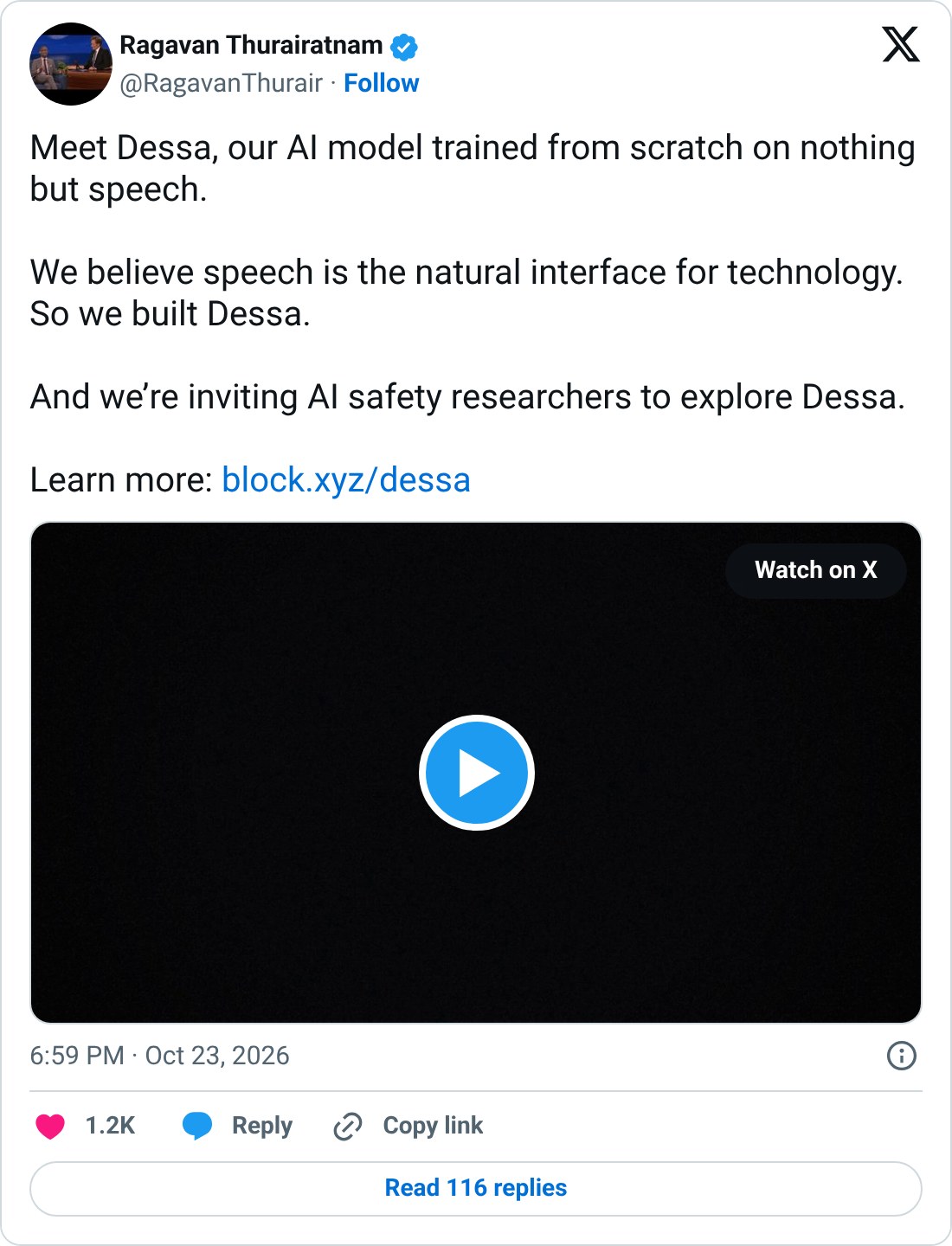
Screenshot: @RagavanThurair on X
Nobody outside Block can use Dessa yet. It is a research preview: the launch page says the waitlist “opens soon” and the download is “coming soon,” and the only people getting in early are “a small group of AI safety researchers” invited “to find the risks we haven’t anticipated.” There is no price, no API, no published paper, no benchmarks and no list of supported languages. But the recordings Block has released, and the way the model is built, say a great deal about where voice technology is heading, for people who make products, for people who use them, and for people who defend companies against fraud.
What Block actually built
Most voice AI today works like a relay race. One system turns your speech into text, a large language model reads the text and writes a reply, and a third system reads that reply aloud. Everything that is not a word, your tone, your hesitation, a sigh, is lost at the first handoff. Block’s launch page puts it bluntly: current voice AI “turns your voice into text and throws away an incredible amount of information text alone can’t carry. The most powerful AIs in the world can’t hear how you feel.”
Dessa skips the relay. It is a speech-to-speech model: audio goes in and audio comes out. Asked on X which language model was behind the voice, Dorsey replied, “speech to speech. no llm.”

Screenshot: @jack on X
It is also full-duplex, which means it listens and speaks at the same time, the way people do on a phone call. Block says it has learned when to cut in and when to “backchannel” with a “yeah!” or a “got it!” to show it is following, that it “natively hears and speaks emotion, sarcasm, laughter, a frustrated sigh, a voice cracking with sadness,” and that inference runs faster than real time. The company says Dessa learned language from “hundreds of times fewer words” than a text model needs, was trained on a single Nvidia GB200 NVL72 rack, and runs locally on a MacBook Pro with an M4 Max chip “or better.”
Full-duplex voice is not new on its own. The Paris lab Kyutai released Moshi as open source in September 2024, though Moshi is built on top of a text language model. OpenAI launched its own full-duplex model, GPT-Live, in July and opened GPT-Live-1 to developers in September. Dessa’s claim to novelty is that it never learned from text at all, and that it is small enough to run on a laptop rather than in a data center.
The name has history. Block says the lab was founded by former members of Dessa, the Toronto deep learning start-up that Square bought in February 2020. In May 2019 that start-up published RealTalk, a synthetic copy of the podcaster Joe Rogan’s voice convincing enough to start a public debate about voice deepfakes. The same team is now back, with a model that does not just sound like a person but talks like one.
Hear it for yourself
Block posted about two dozen recordings, each a live conversation with on-screen subtitles that label who is speaking. In the clip below, which Block calls “Refund,” a caller rings an online shop about a bag that arrived damaged. The caller is a human. The shop assistant is Dessa. Listen to the timing: the small “oh, yes” while the caller is still talking, the easy back-and-forth, the way it rolls with being interrupted.
Video: Block
It also shows the limits. Playing the assistant, Dessa invents a policy on the spot, offers the caller half the money back and suggests he “can leave them a bad review,” then agrees to a free replacement once he pushes back. Asked how long the replacement will take, it says only that it will be “short.” It sounds like a real call center agent having an off day, which is impressive and a warning at the same time.
In a second clip, Dessa plays a worried user asking GPT-Live-1, OpenAI’s voice model, whether ChatGPT learns from what people tell it. Block notes that both voices are AI-generated and that GPT-Live-1’s developer “is not affiliated with Block and has not reviewed or endorsed Dessa.” Listen for the hesitations and the quick “mm-hmm” while the other voice is talking; that is Dessa.
Video: Block
Not every recording is smooth. In one Thurairatnam shared, the model greets its human partner as someone called “Ronaldo.” A chat about Christopher Nolan’s films drifts into Bryan Singer’s Superman pictures. The Verge’s Jay Peters compared the experience to talking with “an awkward new friend.” TechCrunch called it “eerily human.”
Why this could change how we use technology
Typing and tapping became the default way to use computers because machines were bad at conversation. If a machine can keep up with ordinary speech, including the interruptions, the “umm,” and the mood behind the words, a lot of software that now lives behind screens and forms could move to the voice. None of the following is a product Block has announced. These are the areas where a model like Dessa, or the many rivals it will push, is most likely to show up first.
Customer service. This is the obvious one, and the “Refund” clip is effectively a demo. Contact centers already use voice bots, but callers tend to hang up on them or shout “agent” until a human picks up. A voice that answers instantly, hears frustration, lets you interrupt and sounds calm on its 500th call of the day could take a large share of routine calls about deliveries, refunds, bookings and account questions. TechCrunch noted that Square already uses voice AI to take orders, and that an on-device model of its own could let Block power more of those experiences at lower cost. The catch is the one the clip shows: a fluent agent that invents policy is a liability. In 2024 a Canadian tribunal ordered Air Canada to compensate a passenger after its website chatbot described a refund policy that did not exist.
Small businesses. Block’s core customers are coffee shops, salons and restaurants. A voice that can answer the phone during the lunch rush, take a reservation, explain the menu and move a booking would be valuable to businesses that cannot staff a phone line. Running on local hardware also matters here: no per-minute cloud bill, and less customer audio leaving the premises.
Media, podcasting and audio drama. Producers already use synthetic voices for narration. A model that can laugh on cue, react and improvise opens the door to interactive radio, call-in shows with AI co-hosts, and audiobooks or games where listeners can talk back to a character. It also raises hard questions about disclosure, and about the voice actors whose work trains these systems.
Accessibility. The World Health Organization estimates that at least 2.2 billion people live with a near or distance vision impairment. For them, and for people who cannot read or who struggle with fine motor control, a machine that simply talks back like a person could unlock services that are now locked behind screens: banking, government forms, pharmacy refills. Block’s own pitch leans on this, arguing that an AI “nearly deaf to the emotion in our voices” is a worse and potentially more dangerous experience.
Education and language learning. A tutor that never gets tired, notices when a student sounds lost and lets them cut in with “wait, why did you do that?” is a long-standing dream of education technology. Language learning may benefit even more. Block’s researchers ask on the launch page “how efficiently can they learn new languages?” A model trained on speech rather than text could, in principle, learn spoken languages and dialects that have little written material online. Block has not said which languages Dessa speaks today.
Healthcare and wellbeing. Phone triage before a nurse is free, medication reminders that notice confusion in an elderly patient’s voice, and companionship for people who live alone are all plausible uses. In Block’s “Life advice” recording, which the company says shows Dessa sounding “genuinely empathetic,” a speaker tells Dessa about stress and uncertainty about the future, and Dessa answers with unhurried, personal advice. Any clinical use would need qualified oversight, and an AI that sounds caring is not the same as one that is safe to rely on.
Translation and dubbing. Today’s translation apps turn speech into text and back again, losing tone along the way. Speech-to-speech models could one day translate a phone call between two languages while keeping the warmth, the jokes and the hesitation. For families split across borders and for businesses selling into new markets, that would be a real change.
Gaming and entertainment. Block posted clips of team members playing a guessing game with Dessa and chatting about Zelda and Marvel games. Non-player characters that hold unscripted spoken conversations are an obvious next step for game studios.
Enterprise work. Meeting assistants that can be interrupted, field sales rehearsal partners, hands-free help for technicians and warehouse staff, and first-round screening calls for job applicants are all candidates. Each brings questions about consent and fairness, particularly when a machine is judging a human by the sound of their voice.
Creators and personal devices. Because Block says Dessa runs on a laptop, a future version could work offline and privately, without sending audio to a server. That is attractive for creators building voice apps and for privacy-minded users. It is also exactly what makes the security picture harder.

Image: Block
The cyber security problem
The same qualities that make Dessa remarkable, natural timing, emotion, the ability to interrupt and react, are the qualities fraudsters have been missing. Until now, a scam call driven by AI tended to give itself away the moment the victim asked an unexpected question. A model that keeps up with a live conversation removes that tell.
Block appears to know this. It has made safety one of its three stated reasons for building Dessa, kept the model away from the public and asked outside researchers to probe it first. TechCrunch suggested that the safety program is likely to test cases where a voice agent could trick the person on the other end. In one of Block’s own recordings, labeled “Safety lab,” Dessa tells a human it once came in as a volunteer before being hired, and claims it has been able to see “a little bit of your profile” on Discord. It is an AI making up a backstory and claiming access it does not have, which is precisely the behavior safety testers will want to understand.
Here is where the risks lie.
Voice cloning fraud and vishing. Dessa, as shown, picks its own voice and does not clone anyone. But it arrives in a world where voice cloning is cheap and widely available. In March 2025, Consumer Reports found that four of six voice cloning companies it examined lacked meaningful safeguards to stop someone cloning a voice without consent. The FBI has warned since May 2025 that criminals are sending AI-generated voice messages impersonating senior U.S. officials, and in July 2025 a State Department cable said an impostor had used an AI voice of Secretary of State Marco Rubio to contact foreign ministers. Pair a cloned voice with a model that can improvise in real time and the result is a scam call that can answer questions, handle doubts and sound upset on demand.
CEO fraud and business email compromise by phone. In early 2024 a finance employee at the engineering firm Arup in Hong Kong sent about $25 million to fraudsters after a video call in which the chief financial officer and colleagues were deepfakes. Arup confirmed that “fake voices and images were used.” Conversational voice models make the phone version of that attack easier to scale: a “CFO” who can call, chat and push back when questioned.
Voice biometrics. Many banks and phone companies still let customers prove who they are with a spoken passphrase. In 2023 a reporter for Vice used a cloned copy of his own voice to get into his bank account through its voice ID line. In July 2025, OpenAI’s chief executive, Sam Altman, told a Federal Reserve conference that it was “a crazy thing to still be doing,” adding, “AI has fully defeated most of the ways that people authenticate currently, other than passwords,” CNN reported. A model that sounds natural in live conversation also weakens the human version of that check, the call center agent who decides a caller “sounds right.”
Disinformation. In January 2024, voters in New Hampshire received robocalls with a fake voice of President Joe Biden telling them not to vote in the primary. The Federal Communications Commission responded by ruling that AI-generated voices in robocalls fall under existing U.S. robocall restrictions. A full-duplex model could turn a one-way robocall into thousands of two-way conversations, each tailored to the person who picks up.
Local models are harder to police. A cloud service can watch for abuse, block accounts and add watermarks on the server. A model that runs offline on a laptop, if its weights are ever released, cannot be monitored that way. Block has not said what a download will contain or whether it will carry built-in protections.
Image: Block
Consent, watermarking and disclosure. Regulators are starting to catch up. Under Article 50 of the European Union’s AI Act, which applied from Aug. 2, deployers must disclose deepfake audio and people must be told when they are interacting with an AI system, and providers must mark synthetic output in a machine-readable way, though some marking duties for systems already on the market were pushed back to December. The industry standard body C2PA is building content credentials that can travel with media files. Neither helps much on a live phone call, where there is no file to inspect.
Detection. Tools that analyze audio for signs of synthesis exist, but they are in an arms race with the generators, and the FBI’s own guidance concedes that cloned voices “can sound nearly identical” to real ones. Detection should be treated as one layer, not a safety net.
What companies and individuals should do now
The good news is that the most effective defenses are procedural, not technical, and they work no matter how good the voice gets.
For companies:
- Never approve payments, password resets or changes to bank details on the strength of a voice or video call alone. Confirm through a second channel, using a number you already have, not one the caller gives you.
- Retire voiceprints as a standalone way to authenticate customers, and pair any voice check with device signals, one-time codes or app-based approval.
- Train finance, help desk and executive assistant teams with realistic deepfake call simulations, not just phishing emails.
- Set a callback rule and a code word for urgent requests from senior leaders, and make it safe for staff to say no to the boss.
- If you deploy voice agents, keep them on approved scripts for refunds and policy, log every call, disclose that callers are talking to an AI, and give customers an easy route to a human.
For individuals:
- Agree on a family safe word that a caller must know before you send money or share codes.
- If a loved one calls in distress asking for money, hang up and call them back on the number you know.
- Be careful about how much of your voice you post publicly, and never read out one-time passcodes to anyone who calls you.
- Treat urgency as a red flag. Scammers rely on panic, and a voice that sounds frightened is now easy to fake.
What happens next
Block has not said when ordinary users will get access, in which countries, at what price, or whether Dessa will end up inside Square, Cash App or any other Block product. It has promised more recordings on X and early access for safety researchers who apply with an institutional email address.
What is already clear is the direction. Text taught computers to read and write. Models like Dessa are teaching them to talk, and to listen to how we say things, not just what we say. That will make technology easier to use for billions of people. It will also make the oldest security check of all, recognizing a familiar voice, much less reliable. “Imagine being in serious pain while a voice AI has no idea and just keeps going,” Block’s team writes. “That’s the safety problem.” The other safety problem is a voice AI that knows exactly how you feel, and is working for someone else.