
Gadgets
Bambu Lab Teases S1, Its First Handheld 3D Scanner, for November
The 3D printer maker has posted a teaser page and a launch month but no price or specifications, while FCC filings and a SCANOLOGY partnership offer the only early clues.
Shenzhen, China · Noah Park, Gadgets · Oct 13 2026
SHENZHEN, China - Bambu Lab, the company behind some of the best-selling consumer 3D printers, is moving into 3D scanning. It has teased the S1, a handheld scanner it says will arrive in November 2026, with a single tagline: “Easy in Hand. Pro in Every Scan.”
The announcement went out on Monday on Bambu Lab’s official X account, its community forum and a new product page on bambulab.com. The forum post reads, “Create from your world. Start with a scan.” The product page offers little more than a dark teaser image, the November 2026 date and an email sign-up.
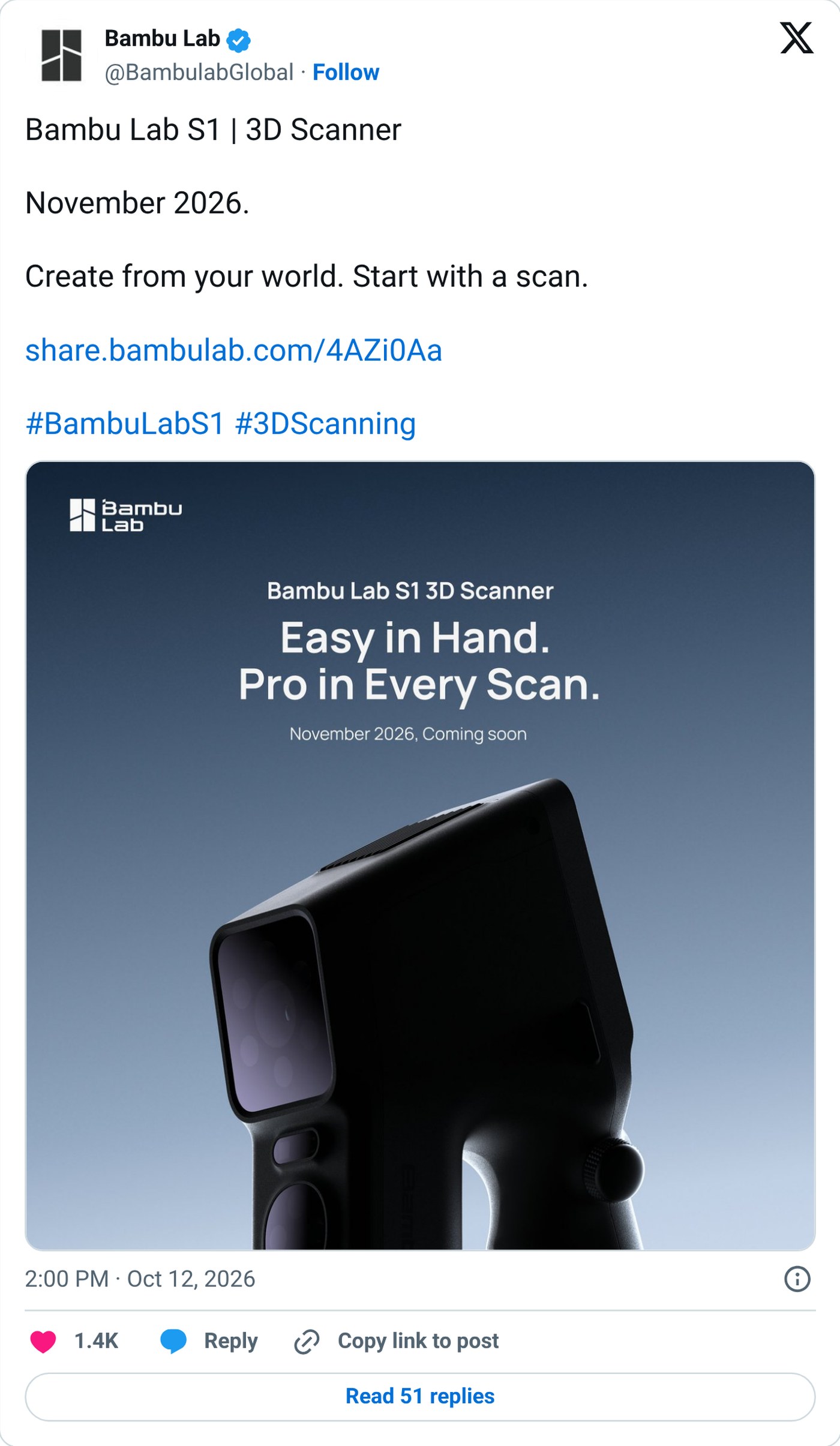
What Bambu Lab has not said is as important as what it has. There is no price, no accuracy or scanning-speed figure, no light-source detail and no word on whether the S1 needs a computer to run. Any number that shows up before launch is speculation.
The teaser images do show the basic shape: a pistol-grip handheld with a large front window, what appear to be several sensors behind it, a dial on the side of the grip and a flat area on top that could hold a screen.
 Image: Bambu Lab
Tom’s Hardware reported that members of Bambu Lab’s forum found FCC filings with a label and drawing that appear to match the scanner. The label shows a 60-watt rated input, the same figure as SCANOLOGY’s 3DeVOK MT Gen2, a wired scanner that uses blue and infrared lasers. Bambu Lab has a framework agreement with SCANOLOGY, which hints at shared technology but does not confirm it. Tom’s Hardware also noted that the 3DeVOK MT Gen2 lists at $8,299, a price Bambu Lab would almost certainly have to undercut to reach hobbyists. The 60-watt rating and no visible battery on the label suggest the S1 may need to be tethered to a PC, but that is also unconfirmed.
 Image: Bambu Lab
The S1 will enter a crowded field. Creality’s CR-Scan line, Revopoint’s Pop and Miraco scanners and SHINING3D’s Einstar already sell to makers who want to reverse-engineer broken parts, digitize objects or build game assets. Early forum reaction centered on two questions: price, with users guessing anywhere from about $1,000 to $2,000, and software, since cleaning up a raw scan into a printable model is often the hardest part of the job.
Bambu Lab has also listed the S1 as a prize in a MakerWorld accessibility design contest. Full specifications are expected closer to the November launch.