Business
Anthropic's IPO, Explained: ANT Targets $70 to $78 a Share on Nasdaq, With Pricing Set for Nov. 18
The Claude maker is selling 825 million shares at a valuation of up to about $1.4 trillion, setting aside up to 20 percent for retail investors, including buyers in the U.K.
San Francisco · Elena Vos, Business · Nov 11 2026
SAN FRANCISCO - Anthropic, the company behind the Claude AI models, formally began marketing its initial public offering on Tuesday, putting a date on one of the largest stock market debuts ever attempted. It is offering 825 million shares of Class A common stock at $70 to $78 each and has applied to list them on the Nasdaq Global Select Market under the ticker ANT, according to its roadshow announcement.
Anthropic itself is selling 801,351,354 of those shares. Existing stockholders are selling the other 23,648,646 and keep the money from their portion. The underwriters, led by Goldman Sachs and Morgan Stanley, also have a 30-day option to buy up to 123.75 million additional shares. At the top of the range the offering would total $64.35 billion, and the company would be worth about $1.404 trillion on a fully diluted basis, TechCrunch reported. That compares with the $965 billion valuation Anthropic announced in a funding round in May.
 Screenshot: ipo.anthropic.com
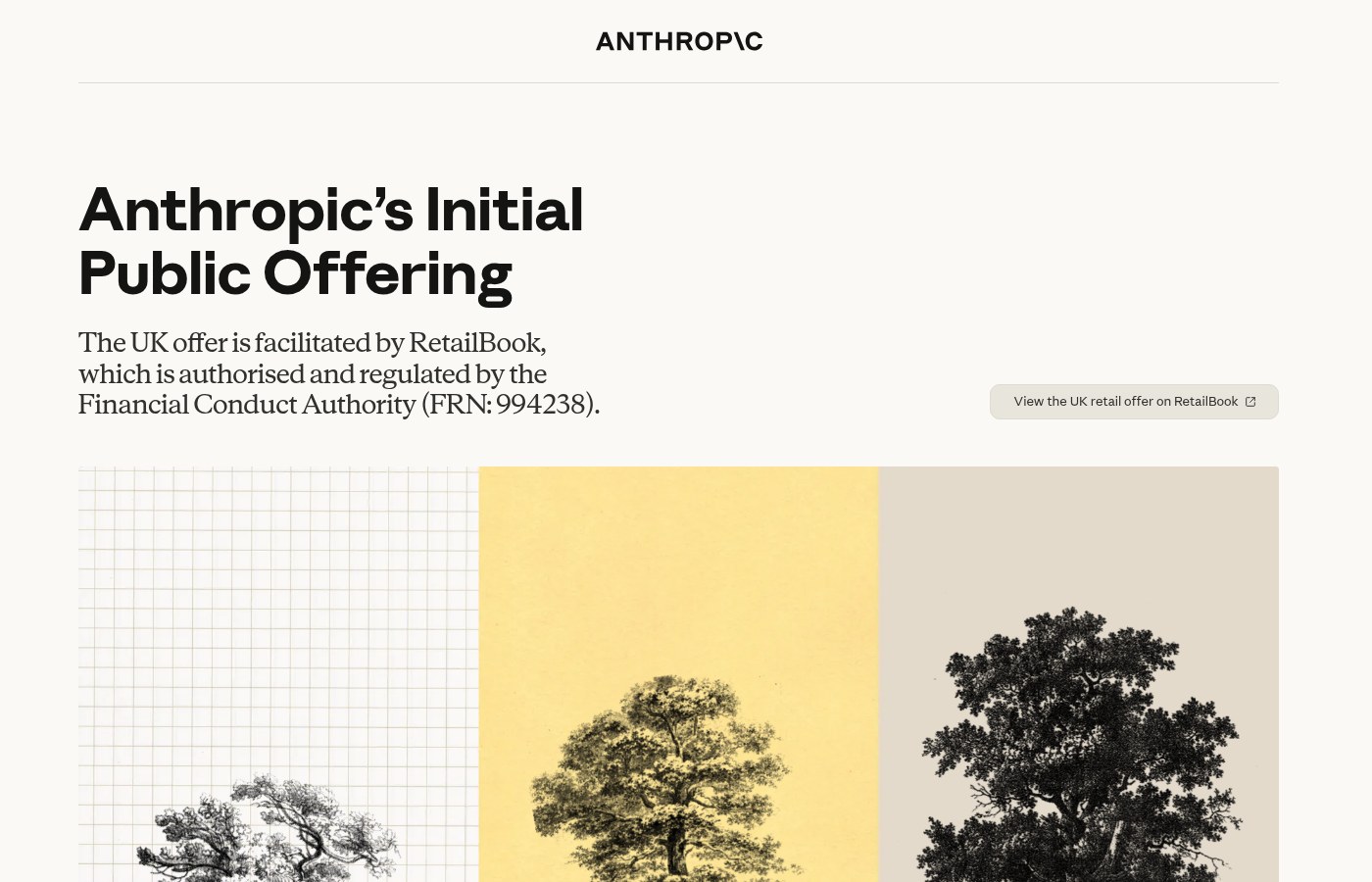
Anthropic’s IPO website sets out the timetable. The roadshow began on Nov. 10, the final share price is expected to be set on Nov. 18 and the stock is expected to start trading on Nov. 19, all in U.S. Eastern time and subject to regulatory clearance. The registration statement Anthropic filed with the Securities and Exchange Commission has not yet become effective, and no shares can be sold until it does.
Before pricing, Dario Amodei, Anthropic’s chief executive, is expected to discuss the offering with Jamie Dimon, the chief executive of JPMorgan Chase, in a livestream around lunchtime in New York on Friday, Nov. 13, Bloomberg reported, citing a person familiar with the plans. Both companies declined to comment to Bloomberg, and no viewing link or exact start time has been published. Lunchtime in New York falls in the late afternoon in London.
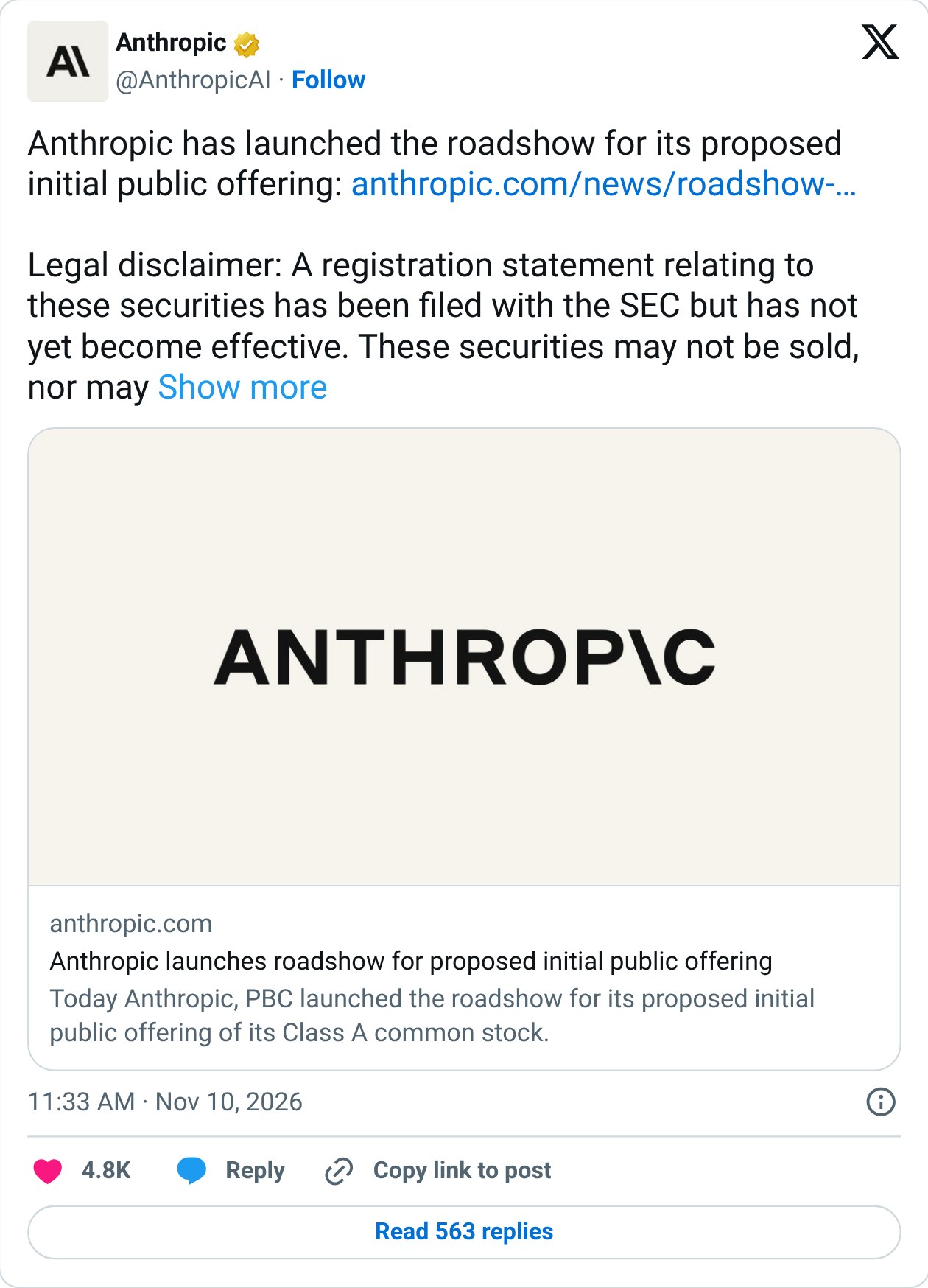
Investors can already watch Anthropic’s roadshow video, a 42-minute pitch that opens with Amodei and includes testimonials from customers such as Bristol Myers Squibb and Accenture, Business Insider reported. Its chapters run from product and safety research to Anthropic’s approach to computing power and its financial model.
 Screenshot: @AnthropicAI on X
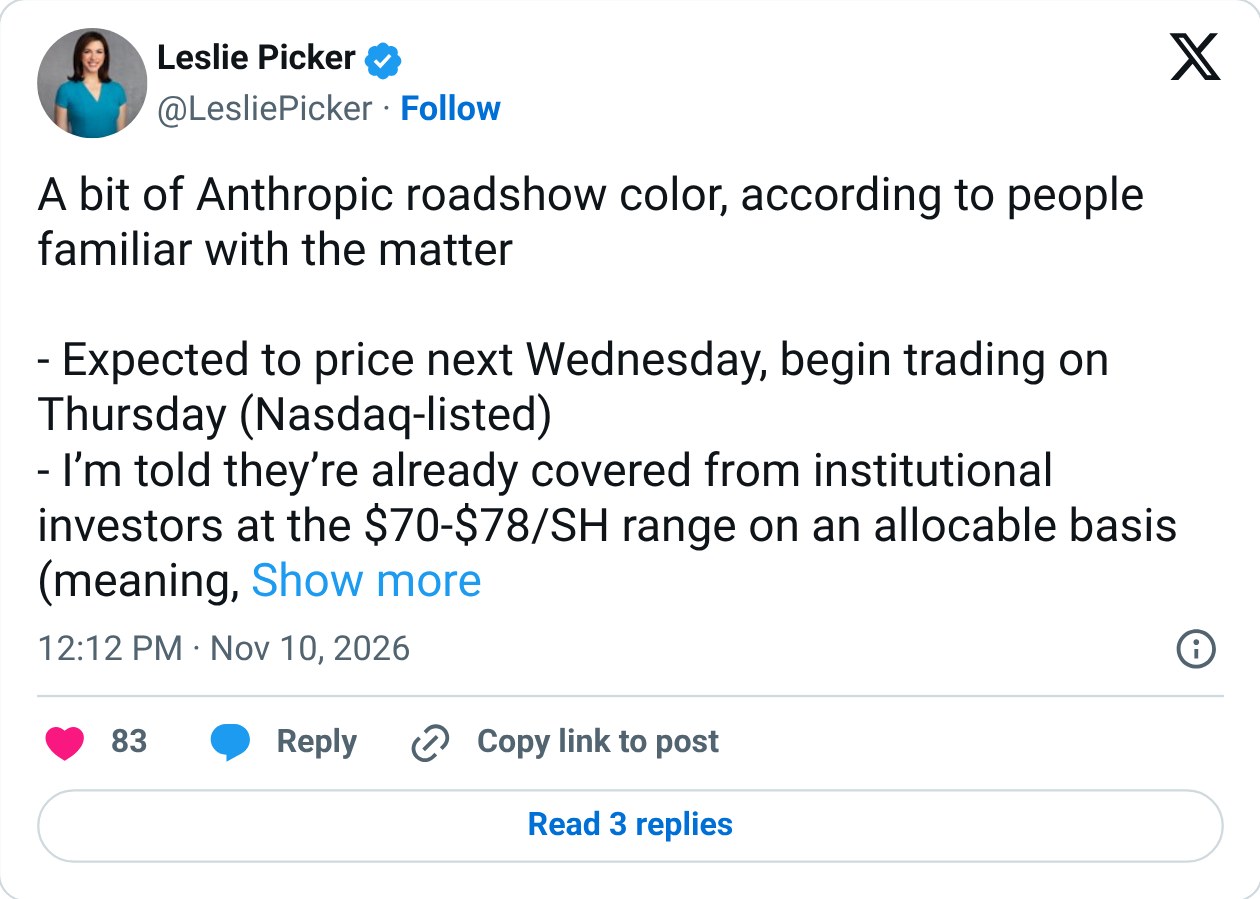
Early signs point to a crowded order book. The deal was already covered within the $70 to $78 range on an allocable basis, CNBC reported, citing people familiar with the details. Bloomberg reported that the offering was multiple times oversubscribed, according to MarketWatch.
 Screenshot: @LesliePicker on X
Alongside the public offering, AMD, Broadcom, Google, Micron, Microsoft, Nvidia and TSMC have agreed to buy $26 billion of Anthropic’s Class N common stock in a private placement at the IPO price, according to the company’s amended S-1 filing. Google and Nvidia are each investing $10 billion, TechCrunch reported. Class N shares carry no votes. They are not registered in the offering and are not covered by the underwriters’ lock-up agreements, but they count as restricted securities and can be resold only through a registration or an exemption.
Anthropic is a Delaware public benefit corporation, and its governance leaves public shareholders with limited influence. Just before the offering is completed, it will issue a single share of Class F stock to a company whose members are its seven co-founders, including Amodei and Daniela Amodei, the president and chair of the board. That one share carries 50.1 percent of the total voting power on most matters put to stockholders, including the election of directors other than those chosen by the Long-Term Benefit Trust.
The trust, which the filing describes as an independent body of financially disinterested trustees with expertise in AI safety, national security, public policy and social enterprise, holds Class T stock. It lets the trust elect and remove the Class T directors, who will make up a majority of the board. Anthropic will be a “controlled company” under Nasdaq’s governance rules.
“We believe that AI is one of the most consequential technologies in human history,” the co-founders wrote in a letter quoted on the company’s IPO site.
 Photo: Ajay Suresh (CC BY 2.0), via Wikimedia Commons
The filing also shows how fast the business is growing and how much it is spending. Anthropic reported $17.0 billion in revenue for the three months ended Sept. 30, and $33.24 billion for the first nine months of the year. It posted a $104 billion net loss over those nine months, most of it tied to changes in the fair value of convertible notes and derivative liabilities, CNBC reported. Run-rate revenue reached roughly $81 billion at the end of October, the company said. Anthropic has never paid a dividend and does not expect to in the foreseeable future.
Most existing holders have agreed not to sell for up to 180 days after the offering, and the co-founders and some larger holders for up to 365 days, the prospectus says, though some locked-up shares could become eligible for sale earlier.
Anthropic expects allocations to retail investors, in the United States and other countries, to make up as much as 20 percent of the Class A shares on offer, with the final amount depending on demand, according to the prospectus. CNBC noted that a typical IPO sets aside 5 to 10 percent for individuals. In the United States, part of that tranche will be sold through several large online brokerages acting as selling group members.
The process at participating platforms generally follows the same pattern. An investor with an eligible account submits an indication of interest, a request for a number of shares, before the platform’s order window closes. Once the deal is priced, investors are usually asked to confirm, which turns the request into an order at the offering price. Allocations will be confirmed on the first day of trading, according to Anthropic’s IPO site, which warns that there is no guarantee any investor will receive all or any of the shares requested, and that applicants should be ready to buy every share they ask for. Anyone buying after trading begins pays the market price, which can move sharply in a new listing.
The offering includes public offers in the United Kingdom, Australia, Canada, Japan, Switzerland and some European Economic Area countries, the prospectus says. Anthropic’s U.K. IPO page says the U.K. offer is facilitated by RetailBook, which is authorised and regulated by the Financial Conduct Authority. Citigroup is handling the retail offering outside the United States, Bloomberg reported, according to Quartz.
Anthropic does not plan to list the stock on any exchange outside the United States, and no U.K. prospectus will be published, according to the filing. The shares will trade on Nasdaq in dollars. A U.K. investor who wants to buy after the debut would generally need an account with a provider that offers U.S.-listed shares, and because the purchase is made in dollars, pounds have to be converted, usually for a fee set by the provider. The value of the holding will also move with the exchange rate.
The prospectus says non-U.S. holders must give the withholding agent an IRS Form W-8BEN or a similar form to claim a reduced treaty rate of U.S. tax on any dividends, which otherwise is withheld at 30 percent, and to certify their status, without which dividends and some sale proceeds may face backup withholding, currently 24 percent.
This article is news, not financial advice.