Business
Alphabet Heads for Its Worst Post-Earnings Drop as AI Spending Burns Cash, While Microsoft's Azure Wins the Night
Both companies are pouring record sums into data centers. Investors rewarded the one still generating cash: Alphabet fell about 10% before Thursday's open after posting negative free cash flow of $9.07 billion, and Microsoft rose nearly 4% on 48% Azure growth.
New York · Elena Vos, Business · Oct 29 2026
NEW YORK - Two of the biggest spenders in artificial intelligence reported on the same evening, and Wall Street picked a side. Alphabet shares were down about 10% in premarket trading on Thursday after the Google parent posted negative free cash flow for a second straight quarter, while Microsoft was nearly 4% higher, according to CNBC. If Alphabet closes more than 9.77% lower, it will be the company’s worst reaction to an earnings report since it went public in 2004.
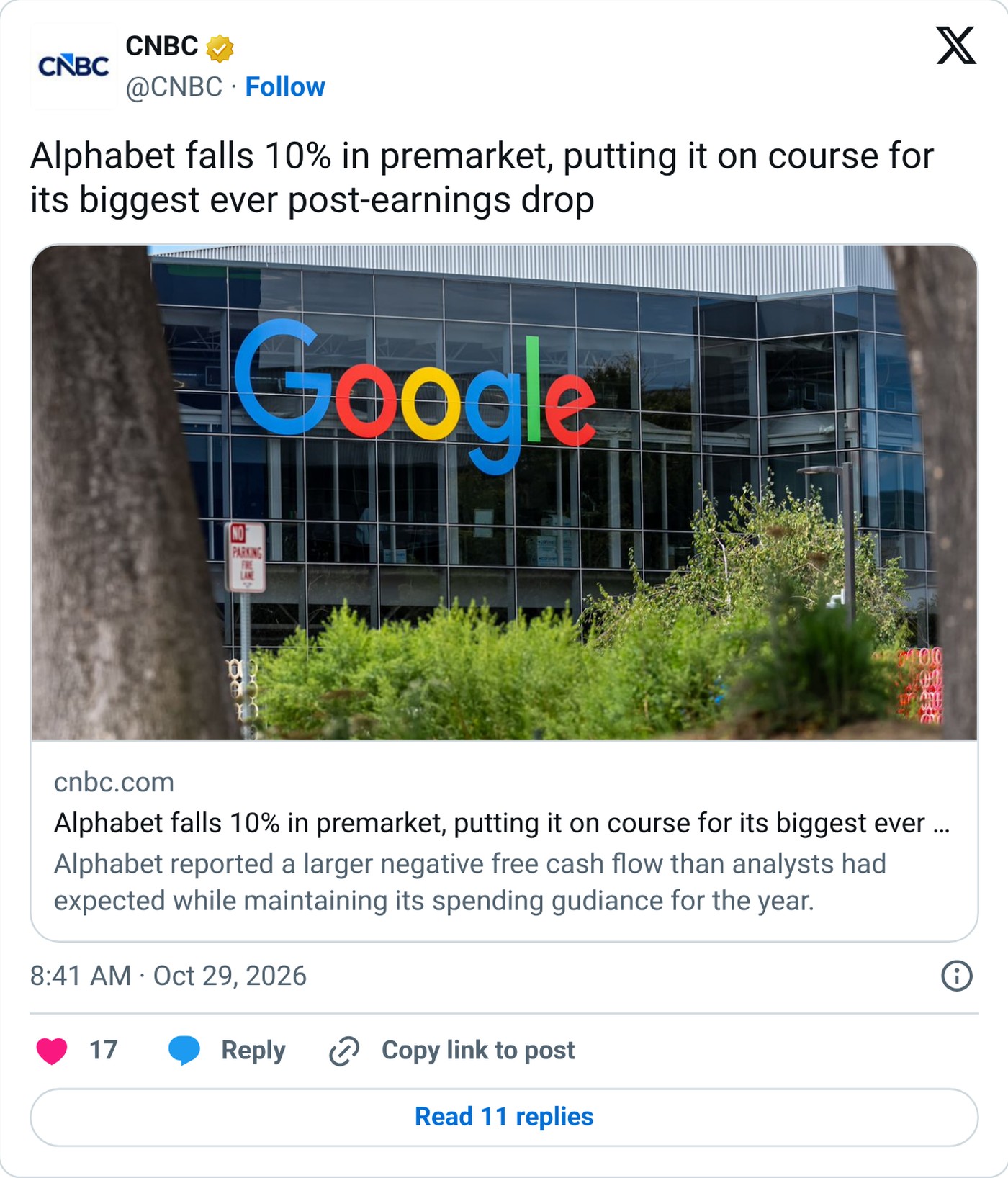 Screenshot: @CNBC on X
Alphabet’s top line was not the problem. Revenue rose 25% to $127.6 billion, and Google Cloud revenue more than doubled, up 103% to $30.7 billion, with the company saying sales of its TPU systems were “a meaningful contributor.” But the quarter still missed analyst estimates on revenue and earnings, CNBC reported, the company’s first miss on both in nearly four years. Search, its largest business, grew 12% to $63.35 billion, short of the $64.96 billion analysts expected. Alphabet’s chief business officer, Philipp Schindler, said part of the shortfall came from lower monetization in AI Mode, and that the company is now scaling ads in AI Overviews and AI Mode.
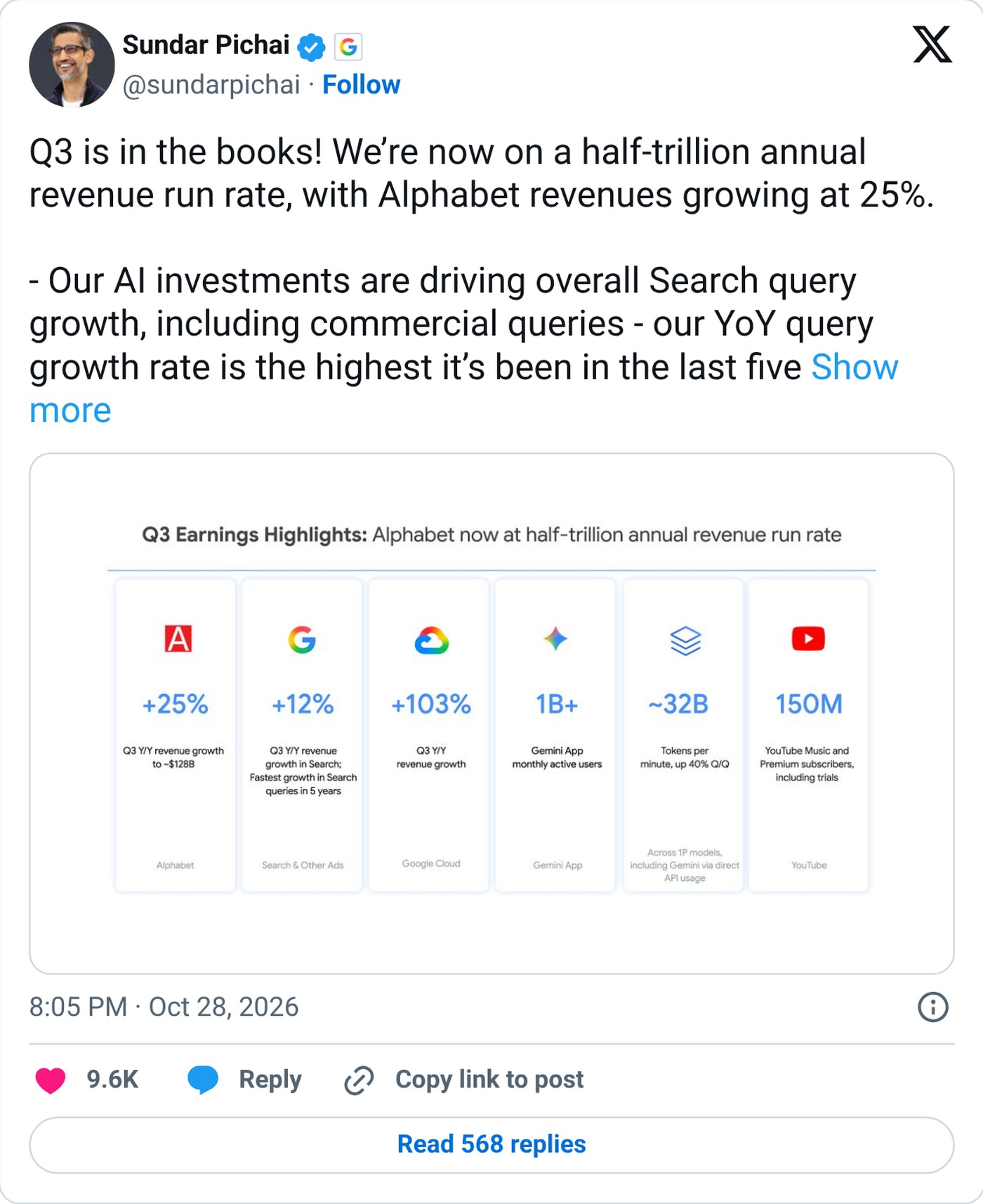 Screenshot: @sundarpichai on X
The bigger worry was cash. Alphabet spent $51.36 billion on property and equipment in the quarter, according to its earnings release, and its free cash flow came to negative $9.07 billion, far worse than the negative $2.70 billion analysts had expected. It kept its 2026 capital spending forecast of $195 billion to $205 billion. “We continue to expect our capex to increase significantly in 2027, and will provide further details on our Q4 call,” chief financial officer Anat Ashkenazi told analysts.
To pay for the buildout, Alphabet is borrowing and selling stock. Its long-term debt stood at $125.1 billion on Sept. 30, up from $46.5 billion at the end of 2025. During the quarter it raised $28.7 billion in senior notes and about $12.4 billion by selling shares through its at-the-market program, and it bought back no stock. A loss of $8.66 billion on its equity holdings also cut into net income, which fell to $26.2 billion from $35 billion a year earlier.
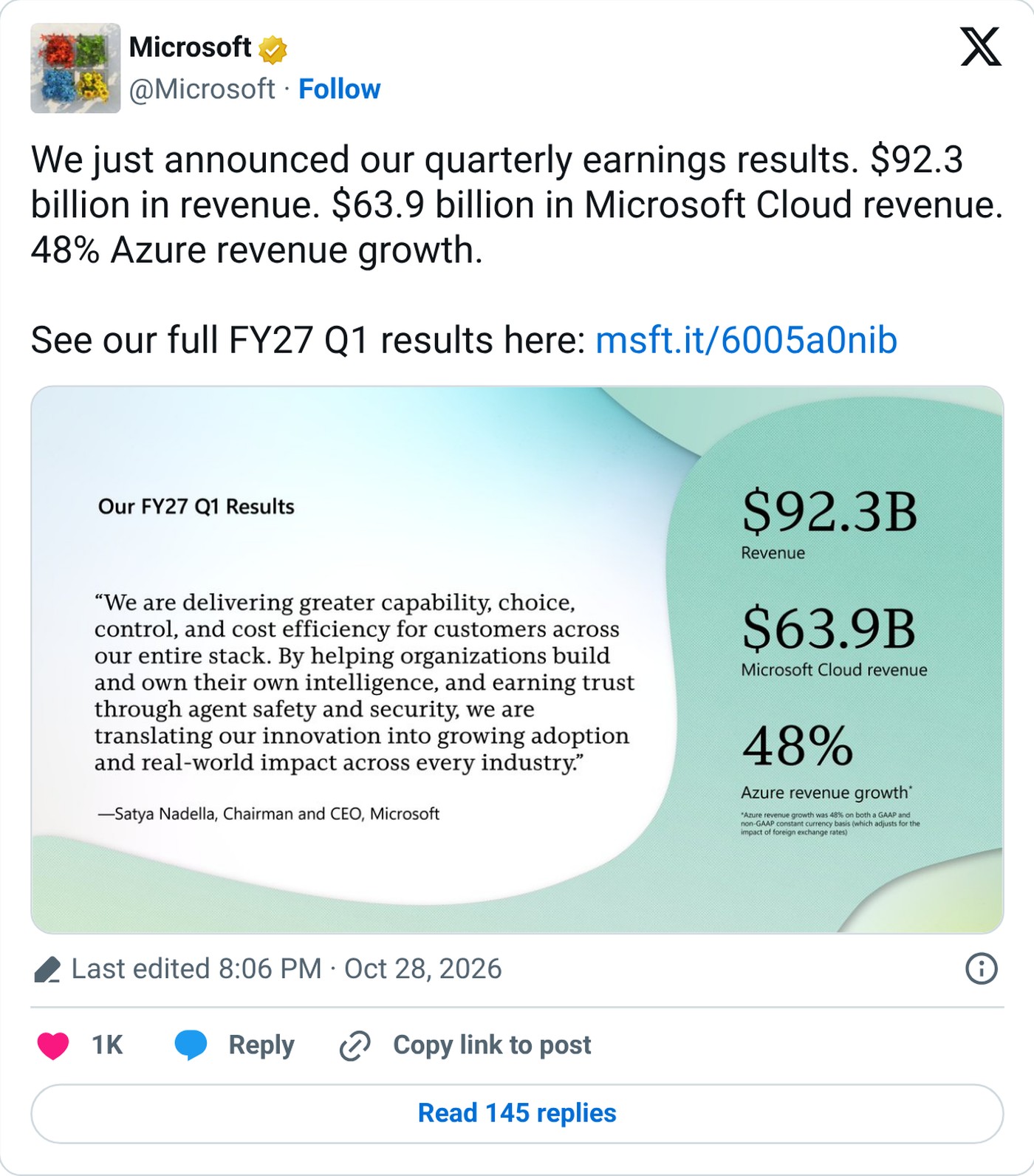 Screenshot: @Microsoft on X
Microsoft told a different story with similar ingredients. Revenue for its fiscal first quarter rose 19% to $92.3 billion, according to its results, ahead of estimates. Azure revenue grew 48%, and Microsoft gave a dollar figure for the business for the first time: $33.17 billion, now its largest single business, CNBC reported. Commercial remaining performance obligation, the contracted revenue it has yet to recognize, jumped 73% to $677 billion. Finance chief Amy Hood forecast Azure growth of 49% to 50% in the current quarter. “We still have demand that exceeds supply,” she said.
 Image: Jonathan Schilling / Wikimedia Commons (CC BY-SA 4.0)
Microsoft is spending heavily too, but it came in under forecasts. Capital expenditures including finance leases were $45.2 billion, up about 30% from a year earlier and below the $50.67 billion analysts expected. Free cash flow fell 27% to $18.63 billion but stayed positive, and Hood said the company will keep generating free cash flow through fiscal 2027. Not every corner was strong: Windows OEM and devices revenue fell 22%.
The lighter capital spending was not good news for everyone. Shares of CoreWeave and Nebius, the so-called neoclouds that rent data center capacity to Microsoft, slid almost 5% in extended trading, CNBC reported, as investors read the lower figure as a sign that partners are taking longer to deliver capacity.
*Video: Alphabet Investor Relations / YouTube*“Microsoft is building out its architecture in a measured way and as such contains fewer surprises,” Ben Barringer, global head of technology research at Quilter Cheviot, told CNBC on Thursday. “Alphabet, by contrast, saw its share price hit after hours as a result of a fairly messy set of results and a poorly handled earnings call.” Alphabet chief executive Sundar Pichai pointed to momentum elsewhere: the Gemini app has reached one billion users, and Google’s model APIs now process nearly 32 billion tokens per minute. On Tuesday, Oracle said it would offer Google’s TPUs inside its own cloud from 2027. Apple and Amazon report after the U.S. close on Thursday.