AI
Alibaba Launches Qwen4-Max, a 2.4 Trillion Parameter Model It Pitches as a Cheaper AI Teammate
The first model in Alibaba's Qwen4 family has native vision and a one-million-token context window, and the company says it cuts the average cost of a work task by 62 percent compared with its predecessor. Smaller open-source Qwen4 models are promised later.
Hangzhou, China · Jordan Hale, AI · Nov 16 2026
HANGZHOU, China - Alibaba released Qwen4-Max on Monday, the flagship of a new generation of its Qwen artificial intelligence models, and pitched it to businesses and developers as an always-on AI teammate that does more work for less money than the model it replaces.
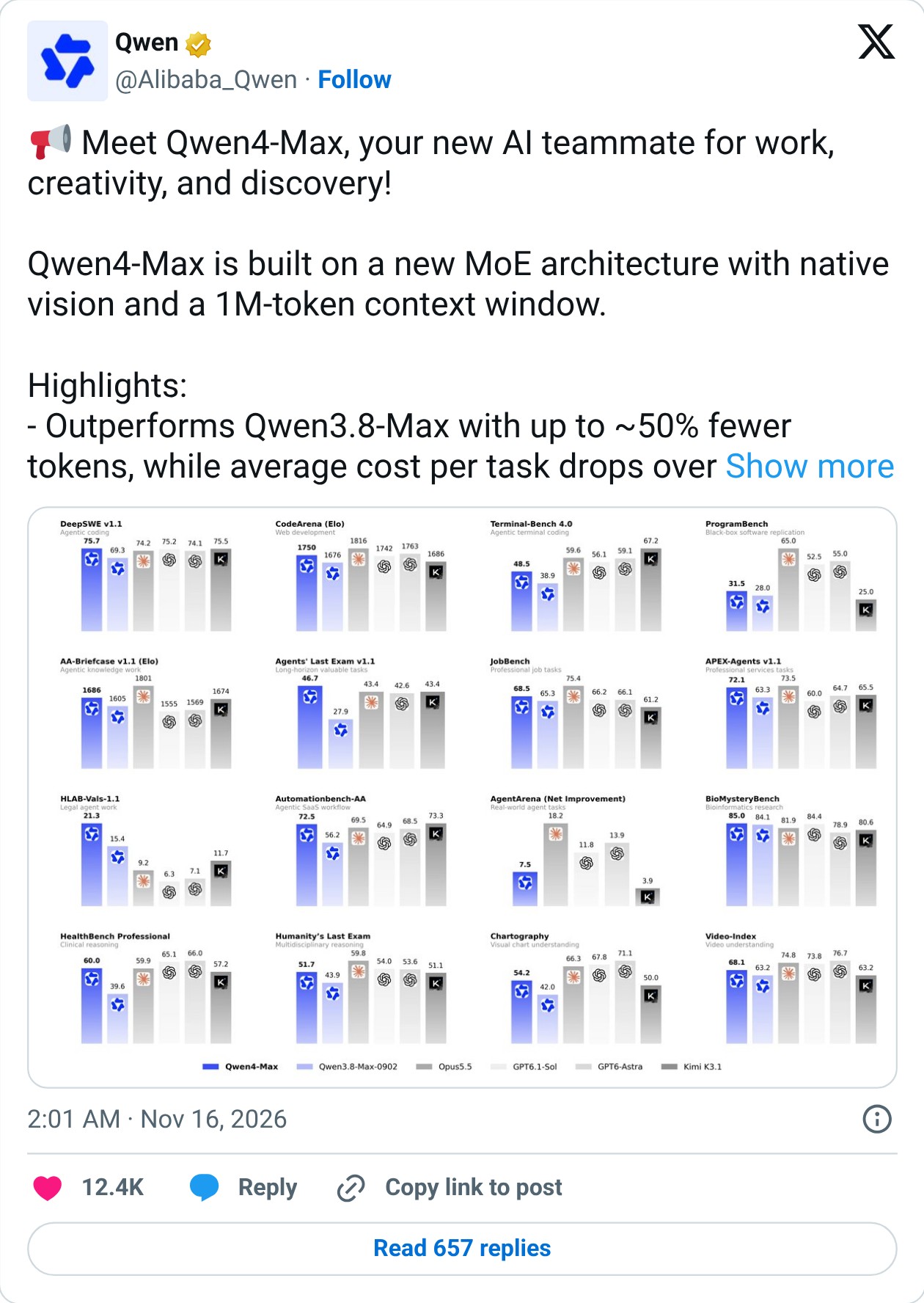
Qwen4-Max is built on a new Qwen4 architecture with a 2.4 trillion parameter backbone, native vision and a context window of one million tokens, the Qwen team said in its launch post. It is a mixture-of-experts model that activates 71 billion parameters for each token, plus an additional 328 billion parameters in a new N-gram embedding layer. The team said training at that scale ran without loss spikes, which it credited to changes in the model’s attention, residual connections and embeddings.
Screenshot: @Alibaba_Qwen on X
The main selling point is efficiency. On Work360, Alibaba’s in-house benchmark for professional tasks, Qwen4-Max scored 52.69, up from 47.74 for Qwen3.8-Max, while using about 24 percent fewer tokens at its highest effort setting and 35 percent fewer at the high setting. On Terminal-Bench 4.0, token use fell by about 48 and 49 percent. The average cost per Work360 task dropped from $4.43 to $1.67, a 62 percent cut, and the team said it had also lowered API prices compared with Qwen3.8-Max.
Through Alibaba’s QwenCloud API, the model costs $1.50 per million input tokens and $4.50 per million output tokens, Digital Trends reported, compared with $4 and $20 for Anthropic’s Claude Opus 5.5. Digital Trends noted that the 62 percent saving compares Qwen4-Max with Alibaba’s own older model, not with rivals.
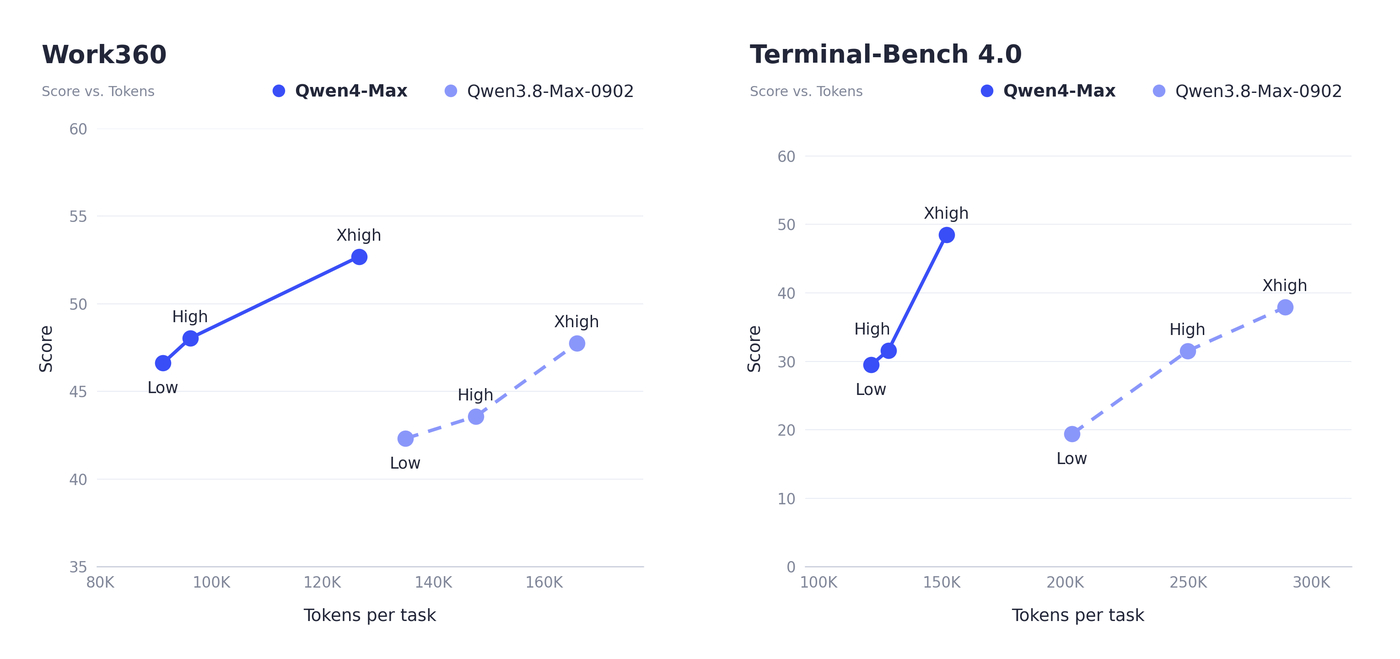
Image: Qwen
Alibaba showed the model running long jobs on its own, including building games in Unity, Unreal Engine and Godot, modeling 3D scenes in Blender, and planning automotive production lines. In one example, Qwen4 spent 48 hours on Deep Principle’s lab platform designing a new coolant molecule for data center chips, screening a space of 2.7 million candidates and then directing an automated wet lab to synthesize and test it. The company is also open-sourcing a plugin for a feature it calls Live Delivery, in which an agent hands over a usable first version of a long task early and keeps improving it while the user steers.
On safety, Alibaba said Qwen4-Max’s pass rate for code that is both functional and secure on the Last Secure Code Bench rose from 22.0 percent to 31.8 percent, and that it filtered cybersecurity training data to keep defensive material. Those results come from Alibaba’s own testing, and the company has not said whether an outside group has red-teamed the model.
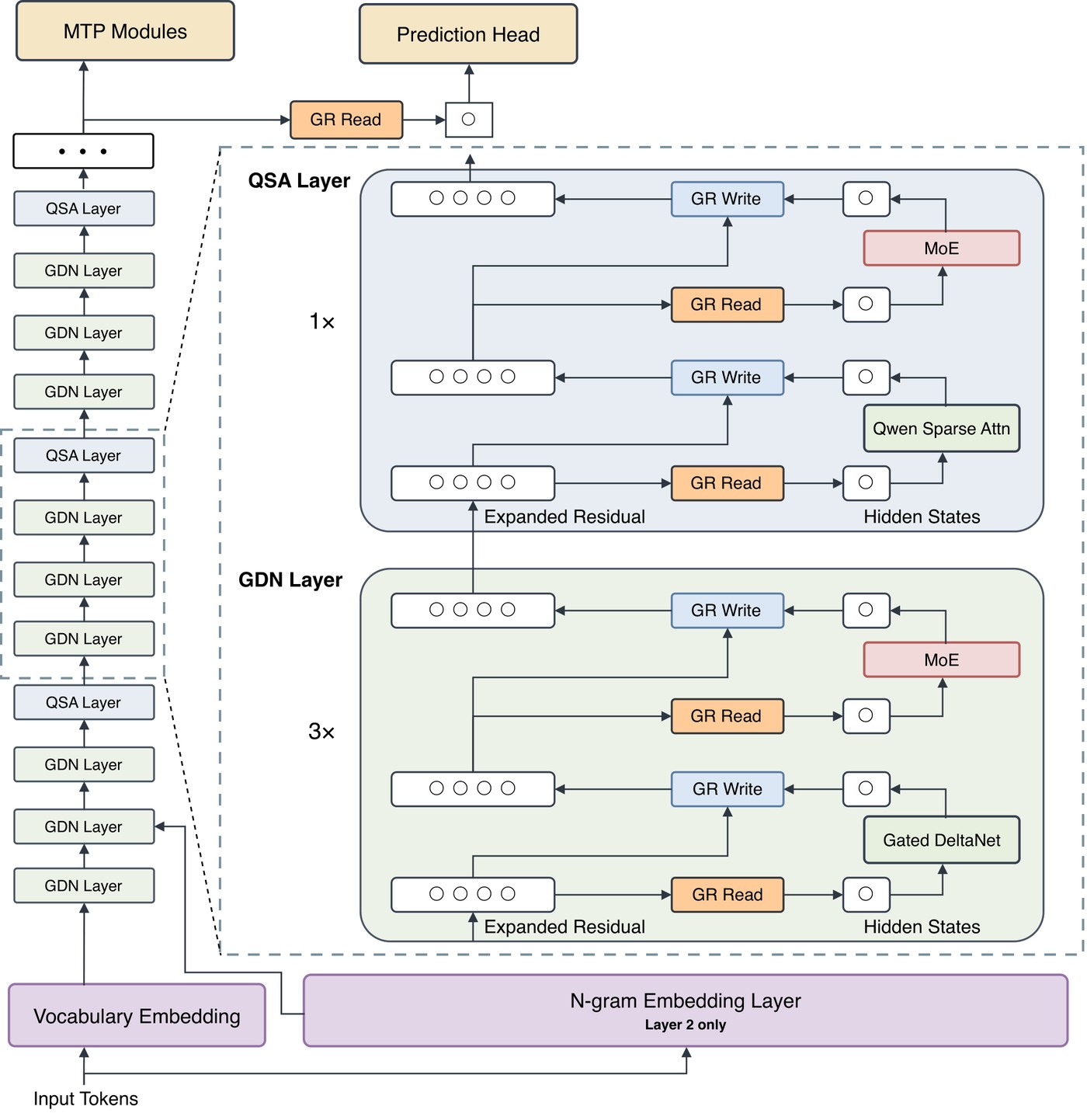
Image: Qwen
Qwen4-Max is available now on QwenCloud through the API or a Token Plan, and in QwenWork, Qoder and QwenStudio. The Qwen account also said on X that the model is live on OpenRouter and Vercel’s AI Gateway. Alibaba said smaller models in the Qwen4 family are coming to open source, but did not give a date.